How to Use AI to Learn Your Writing Style Automatically
 Written by James Parsons • Updated April 15, 2026

One of the biggest issues with using AI to generate content is that people tend to just go to ChatGPT, Claude, or their LLM of choice and just ask it to write something.
On one hand, the underlying technology is an impressive feat of mathematics and engineering. On the other hand, the output is going to be, in a word, generic.
Key Takeaways
- Generic AI content lacks a unique voice; training AI on your style helps preserve brand identity and authenticity.
- Writing style encompasses POV, sentence length, tone, formality, punctuation habits, and storytelling preferences.
- You can prompt LLMs with style rules or sample content, but expect roughly 20% inconsistency requiring manual editing.
- Tools like Jasper automate brand voice integration but limit flexibility and may produce output similar to other users'.
- Training your own micro-LLM on sanitized, human-written content offers the most consistent style replication long-term.
Table of Contents
Generic Content, AI Slop, and the AI Voice
The problem with this kind of generic content is that it loses any voice you bring to the table. If you've ever read guides on how to establish a content department, build an online content brand, or train a freelancer to work for you, one of the big keys is to make sure the content they put out has a consistent voice.
That voice is part of what makes you unique. It's an infusion of your style, your experiences, your writing habits, even your personal beliefs.
AI, too, has a voice. The "AI voice" is what people are talking about when they build lists of common "signs of AI-generated content", things like use of unusual words like testament or tapestry, technical usage of em-dashes, and the like.
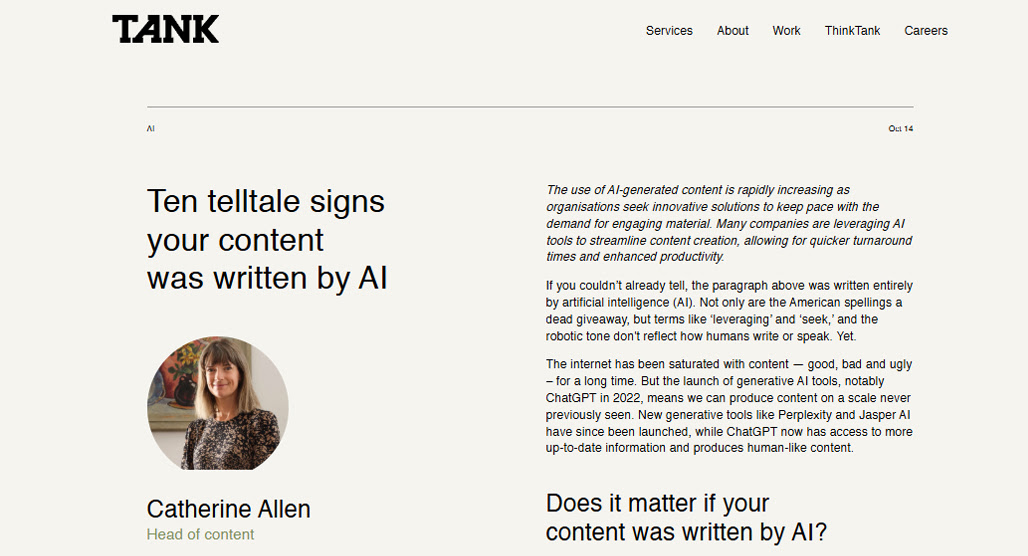
All of that voice came from people originally. Everything in an AI system came from people. The fact that these LLMs were trained on vast amounts of real human content means their output resembles that content. A lot of the artifacts of the AI voice come from the common language and style guides used in older books and in scholarly articles and journals.
That's one of the big reasons you shouldn't trust those signs of AI, too. I know if you go back through my sites, you'll find hundreds of blog posts written in ways that seem AI-like, published years before LLMs even existed.
But the AI voice is now a sign of a certain lack of trustworthiness. People who are sensitive to that voice are going to view AI-generated content more poorly. People who aren't sensitive to it might not consciously notice it, but they might find that it's not memorable or compelling.
If you want to use an LLM to generate content for you, but you don't want to lose that critical voice, what can you do? Well, you have a few options.
- Use the LLM to generate outlines, summarize research, and otherwise give you a foundation, but write the content yourself.
- Use the LLM to generate content for you, but rewrite it to remove the AI voice and inject your own.
- Train the LLM to use your voice.
That third option is the one most often cited as the best workaround, but how do you do it? There are actually a few different options. The specifics might depend on the LLM and the tools you use around it, but the concepts are there.
Unfortunately for most brands, you won't be able to just ask the AI to mimic your voice; they can only do that for specific authors or publications whose work has been tagged throughout, which is also a big part of why the AI companies are losing copyright lawsuits, so don't expect it to be readily available.
Building the Base: What is Your Voice?
Before we can get into a discussion of having an LLM output content with your writing style, we first need to define what a writing style even is. What is your voice? How is it conveyed in text?
Writing style is the sum of the various attributes of text that you tend to use when you create content.
- What is your POV? Do you say "I do X" or "We do X"? Do you write to customers directly or more generically?
- Are your sentences, on average, longer or shorter? Do you tend to use a lot of commas, or more exotic punctuation marks, or none at all?
- Do you use plain, simple language, more complex and technical language, or formalized language?
- Do you tend to use metaphors and similes, or just explain things straight?
- Do you write in active voice or tend towards passive voice?
- Are you more positive on average, or negative?
- Do you rigidly adhere to a style guide, or free-flow your writing however you like?
- Do you tell anecdotes and personal stories, or keep things strictly business?
This is just a selection of the elements of voice you'll want to think about. It all comes together into the whole that is your voice.
What makes this more complicated is that your voice is not static. For one thing, it changes over time, and the more you write, the more it evolves through the process of writing. I look at content I wrote a year ago and barely recognize it, and I see content from 4-5 years ago and almost don't think it's mine.
Your writing style also changes based on your environment. I don't mean the weather, though; I mean your target audience and venue. The way you write a LinkedIn post would be different from the way you'd write a blog post, which is different from how you would write an eBook, which is different from how you'd write an email.
Even within any one venue, it can change. I'll use a different style if I'm writing a guide on something entry-level to my industry, targeted at non-experts, than if I'm writing for an expert audience. The things I need to explain, the jargon I can and can't use, the references I can make, all of that varies.
Similarly, it varies based on the purpose of your content. Are you trying to educate, rally emotions for a call to action, or push people towards sales? The things you emphasize and the way you do it will change.
How to Distill Your Style
You have a writing style, but what is it, and how do you consciously pay attention to it?
One thing you can do is look at lists of elements of style like my list above, and just answer questions about it. The answers to those questions will play into the kinds of LLM prompts you use later.
Some of them will be simple. Do you use the Oxford comma or not? Do you adhere to a style guide or not? Do you keep sentences short, or tend to run on?
Others might be harder when you think about your level of formality, your grammatical preferences, and so on. If you're not deeply trained as a writer, you might not even know the kinds of terms you should be using to describe your style, let alone how to identify it.
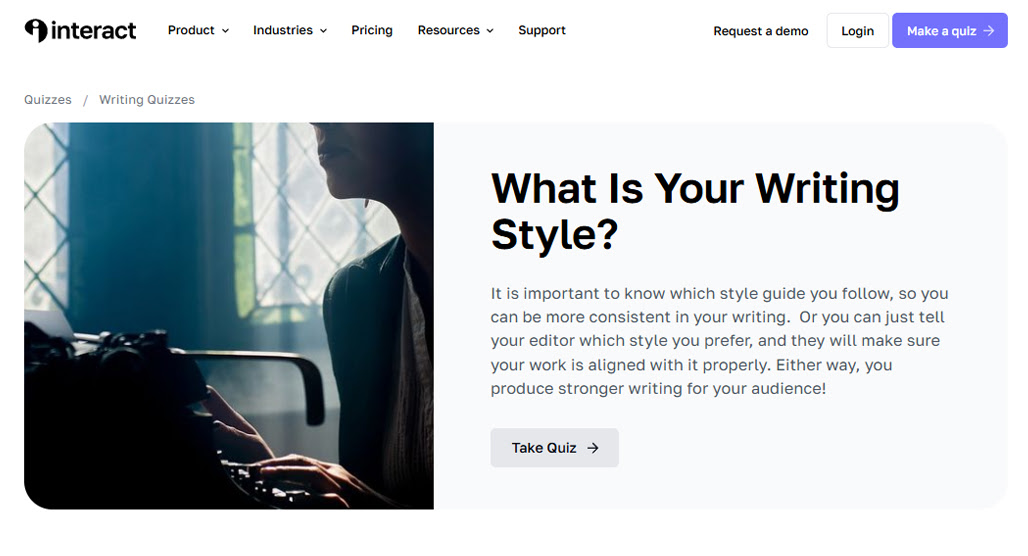
You can also use quizzes to help out. This one, for example, can help you identify your nearest official manual of style. They won't be perfect, but they can give you a place to start.
While we're talking about LLMs, you can also use them here. Pick your favorite LLM, grab a few pieces of exemplary content from your library, and feed them in. Just ask the LLM to give you ten points about your writing style and see what it comes up with. If you're curious about the pros and cons of using ChatGPT for your blog, that's worth exploring too.
Remember that LLMs aren't perfect, so make sure to actually double-check what they claim and make sure it's accurate.
Exploring the Options to Get AI to Write in Your Writing Style
Once you have some idea of what your style is, you can use that information to hammer your LLM of choice into outputting content in your style.
I'm going to discuss three different options you have here, but with one big caveat: I'm being very generic in my discussion. There's a reason for that, and it's the rapid change in the AI space.
Basically, if I were to give you detailed instructions for, say, GPT4, they might not work for GPT6, or Claude, or Gemini, or DeepSeek, or whatever else. Moreover, the list of popular models changes a few times every year, so the instructions and the way they function will too.
So, just take the generic advice and adapt it to your choice of model. If you work with LLMs enough, you're probably used to finessing them into doing what you want anyway, so you probably get it.
Anyway, let's get down to the three options.
Option 1: Prompts Including Your Voice
The first option is the easiest. You're already in the LLM interface, so just paste in your criteria and have it adhere to them.
You can do this in a few different ways. One is to paste in your exemplar content and tell the LLM to stick to a style similar to them. This can be handy if you really aren't sure of your style, or you want to see if the LLM can get more nuance out of full text than out of a few rules.
If you distill your writing style down to 10-20 bullet points, you can just include those in a prompt as well. Telling the LLM to generate your content about X using the following rules can work. This can also be cheaper in the long run, since larger inputs cost more tokens in token-based models.
Depending on the model, you might have to go through the process a few times to get it to associate rules with your account, or to build the kind of robust generic prompt framing that ensures it. You might even need to go back and forth several times to get it to pay attention to everything you're telling it. We all know how frustrating these things can be, after all.
The truth about this option is that you're probably not going to get where you want to be just from your prompt. Even the best models I've tried still need some editing to get the rest of the way there. Figure that the Pareto Principle is in full effect; you'll get 80% of the way there with your 20% of effort through the LLM, but the last 20% of the way there, you'll need to put more effort into.
This is the risky part, though. You need to make sure you actually put in that remaining effort. That 20% inconsistency and variability away from your voice can prove to be a pretty big divergence over time. Two pieces of content with 20% variance from the intended goal, in different directions, means two pieces of content with 40% difference, which is a lot when you're trying to maintain a consistent voice.
Moreover, the fill-in from the LLM is very likely to be in the Generic LLM Voice, which will then flag your content as AI-generated, with all that implies.
Option 2: LLM Shells with Brand Voice Details
Your second option is to use a tool that is designed to do all of this for you.
One of the biggest examples of this kind of tool on the market is Jasper. Jasper is a shell program. It basically prompts you for a bunch of details about your brand, your audience, your voice, your content, and your purpose. It then, in the background, turns all of that into a prompt. The prompt is fed into the various AI models they use, the output is synthesized, and you're given content that adheres to your guidelines.

Jasper isn't the only tool in that vein, either, but it's certainly the most popular.
The downside here is that you end up somewhat limited and hammered into the boxes Jasper has pre-created. The templates and walkthroughs are important for getting the consistency out of the tool, but that does mean you lose the flexibility to spin up something unique.
Also, the more "standardized" your content is from any one popular tool, the more likely it is to resemble other content from that tool made by other people, and that can be a whole other can of worms. It won't be a copied content issue or a direct copycat problem, but it can end up with similar output and issues adjacent to AI Voice.
It also tends to be more expensive than doing the same thing manually with the LLM directly, though you do save in terms of time and effort. That's a trade-off you'll need to decide if you want to make.
Option 3: Train Your Own Model
The most consistent option is to do it yourself. Specifically, I mean taking one of the micro-LLM frameworks and training your own bespoke LLM on your own voice.
Originally, LLMs were created as supercomputer-powered, datacenter-driven mass analyses of the intricacies of language. Every year or two, though, massive jumps in efficiency are made, and now we're to a point where you can train a (small) LLM on your own data.
Start by gathering a data set. Unlike the "find my voice" use above, you want quite a few pieces of content that represent your style. Often, the more data you can feed in, the better it will be. If you ever run out of ideas for content, that's worth addressing before you start this process.
Sanitize your data. Go through and edit them to remove inconsistencies and conflicts, things that would pull the LLM in different directions or make it not care about a detail you do care about. Remove duplicate data so you don't have multiple versions of the same post. Filter out anything unrelated or not useful.
Depending on what kind of data you're using, you might also need to scrub it of anything branded or internally protected. You don't want an LLM to spit out something that would be a trade secret, right?
It's also heavily recommended to avoid using any AI-generated output in your training set. If you've used AI to generate content in the past, don't use that content. Recursively-generated data is poison to an LLM.
If you want, you can also go through and annotate your data. That's useful for one particular kind of training, but might not be generically useful enough to do before you try.

The hard part is picking the model you want to use. There are a lot of models and frameworks for your own micro-LLM, and they all have their own costs, rules on licensing, weights, and other considerations.
Don't forget that training an LLM is an intensive process, which will require a lot of processing power and time. Some models are more lightweight than others, so tailor them to your available resources as well.
From there, it's a matter of actually doing the training and then caring for your new baby LLM. Ideally, once you've trained a model down, you'll have something that can reliably generate something close enough to your writing style to pass. And really, that's what you're going for, right? Otherwise, you'd just write it yourself.

Related Posts


Leave a Comment


Fine-tuned for competitive creators
Topicfinder is designed by a content marketing agency that writes hundreds of longform articles every month and competes at the highest level. It’s tailor-built for competitive content teams, marketers, and businesses.
Get Started