The Best Methods to Increase Your Domain Authority in 2026
 Written by James Parsons • Updated April 15, 2026

Moving into and through 2026, Domain Authority remains one of the most important metrics you can watch as the owner of a website.
Unlike a lot of Google-derived metrics, Domain Authority is a third-party metric and isn't used directly in calculating your ranking. It's more of a measure of the kinds of factors Google (and Bing, and DuckDuckGo, and Brave, and Perplexity, and…) uses to determine your ranking. Since the search engines keep most of their algorithm data hidden, using a third-party metric helps you gauge how well you're doing.
That means, anything you do that increases your Domain Authority is also likely to improve your rankings and visibility in search. Plus, it's nice to see a benchmark go up, right? So, how do you increase your Domain Authority in 2026 and beyond?
Key Takeaways
- Domain Authority measures backlink volume and quality, not on-page SEO factors, and directly reflects likely search ranking improvements.
- Both direct methods (guest posting, broken link building, journalist outreach) and indirect methods (linkbait content) are essential for sustainable DA growth.
- Links from unique domains are more valuable than multiple links from the same domain, so diversifying your link sources is critical.
- AI citations from tools like ChatGPT or Google's AI Overviews won't boost Domain Authority since those links aren't publicly indexed.
- Disavowing backlinks won't improve Moz Domain Authority, because Moz has no access to your Google disavow file.
A Refresher on How Domain Authority Works
Before we start, I want to give a brief refresher on Domain Authority, both for newcomers to the world of SEO and to people who may not have looked into what goes into it (and what doesn't) recently. If you're familiar, feel free to skip this section.
To me, the most important thing is to understand what contributes to Domain Authority, and what doesn't. There are plenty of things you can do to improve your SEO that don't contribute to Domain Authority, so if Domain Authority improvements are your goal, you want to focus your efforts on what works.
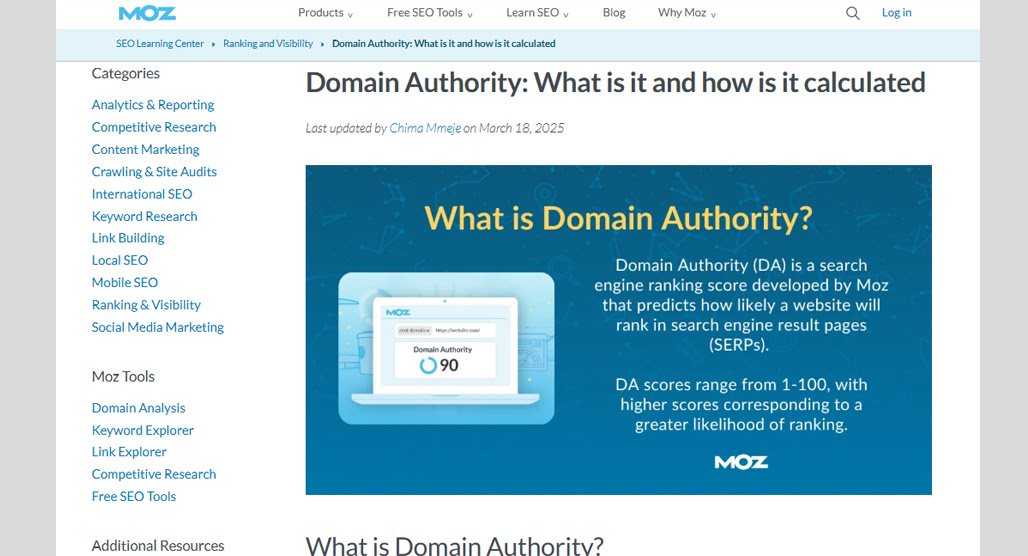
Domain Authority was created by Moz all the way back in 2006. Since then, other analytics platforms have come up with their own similar metrics, like Semrush's Authority and Ahrefs' Website Authority. Though these metrics are also measurements of the authority of your website, they aren't the same as Domain Authority from Moz.
A lot of the same efforts you use to improve Moz Domain Authority will also improve those other authorities, but maybe not to the same degree or in the same way. So, don't feel like your efforts are wasted because you're focused on one analytics app.
To check the Domain Authority of a given site, use the Moz Link Explorer. DA is the first metric at the top of the results page when you plug in a domain.
There are a few key things to know about Domain Authority.
- It's pretty much entirely focused on backlinks. The volume of links and the quality of those links are important.
- It's a comparative metric relative to similar sites. Unlike some other metrics, though, it's not restricted to industry.
- It's vastly harder to improve the higher your score is. Going from 10 to 20 is way easier than 60 to 70, which is way easier than 80 to 90. The scale goes from 1 to 100, with 1 being a new site and 100 being the biggest sites in the world. Only three sites have a DA of 100: YouTube.com, Google.com, and blogger.com.
The biggest takeaway here is to have reasonable expectations. Look around your industry and identify your current competitors and the competitors who are one step above you, and check all of their DA scores. You can use that to benchmark yourself.
Alternatively, don't worry too much about the comparisons and just try to increase the score as much as you can. It will help your SEO simply because of what DA measures.
Basically, it all comes down to backlinks. More backlinks, from better sites, improves your DA. Better quality backlinks help more, but volume is really key. Not all backlinks are equal, so the source and domain extension matter when building your link profile.
Increasing Your Domain Authority in 2026
As I mentioned, Domain Authority is a measure of the volume and quality of the backlinks pointing at your site. That means you can improve your Domain Authority in a few ways:
- Getting more backlinks
- Getting better backlinks
- Getting rid of bad backlinks
As you can see from the Moz list of the top 500 pages, volume is important, but it's not the only metric of importance. The #4 site (LinkedIn) has more linking domains than the #2 (Google itself), and the #30 (Facebook) has 4x that volume.

This also reveals one quirk of Domain Authority: subdomains and different TLDs are treated as different sites and have different DA ratings. You can see that by noticing that www.google.com, www.news.google.com, and www.google.com.br all have different DA rankings.
Another important thing to know is that Domain Authority isn't frequently updated. A lot depends on how frequently they discover links pointing at a site, and then process them and recalculate DA. They say it can be 1-2 months in between updates. So, don't expect a rapid turnaround on your efforts, and treat this as a long-term strategy.
To illustrate, on the top 500, number 76 is jimdofree.com. This is interesting, because that site has 1.6 million backlinks and a DA of 95… and also hasn't existed since the middle of 2024. Whether Moz has cached the top 500 list and doesn't update it, or just hasn't re-checked that domain (unlikely), is hard to say.
Anyway, the way I see it, there are two kinds of techniques you can use to improve your Domain Authority.
- Direct. Direct means you're going out and working on link building specifically, using techniques like broken link building, unlinked mention capture, and guest posting.
- Indirect. Indirect means you're taking actions to draw in links without explicitly seeking them out, with strategies like linkbait content production.
Neither of these is better, and you need a mix of both for a healthy site over the long term. So, let's look at more specific strategies you can use here in 2026 to improve Domain Authority via link building.
The key takeaway is to improve the number of good links pointing at your site from unique domains. Multiple links from the same domain won't be quite as valuable as the same number of links from unique domains of similar authority. Spread out your efforts across many sites, not just a few good ones.
Direct Methods for Building Links to Improve Domain Authority
Direct methods of improving Domain Authority are ways to reach out and take action to build links.
The challenge here is that the bar is very high. Most website owners aren't going to just put a link on their site because you ask for it, and if they do, it's probably going to be nofollowed. Nofollowed links have a lot less value towards DA than followed links.

Similarly, most of the ways you can directly build links yourself (like adding links on social media, in comment sections, and on user-upload sites like Medium, PR aggregators, and the like) all have very little value. Again, they can be very slightly positive, but one great editorial link from a good domain is going to be better than a thousand of those user-generated links.
What strategies can you use to get good links in 2026?
Use Journalist Outreach Platforms
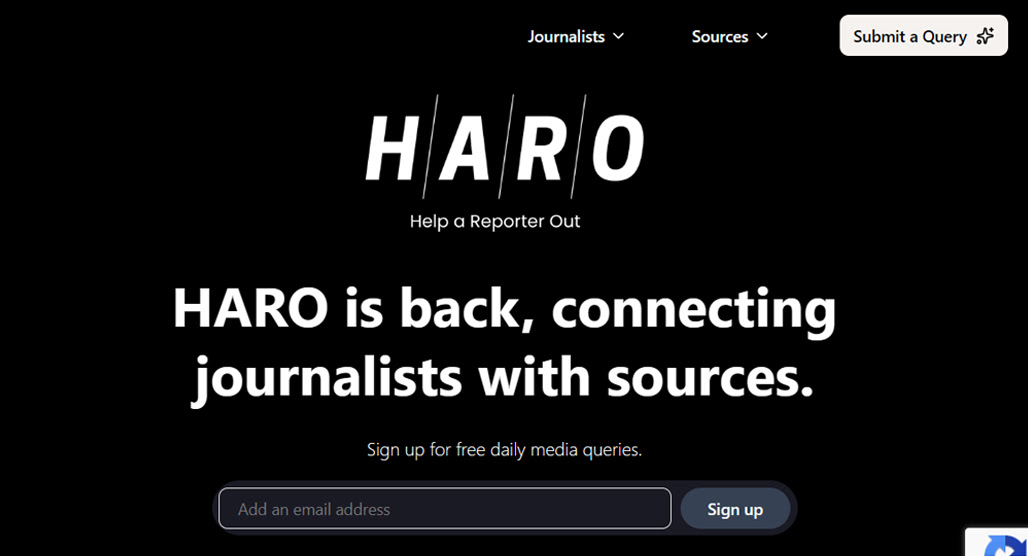
HARO (Help A Reporter Out) has gone through changes, but is back, along with dozens of imitators. All of them exist to allow you to respond to actual journalists' real queries, to become a source or authority they can quote or interview. If you respond well and they pick you, you can earn links and citations. Not all pitches are picked, and many of the ones that are picked won't result in a link, and the ones that are given a link are frequently nofollowed, but even then, the links have value.
I've written a lot of guides on using these sites elsewhere, and there are a lot of resources to help you earn those citations, so it can be an excellent strategy. My #1 tip: don't use an LLM to generate your answers, because the journalists are going to notice. Legitimate, original responses will stand out and increase your chances dramatically.
Work for Valuable Guest Posting Opportunities
Guest posting has been a controversial strategy for years, ever since the infamous Matt Cutts blog post about the fall of guest posting as a strategy. It has never been a bad strategy, just one that's very easy to do wrong.
Identify high-quality sites in your niche that may be open to contributions. Look for "write for us" or "submit a tip" pages, as well as just general contact methods. Come up with content you believe you're an authority in and is of potential use to their audience, and pitch a guest post.

It helps a lot if you can do some behind-the-scenes personal networking with the editor or site owner ahead of time. Anyone who runs a site knows we get inundated with spam emails about "guest posts" that are irrelevant, AI-generated garbage. You need to, again, stand out from the pack by having original value and unique content. Learning how to get an editor to open and respond to your email can make a real difference here.
Use Replacement Techniques
There are a few kinds of replacement techniques that can be very handy, and they all work on basically the same concept. Techniques like the moving man method, broken link building, and updated content linking are all types of link building in this category.

It's pretty simple. Find relevant sites whose links can bring you authority. Look for cases where the external links they already have in their content are broken or outdated.
- Moving Man: The original destination moved or rebranded, and there's no valid redirect or the link 404s.
- Broken Link Building: The external link 404s because the original destination has moved or been deleted.
- Upgrade Content Building: The external link points to a resource that is clearly outdated, like a "guide to improving domain authority in 2021" kind of post.
Identify the link, and find or create a page on your site that fits the destination. Draft an email to the site owner pointing out that the link is broken (while complimenting their content, of course) and offering your own content as a replacement. Since the replacement is close to or better than the original destination, it's an easy swap to make.
Unlinked Mention Recovery
Another great option is to target unlinked mentions. Often, we bloggers will casually mention a brand or service without actually linking to that brand or service. These kinds of unlinked citations are moderately valuable as part of your overall SEO, but they aren't as valuable as links.

The concept here is simple: just find those unlinked mentions and ask the site owner if they can add a link. After all, they already mentioned you, so why not? It works best if you have a specific, relevant post or landing page they can link to (that isn't obviously a sales page), but even if not, asking about a homepage link isn't too bad.
Bonus: You can do this for your name as well. I can vanity search my own name, filter out the actor who shares it, and find mentions of me and not my brand that I can try to tie into my site.
A Note About AI Citations
Something that is becoming more and more popular as an SEO strategy is AIO: optimizing to earn citations and be the website referenced by things like Google's AI overview or LLM platforms like Perplexity and ChatGPT.

While this can be a valuable strategy for traffic, I don't think it's useful for building Domain Authority, for two reasons.
The first is that it's a self-reliant cycle. You need pretty decent Domain Authority to be the one cited by the AI, so it's a case of "you need X to be able to get Y and want Y to build X" in a cycle that's hard to break into.
The second is more important, though: those links aren't permanent or indexed. Google isn't saving and indexing all of the AI Overviews, and ChatGPT's saved history is back-end and non-public by default. They aren't indexed links, so they can't be added to your Domain Authority.
I'm not saying don't try for the AI citations, but I am saying they won't boost your Domain Authority themselves. It's more like your DA will be reflected in earning more citations.
Indirect Methods for Building Links to Improve Domain Authority
Indirect methods of building links center around making people want to link to your content. There aren't a lot of different ways to do this, but there are a few places you can focus your efforts.
Creating Linkbait Content
Linkbait content is content that has some attribute that makes people throughout your industry want to link to it.

It can be:
- Very good, deep, detailed guides and dives into topics.
- Thorough and useful tutorials and guides.
- Deep and valuable case studies and survey results.
It can also include news content, if you have a fast enough turnaround time to be one of the first to report on a given story, or you have a unique perspective that adds value to industry news. If you're playing second- or third-string to the big news sites, though, you aren't going to get much traction with news content.
Linkbait content needs to be very valuable and useful to people throughout your industry. Ideally, it should also be evergreen and kept updated, so you don't end up the target of someone else using the updated content link-building methods above.
You can also create useful assets that draw in links. Remember, link building isn't just about content marketing. Handy tools, code snippets, asset packs, free resources, deals pages, and other useful bits and bobs can all be good enough to draw in links. If it's useful enough that someone might think "hey, this would go good with my audience," it can be linkbait.
One-Upping the Industry
The "anything you can do, I can do better" method is a popular option, also known as the 10x method. Look for highly-rated and valuable industry content, and do the same thing, but better. 10x better would be the goal, but of course, that's a nebulous quantifier.

Make the post longer, cover more details of the topic, dig deeper, go broader, provide more resources, and provide more assets. Make it a better user experience. Address criticisms or questions of the content found from its own comments. One-up what already exists to usurp their position.
Targeting Specific Influencers
Another strategy is to specifically mention brands and, more importantly, people. When you refer to someone as an authority, they're more likely to think highly of you and might even link to you. You don't need to go all-in on flattery like you're writing a puff piece, but even something as simple as quoting a recent post from an authority and piggybacking off it to start a discussion can earn further discussion from them or their audience.

You can even enhance this strategy by reaching out and asking those influencers for quotes related to the topic you're writing about. Finding the right contact email can make all the difference. Sometimes, they'll link to the finished post when you send it to them once it's done.
Safely Cleaning Up at Home
A third thing I want to touch on is a tip Moz gives directly on their Domain Authority page: removing toxic backlinks.

The idea is that some backlinks come from spammy or "burned" websites, whether they're straight-up spam or known to be part of a PBN, or part of another link scheme Google penalizes, or even part of a negative SEO attack. Those backlinks do more harm than good (according to Moz), and you could improve your Domain Authority by removing them.
I have a few problems with this.
First, it's hard to tell the difference between a legitimate link from a bad but well-meaning site and a toxic link. The same goes for PBN links; a burned PBN still looks like a legitimate site, and from the outside, it can be hard to tell if it's bad or not. It's very easy to accidentally disavow links that look bad but actually aren't harming you.
You also have to consider that what Moz considers toxic and what Google considers toxic can be different. Removing a bunch of bad backlinks will affect different metrics in different ways. It's also worth knowing which domain extensions to avoid when building backlinks in the first place.
There's one piece of critical information that Moz leaves out, though, which is that disavowing links has zero impact on your Moz Domain Authority score.
Why? One simple reason: Moz doesn't have access to your disavow file. Disavowing a link doesn't remove that link from existence; it just allows Google to decide not to count it against you. Moz doesn't see your list or have access to Google's link data. They have no way to tell whether or not you've disavowed a link.
While disavowing links can potentially help you in various ways, it won't be reflected by Domain Authority unless or until those links are actually deleted and Moz notices.
Overall, Domain Authority is a relatively simple metric, for all that Moz couches it in machine learning algorithms and proprietary spam scores. Just focus on building more links carefully from more domains, and your score will naturally improve.

Related Posts

Leave a Comment


Fine-tuned for competitive creators
Topicfinder is designed by a content marketing agency that writes hundreds of longform articles every month and competes at the highest level. It’s tailor-built for competitive content teams, marketers, and businesses.
Get Started