What is Search Intent Mapping and How Do You Do It?
 Written by James Parsons • Updated April 15, 2026


I've talked a lot in the last year or so about how important search intent is as part of your overall content marketing strategy.
A roadblock a lot of people encounter with discussions like these, though, is the disconnect between theory and practice. I can describe what search intent is all day, but if all I do is tell you to figure it out, you're left scratching your head. How do you determine search intent? How do you know what your existing content is covering, and whether or not it aligns?
This is what search intent mapping helps you figure out. So, let's talk about it!
Key Takeaways
- Search intent mapping connects user keywords to appropriate content, revealing gaps and misalignments across your sales funnel.
- Five search intent types exist: navigational, informational, tutorial, commercial, and transactional - most content targets the middle three.
- The mapping process requires exporting primary keywords, labeling intent per keyword, then identifying disconnects between content and actual search intent.
- AI tools can assist with classification but require human review, as LLMs may produce plausible-looking but inaccurate intent assignments.
- After mapping, a gap analysis reveals uncovered intents and missing funnel stages, highlighting opportunities for new or improved content.
Table of Contents
Reviewing Search Intent
First, to make sure we're all on the same page, let's start with what search intent is and why it's so important.
Whenever you go to Google (or to Bing, or DuckDuckGo, or ChatGPT, or Perplexity, or whatever other source of information you prefer) and you type in a search query, there's a reason you're doing it.
Not all purposes are the same, though. The different kinds of reasons and the different goals you have when searching are the different kinds of intent. What are they?
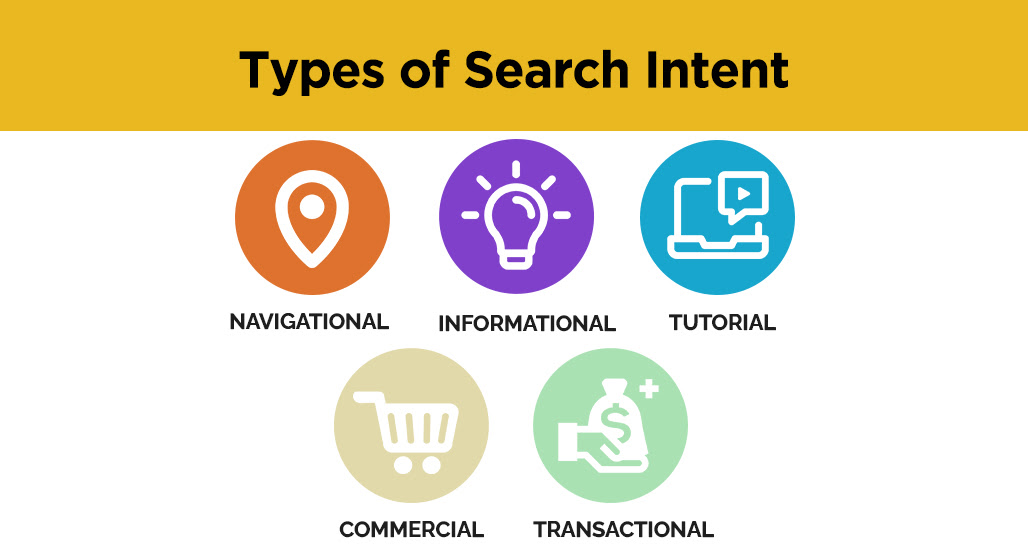
Navigational Intent. Navigational intent is the intent of visiting a particular website or web page. If you go to Google and you type in Netflix, there's a solid chance you want to visit www.netflix.com. Maybe you'd be looking for other information, like the wiki page for Netflix or the Netflix stock price or whatever else, but usually, if you want information like that, you'd type that phrase in instead.
A lot of navigational intent searches come from one of three sources.
- Technological illiteracy or inexperience. People who don't know how browsers work (often old, but also young, or simply inexperienced or incurious) know that typing something in the address bar takes them where they want to go. Or, their browser is set to Google as a homepage, or some portal to a Google search. They don't know or don't think about typing in the .com to go somewhere; they just type in the name of the place, and Google gives it to them. Usually, it works (but it's also a big vector for malware, so if you know someone in this situation, consider teaching them better habits).
- Browser functionality. People who do know how browsers work know that the address bar can be used for URLs to take you to a specific website, but also that it can default to a web search box, regardless. I personally use this all the time. The difference between "Netflix" and "Netflix.com" is whether or not I hold CTRL before hitting Enter, and sometimes the timing is off or the keyboard doesn't track, and I've performed a navigational intent search, albeit accidentally.
- Laziness. Combine the above. Typing .com is four whole extra keystrokes, whereas going to Google and clicking the search result is just one extra click (or tap).
Navigational intent is a common kind of search, but it's also not one that's useful for marketers outside of targeting your own brand name. I'm not going to get a page to rank well for "Netflix", right? And even if I did, 99.999% of traffic isn't going to be clicking it, because that's not why they're there.
Informational Intent. The second kind of search intent is informational. This is a huge swath of searches, and it's also being dominated by AI results, because it's the easiest kind of search for an LLM to generate a good-looking answer for, even if the answer isn't necessarily correct. While Google now puts their AI Overviews on a lot of different kinds of searches, they started primarily with informational intent queries.
Informational intent is when you want to find out a piece of information. "Who played Ripley in Alien?" is an informational intent query. "Netflix stock price" is an informational query.
In addition to AI overviews, Google will also usually show some kind of informational boxes for these kinds of queries. A stock price query will show the stock price chart, a live price measure that updates every few seconds, and a box of news headlines related to the markets, and you have to scroll quite a ways to get to anything resembling a blog.
There are, though, many informational intent queries that aren't dominated like this, often those centered on more niche topics. Even something like "what is search intent mapping" is an informational query, and it gets an AI overview, but none of the other infoboxes, because there aren't primary resources for it. These can be great to target and are a prime candidate for mapping.
Tutorial Intent. Tutorial intent is very similar to informational intent, except that instead of learning a simple fact, definition, or piece of data, the individual wants instructions to follow. Sometimes this leads to sites like eHow, sometimes to industry sites, and sometimes to themed sites. Recipe blogs all fall into this category. The post you're reading now satisfies tutorial intent for "how to map search intent" and related queries.
These are the bread and butter for a lot of marketers because the people searching them, while not necessarily primed to make a purchase, are at least receptive to the need. If the conclusion to my description on how to perform search intent mapping is to link you to a tool to buy to do it, some portion of you are likely to take me up on that recommendation.
Commercial Intent. Also known as consideration intent, this is the people who are performing queries in the pre-purchase stage.
For example, say someone wants to make a cake. They find a recipe they like, but it calls for cake flour rather than all-purpose flour. They perform an informational query like "difference between cake and ap flour" and learn enough to decide if they should use cake flour for their recipe as it calls for, or if AP flour is fine.
After that, they need to find some cake flour to buy, so they look for "brands of cake flour" or "best cake flour" and look for the kind they should buy. They aren't yet looking for a store page, but rather something like a comparison page or social media discussions.
These are some of the best queries to target in content marketing, because they're your opportunity to recommend your products. That's also why they're often the focus topics for landing pages and not just blog content.
Transactional Intent. This is the final part of the funnel, where users are searching for the product they want to buy. They've done their research and they know what they want. Now it's just a matter of finding it.
This is another area where search results are dominated, usually by store pages but also by product infoboxes from Google Shopping, to make it easier for people to compare prices across storefronts.
These are great queries to reach if you're relevant enough to do it. But they're very difficult to land.
How Search Intent Mapping Works
Now, what about mapping these intents?
Mapping is about drawing a line between the user's search intent to their keyword, from the keyword to the topic that would suit their needs, and from that topic to content on your site.

You map types of intent to the phases of your sales funnel. You map your content to types of intent along that funnel. And, you use the map to find holes you can fill with content in the future.
It's simple to explain in concept, but difficult and somewhat tedious to do in practice.
Step 1a: Export the Primary Keywords for Every Piece of Content
The first thing you have to do to map all of this is determine the primary keywords for each piece of content you have on your site and want to map.
I say primary keywords here for a reason. One piece of content can rank for dozens or hundreds of keywords, but most of those keywords are variations on the central keywords you're actually targeting. If you try to make out hundreds of keywords per post, you'll never get close to finishing, so focus your efforts on the most important keywords for the pages.
Note: If you have a huge old site with tons of content, you might choose to focus on the top 20% (since the 80/20 rule is in full effect here), but I highly recommend doing everything. The top keywords are most likely going to be the ones that already align with search intent well, but the ones that don't align, which lead to posts that don't do well, are important opportunities to improve your site. If you ignore them in your map, you lose a lot of potential value.
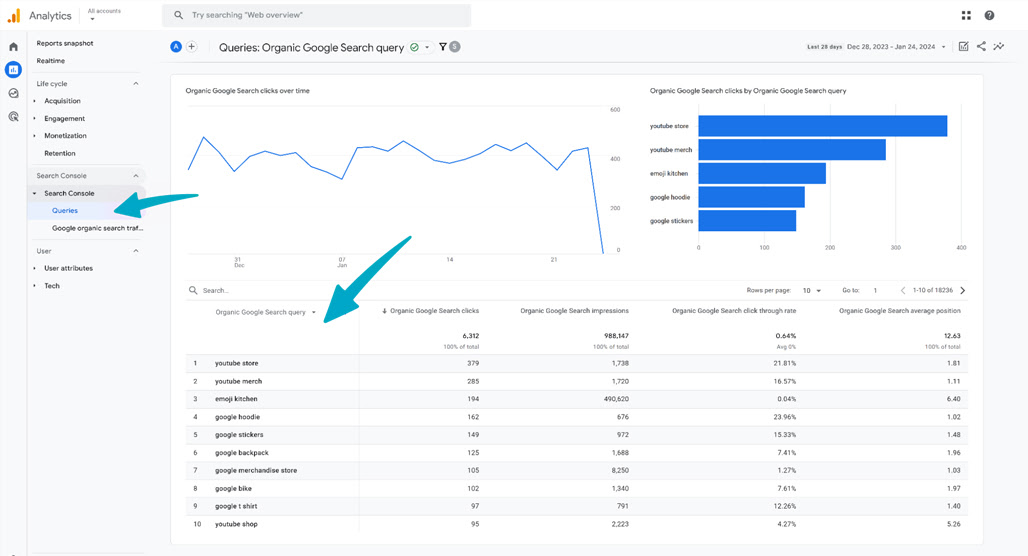
You can get top keyword data from a variety of different tools, or even just sources like Google Analytics. Third-party tools like SpyFu can do it as well. There are also AI tools that can do it, though I have some reservations about those, which I'll bring up later.
Step 1b: Identify the Intended Search Intent for Each Piece of Content
Generally speaking, when you're writing a piece of content, you have a perspective and a goal for that content. Whether you know you're doing it or not, you'll have put a search intent into the content. I find that most people default to something informational or tutorial when they aren't explicitly targeting one of the others.
Right now, you aren't looking for the connection between keyword and intent. You just need to identify the intent behind the content that you produced. Whether it's aligned with the actual intent or not is what we're uncovering in a later step.
Step 2: Identify the Search Intent Behind Each Keyword
This is where a lot of the effort of search intent mapping comes in. You have to go through the keywords you've listed out and figure out what the search intent is behind each of them.
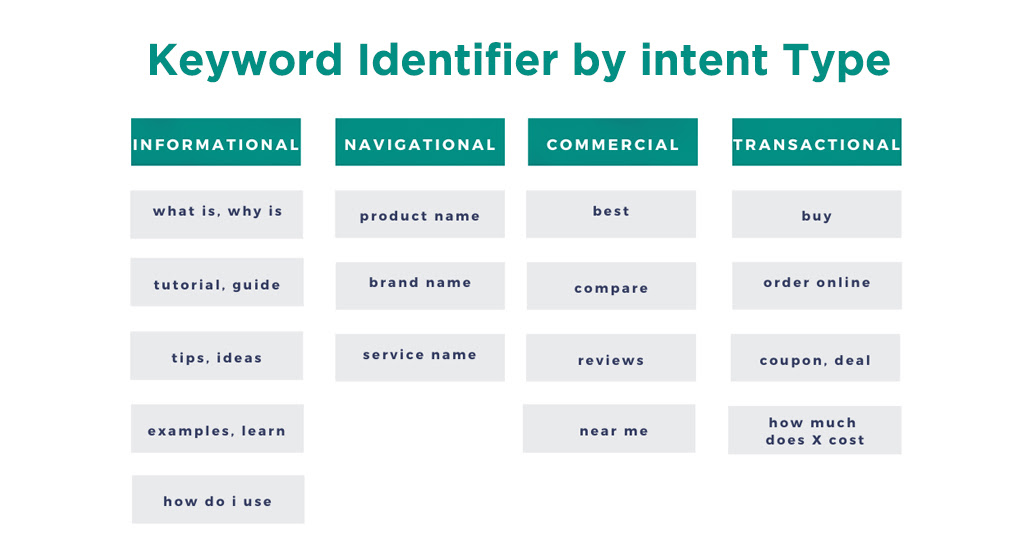
Now, above, I listed five search intents: navigational, informational, tutorial, commercial, and transactional. Realistically, though, most of your keywords are going to be informational, tutorial, or commercial. Navigational searches don't use keywords that go to blog posts, and transactional keywords would lead to your product pages. So you really only have three intents to classify.
It's still a lot of work, especially since some vague, short-tail keywords can apply to several intents. That's where you need to map them, not just to the search intent to keyword flow, but also to how it presents as part of your sales funnel.
There are an increasing number of tools that claim to be able to do this for you. Most of them say they use AI to do it. I'm hesitant on this (like I am for the tools for step 1) because so many of them are just shells for ChatGPT or a similar LLM.
AI in the "machine learning" and "data classification" sense can do some of this kind of mapping. LLMs, though, don't function the same way. They're statistical models of language. They'll give you an answer, because they're incapable of not giving you an answer, but they don't actually do any data analysis according to any real models. They might be accurate or they might not, and without putting your own mind to it, you have no way of knowing.
If you want to use an AI-based tool to do a lot of this classification for you, feel free. However, you 100% need to do reviews of the output to make sure it's actually true, and not just making up pretty-looking lies.
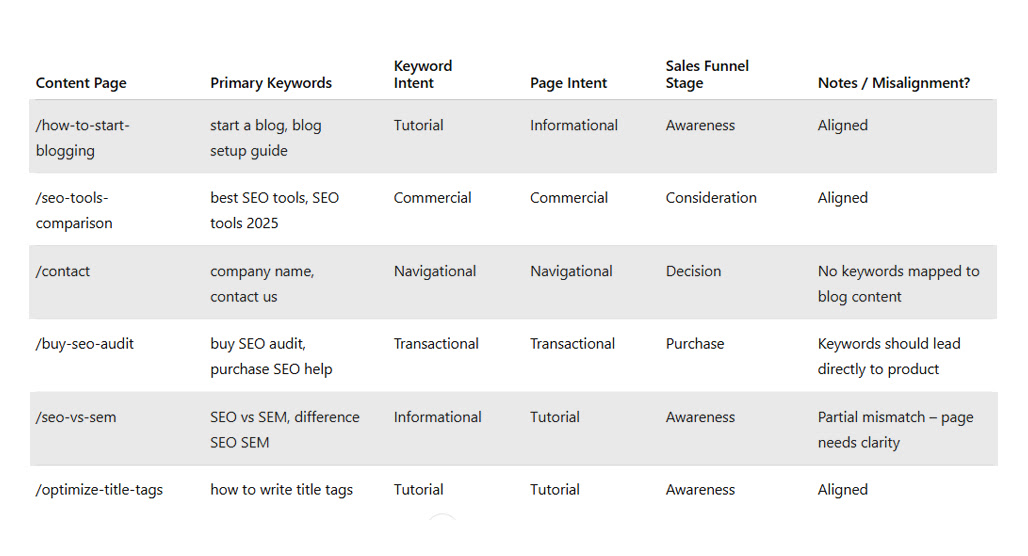
When you're done with this step, you'll have a spreadsheet that:
- Has a column for your content, page by page.
- Has a column with the existing search intent behind the content.
- Has a column where each piece of content lists its primary keywords.
- Has a column where each keyword has the search intent associated with it.
Already, you can see where you can start finding disconnects, so now we dig into that.
Step 3: Identify Disconnects Between Intent and Content
Your next step is to look for the disconnect between the current search intent of a piece of content and the search intent behind the keywords it's ranking for.
This can be tricky and needs a lot of judgment, because there are some self-reinforcing loops in here. Content that is misaligned between produced intent and keyword intent won't rank well for keywords with the best intent behind them, so those keywords might not show up as the primary keywords for the content.
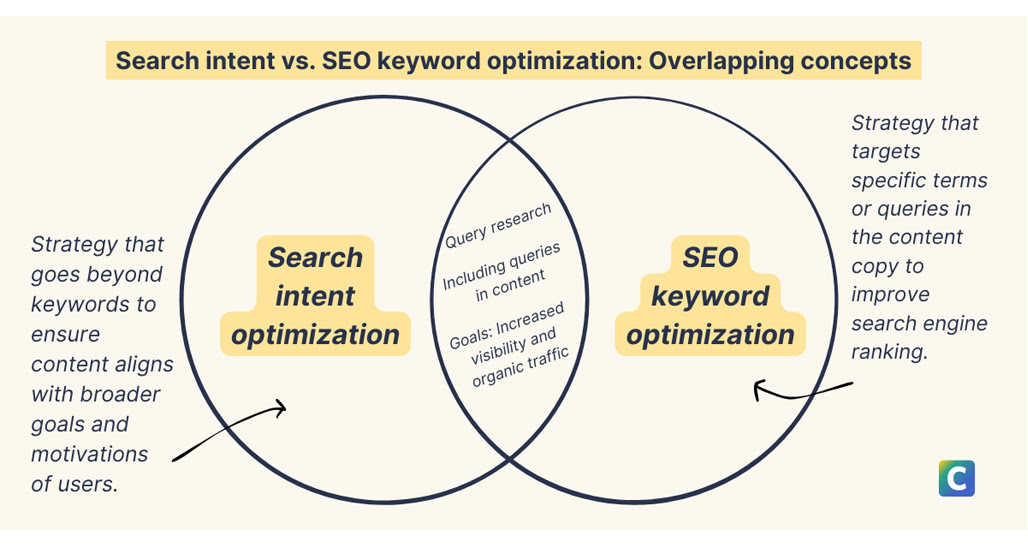
Conversely, the content that aligns well will work well, and while it's good to see in action, it doesn't give you actionable opportunities, just a model for what you're aiming for.
I have yet to find a tool, AI or otherwise, that can do this for you. It requires your own judgment to evaluate if the content is working for its intended purpose and if that intended purpose is aligned with the intent behind your visitors' searches.
Step 4: Search for Gaps in Intent Coverage
If step three is looking internally, step four is looking externally. You'll have a keyword list of what you cover and the intent behind it, but since a lot of keywords can be served by multiple intents and because the higher-value intents can still be covered with content marketing, you can perform a gap analysis to identify opportunities that you haven't covered.
So, look for keywords that don't have aligned content, or intents that you aren't covering as well as you should, and flag those as opportunities for future content.
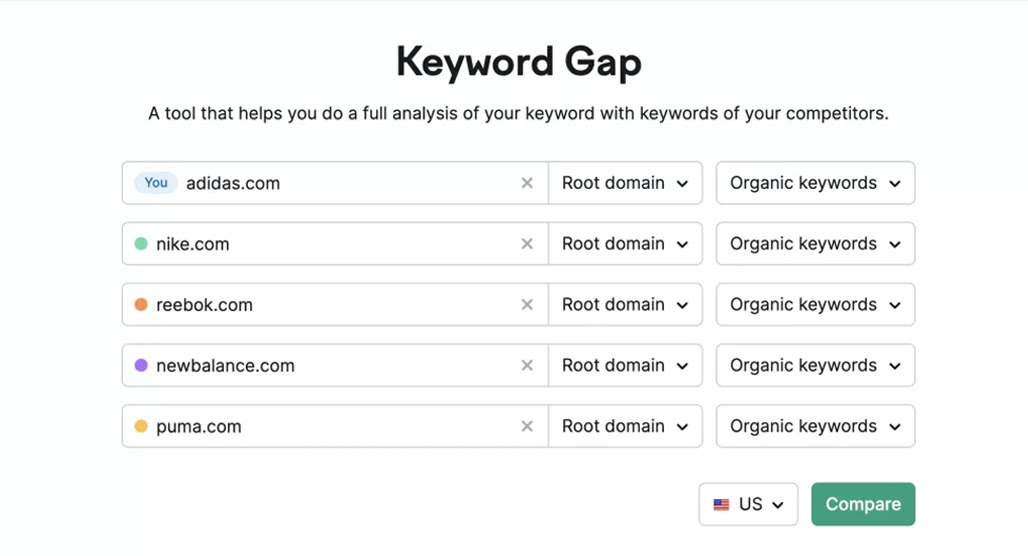
This is also where the sales funnel comes in; when you map your content according to the effective stage of the sales funnel, you can see if it really resembles a funnel, and where additional content can be produced to fill it out and provide additional avenues for consideration and conversion.
Once you're done with all of this, you'll have a fairly complex but very useful map and a list of new opportunities to fill out to reinforce intent flow and build a better funnel. All that's left from there is the work - adjusting existing content to better align with the intent it ranks for, and producing new content to fill intent gaps in your funnel.

Related Posts



Leave a Comment
Comments


Fine-tuned for competitive creators
Topicfinder is designed by a content marketing agency that writes hundreds of longform articles every month and competes at the highest level. It’s tailor-built for competitive content teams, marketers, and businesses.
Get Started
Another great post!
Thanks Kamya! Glad you enjoyed it 🙂 are you doing much search intent mapping for your sites?