Query Fan-Out: Ideating for How LLMs Split Questions
 Written by James Parsons • Updated October 12, 2026

Query fan-out is the mechanism behind a particular kind of AI search experience, and it has a name Google made official at I/O 2025. Google's Head of Search Elizabeth Reid introduced the term while revealing AI Mode, describing how the feature does not treat a single question as a single lookup. Instead, it quietly breaks that question apart, dispatches multiple sub-queries in parallel, and synthesizes what comes back into a single, layered answer. One question can become many, all at once, without the user ever seeing the machinery turn.
The concept is easy enough to know in a sentence. But the implications take longer to sit with. For anyone who creates content, builds search strategies, or simply wants to know how AI systems are beginning to reason through language, query fan-out changes some assumptions worth looking at. What does it mean for a piece of writing to be found when the search that surfaces it may have started as something else entirely? And how does a model choose which sub-questions to ask, and what counts as a satisfying answer to each one?
I'll work through those questions - starting with how query fan-out actually functions, moving into what it reveals about the way large language models approach inquiry, and ending with what it might mean practically for those on the other side of the search bar.
Key Takeaways
- Query fan-out breaks a single user question into multiple parallel subqueries, synthesizing results into one layered answer invisibly.
- Complex, multi-entity, or comparative prompts generate significantly more subqueries (up to 20+) than simple factual questions (1-3).
- FanOutQA research shows subquery evidence sources almost never overlap, explaining why AI answers can feel disjointed.
- ChatGPT, Claude, Gemini, and Perplexity each handle fan-out differently in depth, transparency, and whether research modes are available.
- Understanding fan-out helps users prompt more precisely and helps publishers recognize how AI surfaces their content indirectly.
Table of Contents
What Query Fan-Out Actually Does When You Ask a Question
When you submit a prompt to an AI, the system doesn't just look for one answer to one question - it breaks your input into a cluster of smaller, more focused subqueries and then pulls from those results to build a response; it's the core mechanic at work.
Take a prompt like "What's the best city to retire in on a budget?" On the surface, that looks like a single question. But to answer it well, a model might generate subqueries around cost of living by city, average healthcare costs for retirees, state income tax on retirement funds, climate preferences, walkability for older adults, and access to public transit - it's 8 to 12 directions the model pursues before it writes a single sentence back to you.
Each subquery targets a narrower slice of the problem. That's what lets AI replies feel deep instead of shallow - the model isn't just grabbing the first result it finds; it assembles pieces from different angles and synthesizes them into something readable.
There is a tradeoff, though. More subqueries means more processing, which can slow things down - it also means more places for inaccurate or conflicting information to enter the picture. If two subqueries return data that contradicts each other, the model has to reconcile that - and it doesn't always get that reconciliation right.
| Prompt Type | Estimated Subqueries | Response Depth |
|---|---|---|
| Simple factual question | 1-3 | Shallow, direct |
| Comparative question | 4-7 | Moderate, structured |
| Multi-factor decision prompt | 8-12+ | Deep, synthesized |
The richness of a response is directly tied to how many subqueries the model runs. A simple "what year was X founded?" barely fans out at all. A layered question about retirement cities pulls in data across economics, geography, health infrastructure, and lifestyle factors all at once.
This helps you see why identical prompts can produce different answers on different days - the subquery outputs themselves can vary based on what the model retrieves or weights at any given second. Understanding how entity-based keywords work can help you structure prompts in ways that produce more consistent, targeted results.
How Prompt Complexity Shapes the Number of Subqueries
Not every question breaks into the same number of pieces. An easy factual prompt like "What year was the Eiffel Tower built?" might generate just one subquery, or none at all. But ask something like "How do the tax policies of Germany, France, and Japan compare for small business owners in 2024?" and the model has quite a bit more ground to cover.
What makes a prompt feel "complex" to an LLM can depend on a few things. The number of entities involved matters quite a bit - each person, place, country, or product in your question can become its own thread to pull. Time constraints add another layer, because the model may need to retrieve or reason about information across different periods. And comparative structure is probably the biggest driver of fan-out. The model has to collect data points before it can weigh them against each other.
On one end of the spectrum, single-focus questions need one lookup. On the other end, deep research prompts can generate 20 or more subqueries as the model works to build a picture. Most questions fall somewhere in the middle, between 2 and 8 subqueries.
| Prompt Type | Estimated Subquery Range | Example Use Case |
|---|---|---|
| Single-entity factual | 1-2 | "Who is the CEO of Apple?" |
| Multi-entity lookup | 2-5 | "What are the capitals of Canada, Brazil, and Australia?" |
| Comparative question | 4-8 | "How does Python compare to JavaScript for backend development?" |
| Time-sensitive layered | 5-10 | "How has inflation affected housing prices in the US over the last three years?" |
| Deep research / multi-domain | 10-20+ | "Compare healthcare systems across five countries by cost, access, and outcomes." |
The helpful takeaway is that your prompt structure directly shapes how much work the model does. A vague large question can produce more subqueries than a precise one, but not necessarily in a helpful way. Precision generates focused fan-out, but ambiguity can send the model in a few directions at once without much coordination between them.
This is worth keeping in mind as LLMs get used for more research-heavy tasks. The structure of your input is a signal the model uses to choose how deep to go.
The FanOutQA Benchmark and What It Reveals About AI Reasoning
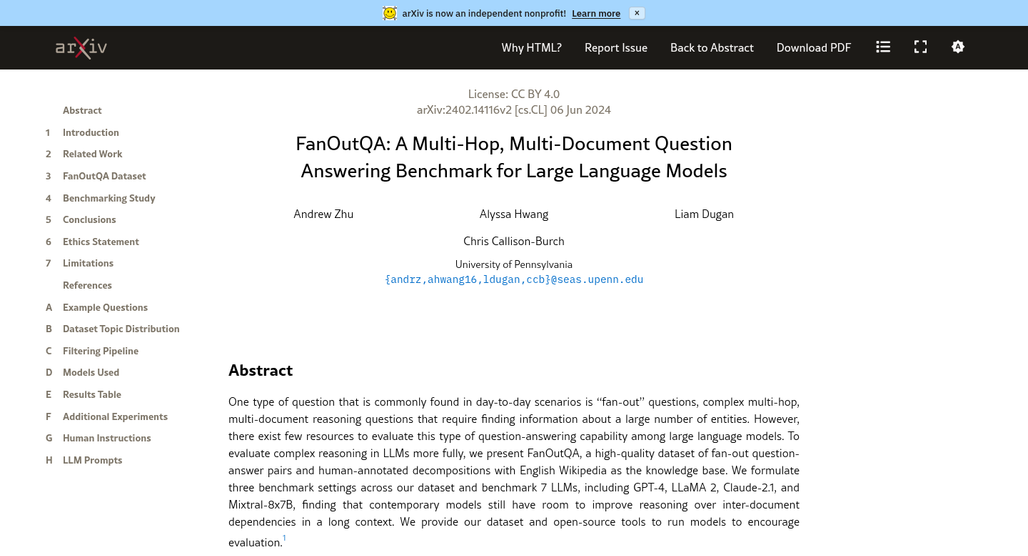
The FanOutQA dataset was built specifically to test how well AI models manage questions that need multiple pieces of information to answer- it has 310 fan-out questions and each one draws from a context group that spans anywhere from 38 to 87 Wikipedia articles. The token loads for those context groups run between 0.9 million and 2.1 million tokens, which is a significant amount of text for a model to work through.
The most telling finding comes from the question pair analysis. Across roughly 48,000 question pairs in the dataset, only 1.1% share even a single evidence page. And when pairs do overlap, they share just about 2.4 pages on average.
That number is worth sitting with for a bit- it means that when an AI breaks a question into subqueries, the information needed to answer each one is almost entirely separate from what the others need. The subquery net is very wide and very sparse at the same time.
This tells us something helpful about why AI-generated answers can seem a little disjointed. The model pulls from sources to construct a response and those sources don't have much to say to each other. There is no natural thread connecting a subquery about a country's GDP to one about its head of state - they just serve the same parent question.
The benchmark also shows that fan-out reasoning is about taking care of legitimately separate knowledge spaces and then combining the results into something coherent. That combination step is where the difficulty lives.
The dataset was designed to push models into this territory on purpose, forcing questions that can only be answered through wide retrieval. FanOutQA exposes how well a model can manage isolated evidence without losing the thread of what was asked. Models that manage this well maintain the relationship between subqueries and the original question throughout the whole process. Models that struggle answer each subquery as if it stands alone, which is where that disconnected feeling in replies comes from - something worth keeping in mind if you've noticed ChatGPT sending traffic to your website and wondered how it pieces answers together.
How ChatGPT, Claude, Gemini, and Perplexity Handle Fan-Out Differently
Each of these four tools handles fan-out in its own way, and the differences matter every time. The question is not which one gives a longer answer - it's how each one breaks a question apart before it even starts to respond.
ChatGPT, and that's also the case in its deep research mode, tends to make its subquery process more visible - it will show you the questions it's looking at as it works through them, which gives you a window into its reasoning. Claude decomposes quietly - it fans out internally but doesn't always surface that process for the user to see. Gemini leans on its integration with Google Search to pull in multiple angles, and its fan-out tends to go well with that search-first structure. Perplexity is the most transparent of the group by design. It was built around showing sources and sub-searches as part of the core experience.
Research modes change the picture for ChatGPT and Gemini. When those modes are active, the depth of fan-out goes up and the tool takes more time to collect information before responding; it's a tradeoff - more decomposition, but slower results.
| Tool | Subquery Visibility | Fan-Out Depth | Research Mode Available |
|---|---|---|---|
| ChatGPT | High (in deep research mode) | Deep with research mode active | Yes |
| Claude | Low (mostly internal) | Moderate | No |
| Gemini | Moderate | Deep with research mode active | Yes |
| Perplexity | High (built into the interface) | Moderate to deep | Partial (Pro search) |
No single tool does everything. Some prioritize transparency so you can follow the reasoning, and others prioritize a clean output without showing their work. Neither strategy is wrong - they just suit different ideas about what a user actually needs from an AI answer.
Fan-out is not a feature you toggle on or off - it's baked into how each tool thinks, and the tradeoffs between speed, depth, and visibility are built in from the start.
Thinking in Subqueries: A Smarter Way to Prompt and Publish
Query fan-out is not a bug in the system or a technical footnote buried in a research paper - it's a look into the associative, layered way AI models actually process meaning - closer to how a curious expert breaks down a problem than how a search engine matches strings. When you understand that your question doesn't land as a single unit but unfolds into a constellation of smaller ones, you stop prompting at the surface and start thinking with the model. That change, small as it sounds, is where the value is.
FAQs
What is query fan-out in AI search?
Query fan-out is the process where an AI breaks a single user question into multiple parallel subqueries, retrieves information from each, and synthesizes the results into one cohesive answer - all without the user seeing the process.
How many subqueries does a complex prompt generate?
Complex, multi-domain prompts can generate 10-20+ subqueries, while simple factual questions may generate just 1-3. Comparative and time-sensitive questions typically fall in the 4-10 range.
Why do AI answers sometimes feel disjointed?
FanOutQA research found that only 1.1% of subquery pairs share even one evidence source. Because subqueries pull from almost entirely separate knowledge spaces, combining them coherently is where AI models most often struggle.
Which AI tool is most transparent about fan-out?
Perplexity is the most transparent by design, showing sources and sub-searches as part of its core interface. ChatGPT also shows its subquery process, but primarily when deep research mode is active.
How can understanding fan-out improve my prompting?
Precise prompts generate focused, coordinated subqueries, while vague prompts can scatter the model's retrieval without useful coordination. Structuring your input with clear entities and comparisons helps produce more accurate, targeted AI responses.

Related Posts



Leave a Comment


Fine-tuned for competitive creators
Topicfinder is designed by a content marketing agency that writes hundreds of longform articles every month and competes at the highest level. It’s tailor-built for competitive content teams, marketers, and businesses.
Get Started