What Are Parent Topics and Why Do They Matter for SEO?
 Written by James Parsons • Updated April 15, 2026


If someone asks you a question about topics and brings up parent topics, there are two possibilities.
The first is that they're talking about topics about parenting. How to raise a kid, what to feed a kid, how to evaluate a school district, you get the idea.
More likely, though, they're asking about the concept of parent-and-child topics in SEO. It's closely related to concepts like content clustering and site structure, so it's important to know what role it plays in your marketing.
So, let's talk about it. What is a parent topic, how do you identify parent topics, and why do they matter for your SEO?
Key Takeaways
- Parent topics are broad, top-level categories in a hierarchy that contain multiple related child topics underneath them.
- There's no SEO penalty for choosing the "wrong" parent topic, but overly broad choices create muddled site structure.
- Tools like Ahrefs can suggest parent topics, but they reflect how others structure content, not necessarily your ideal organization.
- Parent topics improve SEO by helping search engines and users understand site structure through categories, breadcrumbs, and subfolders.
- Identifying parent topics helps uncover orphan pages, internal linking opportunities, and whether a topic needs a pillar post.
What is a Parent Topic?
Parent topics are the top-level topics in the parent-child hierarchy structure that many websites use as an overall organizational structure. In a grandparent-parent-child hierarchy, parent topics are in the middle.
Basically, a parent topic is a broad, overall topic that is too wide and too deep to cover with a single piece of content. They're more like categories for topics.
So, for example, you might have one overarching grandparent topic labeled "marketing". Within that overall category, you would have parent topics like "organic marketing" and "paid marketing". Then, you would have child topics within those, such as "content marketing" or "PPC advertising."

Truthfully, topics aren't nicely broken down into three easy tiers like this. Imagine a string of breadcrumbs from a top-level topic down to a specific blog post. You might have:
Business > Marketing > Organic Marketing > Content Writing > Topics > Parent Topics
Then, within "parent topics," you can have individual child topics with specifics, like "what are parent topics," "how to choose parent topics," and "how to use parent topics for SEO".
Each one of those could be its own piece of content. Or, as you're seeing in the post you're reading right now, they can be sub-sections of one topic. Neither option is any more or less correct than the other, but they're both ways of looking at and digging into the information.
Thus, a parent topic is generally just the concept of "the overall subject that a child topic falls under." A child topic can itself be the parent topic of several other children, and a parent topic can be a child topic of a larger and more overarching topic. In other words, it's a relational descriptor.
How Do You Identify a Parent Topic?
If you have a topic, how do you identify what the parent topic is for that topic?
Generally, it's just a matter of thinking about it. A discussion of parent topics is part of an overall discussion of topics, but it's also part of a discussion of hierarchical organization, and can be part of discussions into navigation, SEO, and so on.
All of these are right answers. You aren't going to get into trouble for picking the wrong parent topic, you won't eat a search engine penalty for it, or anything else.
The idea of looking into parent topics is a way to think more in terms of structure and interrelations between your pieces of content.
The risk is that if you think that the parent topic is something too broad, you end up with muddled structure.
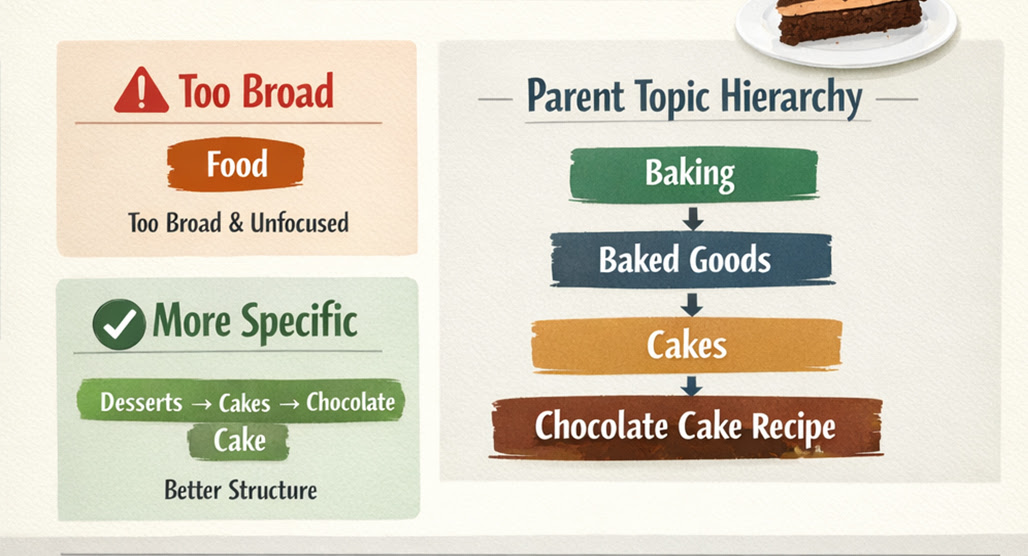
Consider something like a recipe for baking a chocolate cake. You could pick "food" as your parent topic, and you'd be correct: cake is food, after all. But that leaves you with very flat navigation. Users visit your site, click on the "food" category, and see everything from cakes to steaks to sea salt flakes.
It's more helpful to be more granular. A chocolate cake recipe can fall under the heading of cakes in general, which in turn falls into baked goods and baking. You could even add another division of desserts in there.
Your choice of how far up the chain you want to go depends on the scope of your site. For example, here on Topicfinder, I talk a lot about keywords and topic selection, but even though those subjects can relate to PPC ads, I don't generally cover PPC. That's because this site's overall parent topic is centered around content marketing, not marketing in general.
Can you use tools to identify a parent topic?
Yes… sort of.
If you don't want to put the ol' noggin to work thinking about the overall context of a topic, you can use tools to give you some indicator of how other sites have thought about it and structured their own content.
Broadly, two types of tools can do this. One of them is tools like Ahrefs. The Ahrefs keyword explorer, when you give it a keyword, can give you information about the parent topic for that keyword. Their purpose is primarily to help you determine if it's smarter to target the higher-tier parent instead of the child for a piece of content. You can learn more about how to use Ahrefs for content analysis to get the most out of these features.

The other type of tool that can give you some insight is, interestingly, LLMs. LLMs are built on the relationships between words across topics; it's like their entire point. Being able to explore and enumerate those relationships is one of the few things LLMs can actually be good at doing.
The trick here is that you can't necessarily just go to an agentic AI and ask it about parent topics for keywords. That can work some of the time, but the trouble is, you're not actually asking for or getting the relational data behind the LLM; you're inputting a shape made of words and asking for a shape that corresponds to it. LLM output isn't your goal; LLM data is your goal.
To get that, you need to get a lot deeper into how LLMs work and function, and that's not something you're going to easily access from a marketing tool.
There's one potential roadblock when using tools, and that's the fact that what you're getting isn't necessarily the semantic and topical relationships between topics; it's how other people have modeled those relationships.
Your structure can be different, and you're not necessarily wrong for doing so.
To go back to the baking example, imagine if your site is centered around desserts instead of food in general. It's a narrower niche, which means more specialization and more ability to leverage that focus into stronger, albeit narrower, results. If you're wondering whether covering two different topics on one website hurts your SEO, that's a related question worth exploring.
But that means rather than the parent for "chocolate cake" being cake, you might flag it as chocolate, and put it in with other chocolate desserts. If you organize your site around primary flavors instead of the form of the dessert, that organizational structure still works and is still effective, but it's not what a tool would tell you to do.
Are there advantages to using a tool and finding the structures other sites use? Sure. You get better and more directly relational data from things like search volume and keyword difficulty, and tools that focus on content clustering will work better for you.
Why Are Parent Topics Important in SEO?
So, why do you have to care about parent topics when it comes to SEO?
It's all about structure.
You could just put every piece of content on the same equal footing. Every blog post is just hosted on example.com/blog/title-of-post. Relationships between them end up defined by internal links that jump between them, but that's all the structure you get.
When you focus on parent topics, you start building categories and sub-categories. You end up with example.com/baking/cakes/chocolate-cake-recipe.
It's easier for sorting and organization. If someone wants to find the ace of spades in a deck of cards, they'll have an easier time of it if they look through just the spades than if they look through the full deck.
Parent topics fuel navigational aids like categories and breadcrumbs. Other attributes can fuel alternative navigation. For example, you could have a tag for aces or a tag for chocolate desserts, which are alternative ways of exploring the content, while the primary structure is still locked into the one you chose.
Fun fact: in some site structures, this navigation is post-hoc and done using parameters called facets. This is something that comes up when you look into e-commerce specifically, like Magento storefronts.
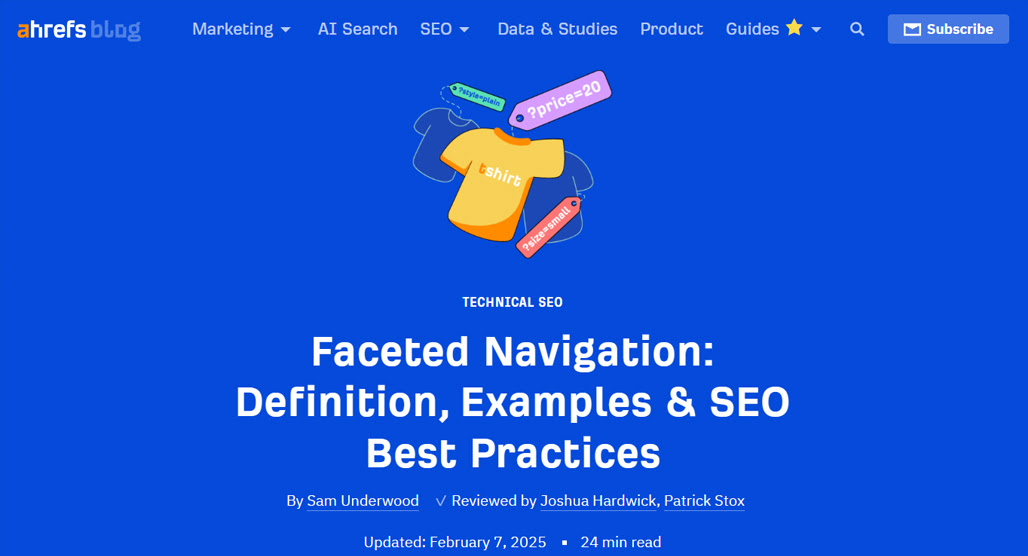
When you take the broad category of "all products" and allow users to add facets to their search, they narrow it down. They click the facet for chocolate, and the facet for baked goods, and they're left with three-tier chocolate cakes, one-tier chocolate cakes, large chocolate sheet cakes, chocolate cupcakes, and so on. It's easier for them to pick what they specifically want.
The downside is that this can leave one product page with numerous different URLs pointing to it based on the different combination of facets. This becomes a huge hassle with duplicate content algorithms and filters. It's a solvable problem (and a topic for another time), but it's something to be aware of.
Anyway, I digress. The point is, parent topics are a key part of organizational structure, which helps users drill down to specific information they want to find. It's also important for search engines like Google to understand the overall structure and subject matter of your site. While they can extract that information from the word cloud of structureless posts, they get it better when you give it to them as a nice, orderly chart using subfolders and categories. If you want to go deeper on this kind of architecture, it helps to understand what topic clusters are and why they matter.
How Can You Use Parent Topic Information?
Identifying the parent topic for a piece of content lets you evaluate where you want that content to fall in your overall marketing.
When you start with a topic, you can "zoom out" to the parent topic. Then, you can look around your site for anything else that fits that same parent topic. This helps you figure out where that one piece fits with the puzzle.
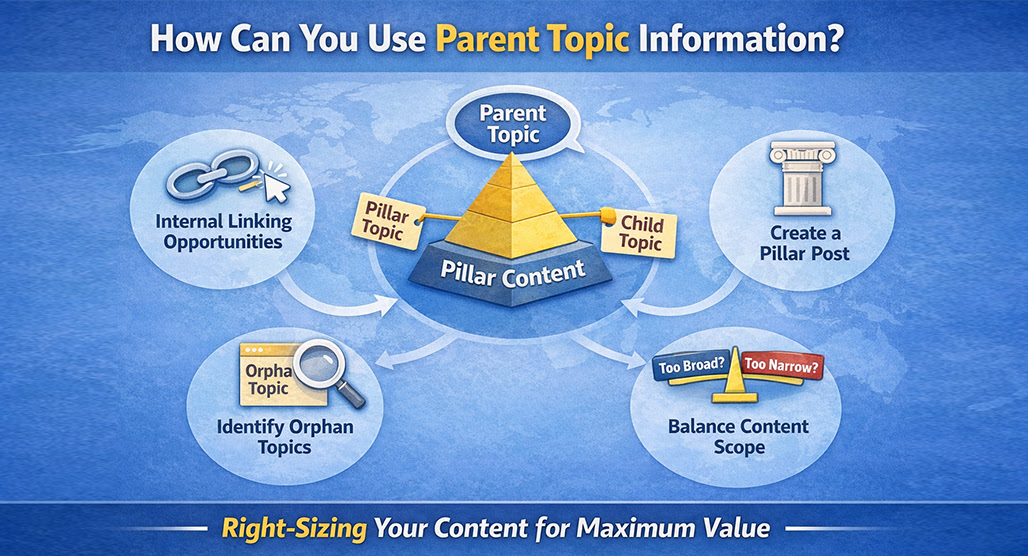
It also helps you choose internal links to add, interrelated topics to mention, and parent topics to link to.
If the parent topic doesn't have an anchor, this becomes a great opportunity to create a pillar post. Something that ties together and anchors all of the child topics becomes a great source of links and value, both internally and externally.
Thinking about parent topics can also help you determine if your chosen topic is actually too broad to be a stand-alone piece of content. Sometimes, you start thinking in the other direction: what topics are child topics for the one you're working on? Do those child topics have enough substance to make for full pieces of content on their own, or are you better off making them subheadings in your current piece?
This is also where you might identify orphan topics. As the name implies, orphan pages and orphan topics are pages and topics where you don't have any coverage of the parent on your site. Creating orphaned content is fine, sometimes, but it stands alone and doesn't have much support to gain traction or grow.
Orphan topics can also be an opportunity. If you find that you've orphaned pages on your site, you can build more content around them and rebuild a structure for them. This is especially valuable if orphaned pages on your site have built up traffic, links, and search ranking on their own. The more support you give them, the better they'll do.
Whether you're building up or breaking down, this is sort of like right-sizing your content to fit the scope of the topic.
If you try to cover a parent topic in the space of a normal blog post, you might find that you're only scratching the surface of the possible details you could add. People aren't usually going to want to read a 10,000-word blog post about it, though, so it's better to break it into child posts. Creating a content roadmap can help you plan out how those child posts connect and build on each other.
Conversely, you might find that the topic you're looking at is actually a lot thinner than you thought. When you think about the parent topic, you can figure out where to put that child topic in a larger overall post as a sub-section rather than a stand-alone post. If you're ever unsure whether a topic has enough depth, it helps to consider how competitive that topic really is before investing time in it.
It's all about the organization of information, the balance of depth, and the ability to structure it all so users can get the most value for the least effort.

Related Posts


Leave a Comment


Fine-tuned for competitive creators
Topicfinder is designed by a content marketing agency that writes hundreds of longform articles every month and competes at the highest level. It’s tailor-built for competitive content teams, marketers, and businesses.
Get Started