What Are Pain Point Topics and How Do You Find Them?
 Written by James Parsons • Updated April 15, 2026


Different pieces of content serve different purposes. This ties into search intent; why are people searching for the things they're searching for, and what do they hope to find?
One of the most useful kinds of content to create is content that addresses a pain point. A user has a pain point, they search for information about it, and they have the intent of solving it.
Pain point content can fit several different kinds of search intent. Sometimes the user is looking for information just to know if it's a common or rare pain point, or if it's even solvable. Other times, they're looking for steps to DIY a solution. Sometimes it's even a commercial intent as they look for products that can solve their problem.
The flexibility, depth, and utility of the topic make for excellent content. You just need to know what pain points are, how to identify them, and how to target them appropriately. So, let's get to the rundown.
Key Takeaways
- Pain points are friction or roadblocks people encounter, spanning process, financial, support, product, information, and emotional categories.
- Pain points can be identified inside-out (personal experience) or outside-in (customer surveys, Reddit, support queries, blog comments).
- Avoid using AI to generate pain point lists, as hallucinations can resemble valid pain points and waste significant time.
- Not all pain points suit content creation; technical bugs or unsolvable problems may require product fixes instead.
- A single pain point with multiple search intents can generate several content pieces or even a full content cluster.
What Are Pain Points?
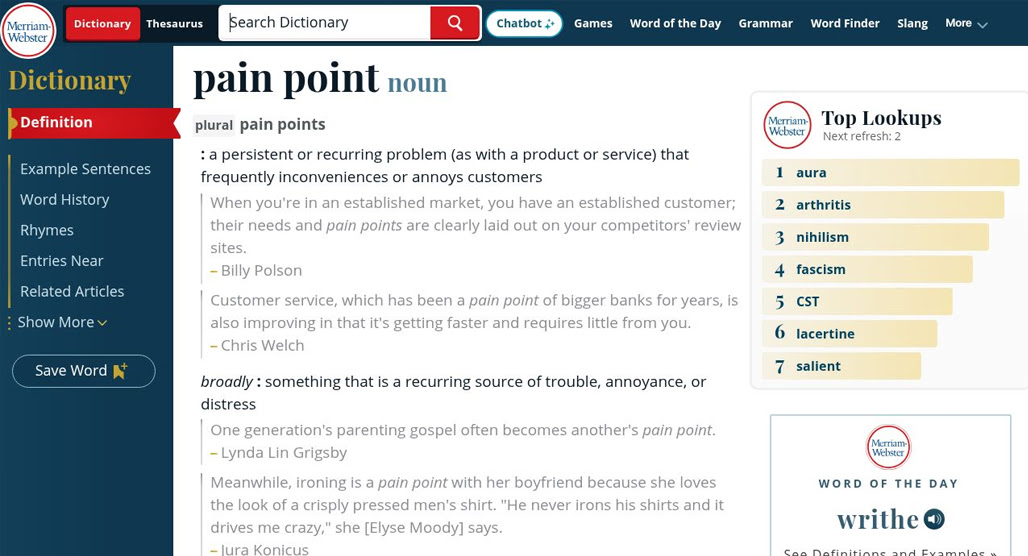
First, what even are pain points?
Pain points are friction. They're roadblocks. They're places where a person runs into a problem they don't know how to navigate or solve.
Usually, you see pain points discussed in the context of product usage and customer service. If you buy a vacuum cleaner and it turns out to be very difficult to open up to change the bag, that's a pain point. You might wonder if you're doing something wrong, or if it's a common problem with that model, or if customer service can help with instructions, or even if you can get a refund.
Pain points can be used to iterate on a product, develop new features or streamline existing features, or develop new products to solve problems. Addressing pain points can smooth out the user experience and reduce the need for customer service.
Pain points go beyond just product R&D and customer service, though. Pain points in life are how new products get made, and how informational books, tutorials, and DIY instructables are all created. Pain points can also be present in other areas, like your basic sales funnel. A user not knowing where on your website to click to go from a blog post to your product page is a pain point.
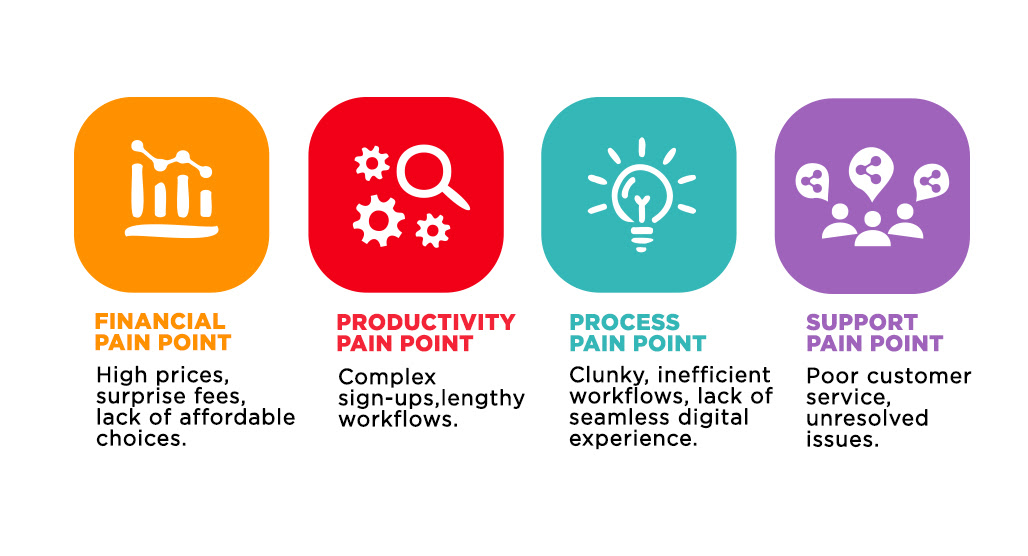
Pain points can come in many forms.
- Process pain points. These are frictions within your business processes. Complicated sign-up forms, unnecessarily tricky fulfillment, prolonged deployment or shipping, and so on.
- Financial pain points. These are sources of monetary friction. Large up-front "setup" fees, locked-in subscriptions and memberships, hidden fees that aren't visible until check-out, and even planned obsolescence
- Support pain points. These are sources of friction within interactions with your customer service. "Live" chats that are just LLMs that can't answer problems, unreliable support, lack of knowledge, inability to break from a script to solve a problem, and even just slow response times all contribute.
- Product pain points. This is friction within your product, from usage to maintenance to reliability.
- Information pain points. These are pain points related to knowledge. Users who experience a pain point in their life just caused by not knowing how to do something might seek out information on the problem itself, how it can be addressed, and so on.
- Emotional pain points. A less tangible form of pain point, sometimes a product works fine and does what it needs to, but it feels bad to use, causes anxiety, or has enough tedious or frustrating elements to it to cause friction.
Obviously, some of these are more suited to changing the way your business functions or your product works than they are to creating content. It's always going to be better to fix a problem with your product than it is to just create a knowledge base article for it and tell people to read that.
How to Identify Pain Points
At the heart of it, a pain point is a complaint. A point of friction that slows down, frustrates, disrupts, or otherwise hinders smooth living. Every time you get hungry, you experience a pain point, which is solved by eating food.
Obviously, you aren't going to get anywhere by trying to explain hunger to someone who has no idea what that funny feeling in their stomach is, but there are a million possible pain points surrounding your industry, your product, and your ecosystem to address.
Identifying pain points happens, broadly, in two ways.
Inside-out: You use your internal perspective to think about what pain points you experience, what you've seen your friends and customers experience, and what you might encounter when trying to solve them yourself.
Outside-in: You use information from users, customers, and people in your industry to identify their pain points directly. User surveys, customer outreach, blog comments; any source of feedback from customers can give you insight into pain points.
Some Common Pain Points
To show you what I mean, let's go through a few of the common kinds of pain points you might run into.
The cost justification. In marketing circles, you tend to have people on two extremes. Some have big budgets and are happy to buy a hundred tools to put together a list that does everything. Others are operating on a budget of $3.50 and some chewing gum and want to growth hack everything. That latter group needs to justify every penny spent; the financial cost is a pain point. You can create a piece of content that justifies why your product is worth the expense.

The unclear functionality. "How do I do X?" Sometimes the solution to this is in technical writing for a user manual, or for a better UI/UX iteration, or documentation elsewhere. Sometimes, though, it's a gateway. People having pain points with your competitors can find your resources explaining how to do the task faster, possibly using your products.
The technical issue. Someone help, my Samsung ultrawide monitor is ghosting on bright images, how do I fix it? These kinds of problems are ripe for troubleshooting guides, ranging from "have you tried turning it off and on again?" to "here's how to replace the control circuit board" to "there's nothing to be done, it's a common issue, hope you had a warranty."
Gathering Pain Point Information
The process of using pain point topics starts with gathering information about pain points. Like I said above, you can do this from the inside out and the outside in.
Inside-out pain points mean looking at your data and your experiences.
Start by just thinking through your processes and the tasks people are likely to want to accomplish in your industry. What kinds of troubles, questions, and problems come up? Are there spots of friction and roadblocks even in your own experience as an expert?
You can also make use of buyer personas here. Buyer personas are usually more for sales than for content, but they can work well in figuring out what different kinds of people are looking for and what kinds of pain points they experience. Like the growth hacking example above, some people have budgetary pain points while others don't, and both have valid perspectives and their own pain points to address.
At this point, adding any pain point you can think of to a document is all you need to do. Yes, some of them might be very rare or niche, or not even really relevant, or solved in other ways. A lot of them might not be relevant for content, either. That's fine; they can still be useful for other purposes, but the filtering is the next step.
Outside-in pain points are those you find from customers and users. You can gather these in a lot of different ways.
- Look at historical support queries.
- Look at documentation pages that are commonly visited.
- Look at blog comments, especially the ones asking questions.
- Look at social networks and feeds like Reddit, where people discuss your industry.
- Look at the queries used to find your site in search results.
You can also be proactive. Go to Reddit or to your email list of customers and send out surveys asking them what they would add, change, or optimize in your product or process. Leave it open-ended for the most varied feedback, even if it's not all going to be useful.
For example, I can go to Reddit r/SEO right now and identify some pain points just by skimming recent topics.
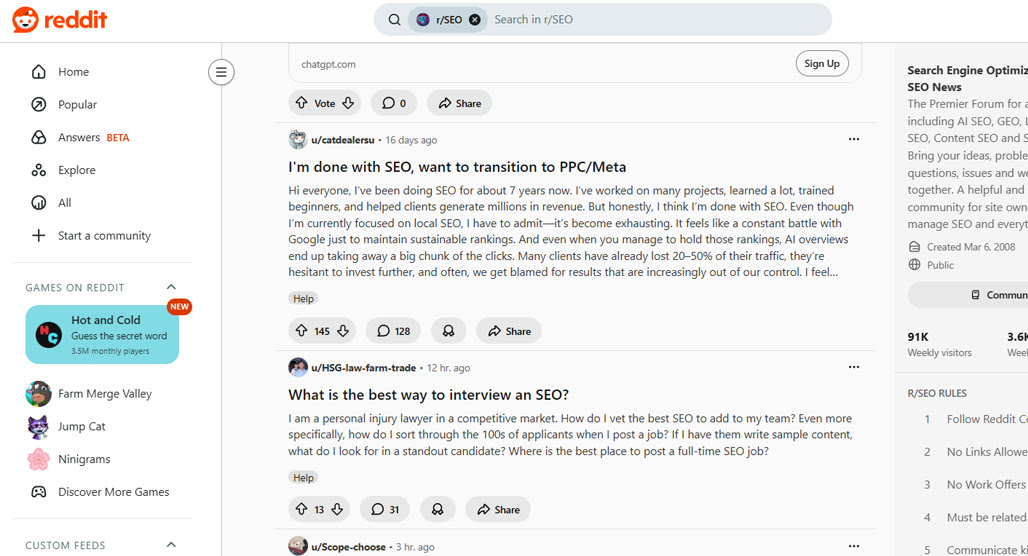
Here are just a few:
- Someone posts that they think third-party tools like Ahrefs are much less useful now. I could use that as a jumping-off point to explaining how to better use the tools, or pointing out new tools that I've found valuable, or discussing why the value has dropped and how to get around it, or all of the above.
- Someone asks how to acquire backlinks. Obviously, that's a pretty broad and well-trodden road, but coming up with novel strategies for backlink building is an evergreen subject.
- Someone asking if listicles are coming back into style with AI optimization since the LLMs are more prone to pulling from structured posts like that. I could cover a post on how to make a good listicle in 2026, how to implement Schema to augment it, and more.
- Someone having a technical issue with breadcrumbs; I could dig into the subject and find the answer, write a guide on it, and help anyone with similar issues.
That's just from the top half-dozen or so posts as I'm writing this.
Are all of those good ideas for me to cover? Maybe. I'd have to do more research and validation. But the point is, they're all readily available pain points I could address.
One note I want to make here is about AI. I highly recommend not using LLMs to generate pain point lists for you. Hallucinations can look a lot like valid pain points, and you can waste a lot of time, potentially even up to creating content, before you realize it's not really something real people care about. That holds doubly true if you're building a pain point list that you might use to optimize your product later.
Filtering Pain Point Topics
The next step is to filter the pain point data you gather. Like I said, a lot of what you come up with might not be relevant for content.
What disqualifies a pain point from being relevant as a topic for your content?
- The pain point is focused on something that needs a technical solution. If users are struggling with authentication servers timing out, writing a blog post isn't going to solve it; you need to get your authentication in order.
- The pain point is something you can't solve. This doesn't entirely disqualify a pain point from being a good topic, but if it's a topic where the only valid solution is your competition, maybe don't cover it. On the other hand, if it's something like shipping delays caused by UPS, not a lot you can do about that.
You might also have pain points you've already covered. If that's the case, your task might not be to write new content for the topic, but to improve existing content or make it more readily visible.
Essentially, you just have to go through each pain point and think about whether or not writing a piece of content for it would be helpful to the people who experience that pain point. Your content can lead into a sales pitch for your product, or DIY instructions, or just a discussion of the topic and why it's not easily solved; all of those are valid content ideas worth considering before you write.
Creating Pain Point Content
The third step is just to create your content.
I say "just" but, as we all know, creating content isn't all that easy.
- Identify the kinds of keywords people who experience the pain point are using to search for solutions.
- Look into existing content that ranks for those keywords to see what bar you need to overcome.
- Check if you have any existing content that addresses the same or a similar pain point, that could be expanded or revamped to target it more effectively.
It's also important to think about search intent in the people looking for this pain point. Basically, if someone wants DIY options to solve a problem, they aren't going to be happy when your solution is to buy your product, even if they expect it. Someone looking for a product to quickly and efficiently solve a problem won't want the tedious step-by-step instructions, either.

The good news is that if a single pain point has multiple viable search intent interpretations, that means you can create multiple pieces of content targeting each of them. You might even be able to build a whole content cluster out of it.
Once you have content created and published, all you need to do is promote it in the right places. Take it to the Reddit threads, the support servers, or just send it out to your newsletter. Once the word is out and you start to rank, you've addressed the pain point and can work on more.

Related Posts



Leave a Comment


Fine-tuned for competitive creators
Topicfinder is designed by a content marketing agency that writes hundreds of longform articles every month and competes at the highest level. It’s tailor-built for competitive content teams, marketers, and businesses.
Get Started