Is It Bad to Use AI to Write Your Meta Titles / Descriptions?
 Written by James Parsons • Updated April 15, 2026

AI has been disrupting approximately everything about the world over the last few years. Some of it is good, some of it is unquestionably bad, and a lot of it sits somewhere in the middle.
It doesn't help that "AI" is a loaded phrase that describes at least three separate things: the LLMs that generate text, the character-driven chatbot AIs, and the machine learning and data processing AIs that share nearly nothing in common but have a lot more beneficial applications in things like medicine. And that's before getting into the graphical AIs, predictive AIs, and other things less applicable to today's discussion.
I'm going to bypass somewhere around 90% of this whole discussion and drill down into one specific thing today: using text-generation LLMs to complete specific, narrow tasks. In this case, I'm talking about the meta information for a website.
Is it a bad thing to use an LLM like GPT, Gemini, or Claude to write the meta titles and meta descriptions for your website?
I'm going to look at this problem from a bunch of different angles. I'll tell you right away, though, I don't have a firm yes or no answer for you. Partly because there's no firm answer from Google (and it's their search influence that matters most here), and partly because it depends on what you care most about.
So, let's dig in and see what's most important to consider.
Key Takeaways
- Google rewrites 60-75% of meta descriptions and 61% of meta titles, making AI-written metadata potentially irrelevant.
- A Seer Interactive study found AI-written meta descriptions decreased CTR by 21.5%, while human-written ones increased it by 16.25%.
- The main benefit of AI for metadata is speed, but lengthy prompts required for quality output can eliminate time savings.
- AI hallucinations are mathematically inevitable per OpenAI, making human review of all AI-generated metadata essential.
- The article concludes against using AI for metadata, citing poor performance, potential algorithm penalties, and nearing obsolescence of meta descriptions.
Table of Contents
The Comparative Importance of Titles Versus Descriptions
The first thing I need to mention is that, while meta titles and meta descriptions are lumped together as "page meta information" and often discussed at the same time, they are two very different things, with very different levels of importance.
Both meta titles and meta descriptions are metadata you specify on your site, and they both exist to be read off-site rather than on-site. On-site, you don't need or have space for a meta description, and you have your H1 title rather than a meta title. Off-site, the title and description show up in the search results.
For a long time, these were considered very important SEO signals, as they were the way you could entice people to click on your site in the list of search results.
But that was all really just a tacit agreement with Google. After all, Google isn't required to show what you give them, right? Google owns Google.com; they can do what they want with it.
A few years ago, I did a study on meta descriptions and found that a huge percentage of the meta descriptions you see on Google's search results are not what the page specified. Other studies done by Ahrefs and Portent found the same thing. Somewhere between 60% and 75% of meta descriptions you see in search are not what the site owner specified.
The conclusion: meta descriptions are generally worthless at this point. Google's language processing is a lot better, and they do a lot more tailoring of the search results to the person and the query, to provide what they think is most enticing to any given user.
What about titles? Titles are unquestionably more important than descriptions for SEO, so surely they're safer, right?
Well, maybe not as safe as we used to think.
A recent study by Zyppy found surprisingly similar rates of rewriting for titles, at 61%. Now, this number isn't quite as important as it seems; a lot of those rewrites were minor, things like removing - or | symbols, shortening titles that run too long, or removing redundant use of the same keyword. They might also add your brand name or information to your title, especially if the default page title is too short.

The biggest takeaway, though, is that Google much, much more rarely rewrote titles when the meta title and the H1 title matched.
All of this is to say that it seems like, in 2025, meta titles and meta descriptions are both leaning towards the "do we even need these anymore?" side of the scale, and might go the way of the meta keywords field in the next few years.
Which is to say that using AI to write them might not be very impactful either way, because, let's be real here, Google is probably using its AI to rewrite them anyway.
Nevertheless, as long as Google still allows the data you add in the meta field to be displayed as-is, which is still 30-40% of the time, it's worth asking how to do it better.
Does AI Affect the Results?
The second question, then, is whether or not using AI to generate meta titles and meta descriptions is impactful at all. If you take a large sample, and you evaluate metrics like the click-through rate for posts, and test titles and descriptions written by humans or with AI (or even left blank for Google to fill in), do the AI-written pages perform better or worse, or the same?
Seer Interactive did a study exactly like this for meta descriptions. They tested human-written meta descriptions, AI-written meta descriptions, and blank Google-customized meta descriptions.
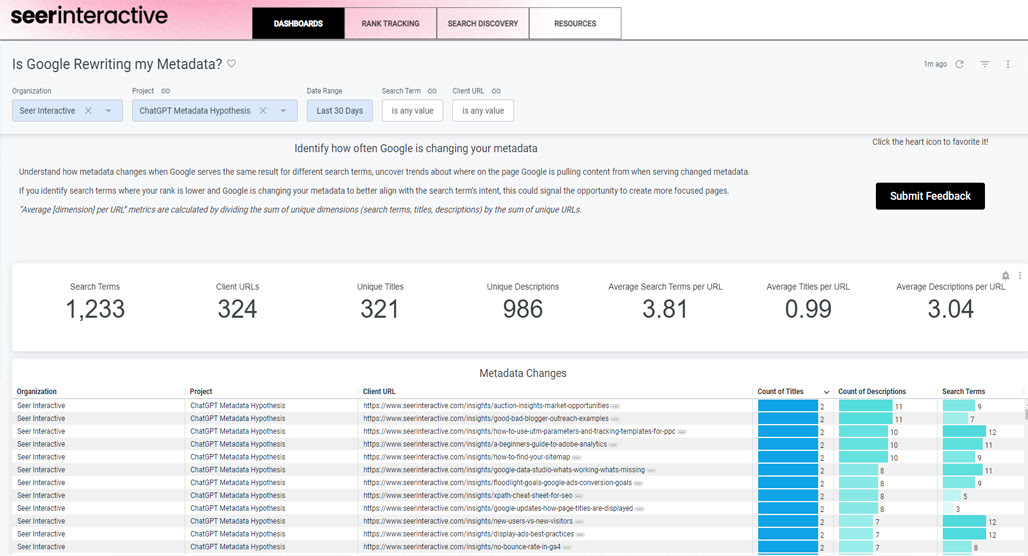
Their findings:
- Letting Google write the meta descriptions increased CTR by 10.5%.
- Having a human write the meta descriptions increased CTR by 16.25%.
- Having ChatGPT-4 write the meta descriptions decreased CTR by 21.5%.
That's a pretty stark difference, especially for a piece of data we already know Google is happy to just change as they see fit. They did look to see how often each group's meta descriptions were rewritten, and found that manual descriptions were rewritten more often, but also that the GPT-written and Google-written descriptions changed roughly the same number of times, and it was a relatively small difference.
The Benefits of Using AI to Write Metadata
Now, let's look at the benefits you can get from using AI/LLM systems to write your meta descriptions and meta titles for you.
The Benefit of Efficiency
The biggest benefit to using AI to write metadata for you is that it's fast. When you're writing and formatting a blog post or product page for publication, you need to fill out the metadata fields, and that takes some time spent thinking about what's most important on the page, what's most relevant to the user who finds the page, and what data and keywords you need to highlight. Then you write it, you read it, you re-read it, you rewrite it, you edit it, and finally you publish it.
For a few dozen words, that's not a lot of time, but it is some time. The AI, meanwhile, can generate not just the titles and descriptions for a page in a couple of seconds; it can generate multiple variations.

Even then, if you don't take what the AI does out of hand, you can use its generated content to give you ideas. It speeds up the process, often dramatically.
And that's before you get into the plugins that just do it automatically. I always recommend caution with unsupervised AI usage, since you never know if it's going to put something wildly out of pocket in those fields, but I'll talk more about that later.
So, what other benefits are there?
(Pretend I have an audio file of cricket noises embedded here.) 🙂
A lot of AI marketing companies will tell you it will benefit you for click-through rates, but the studies I've seen say the opposite. Some will tell you it's a benefit to use big data to make decisions, but you don't really want big data here; you want something tailored to the specific post you wrote or product you're selling. Those benefits can be relevant for other kinds of content generation, but less so for the metadata.
The Risks of Using AI to Write Metadata
Now let's talk about the risks you have to contend with when you use an AI system to write your meta titles and meta descriptions.
The Risk of Generic Content
One of the biggest risks when using AI to write something for you is that the product it creates will be generic. LLMs are trained on massive amounts of existing writing, and they function by producing something that is statistically likely to take the same shape, linguistically, as what already exists to satisfy the prompt.
There are multiple lawsuits ongoing about how AIs produce works so derivative that they can even trip Copyscape; it's so close to the originals.
Generic content can be very basic or just not tailored to your specific content or your specific audience, both of which can make the descriptions and titles less effective. You can usually get the AI to be more specific and tailored, but you have to have a lengthy and detailed prompt to do it.

I can safely say that if you're spending 10 minutes writing a prompt to save yourself 5 minutes on writing the metadata, you aren't coming out ahead.
There are two ways around this problem. The first is that, once you have a prompt down, you only need to do a little bit of customization for that prompt each time; you aren't rewriting it from scratch. The second is using add-ons like LinkReader to view your content and write based on the post, rather than just based on the existing training data.
You do still need to manually review what the AI generates for you, and tweak it to fit your needs. I find that you almost never can use AI output as-is, pretty much no matter what you're using it for. If you want tips on SEO-friendly ways to add ChatGPT to WordPress, there are options worth exploring.
The Risk of Inaccuracy and Hallucination
AI hallucinations are a boogeyman that will never go away. Even OpenAI said themselves that hallucinations are a mathematical inevitability, not a problem that can be solved. It's simply a result of how LLMs work.

Above, I said that LLMs generate something "statistically likely to take the same shape, linguistically, as what already exists" to satisfy a prompt. It has words in an order, with the right arrangement of nouns and adverbs and participles, with mathematical relations between words that convey the right kind of overall semantic meaning.
But LLMs don't know what words mean, what facts are, or what concepts are. They don't "know" anything, because that's not how they work. It can lie to you as easily as tell the truth because the concepts of truth and lies don't exist, foundationally.
This is, again, why you need human oversight on AI generation. Maybe 90% of the time, or 95% of the time, or 99% of the time, it's perfectly fine and accurate. But that remaining bit of time can be a problem, and it will never go away under our current model of AI. This is especially worth keeping in mind when you validate content topics before you write - relying solely on AI for that process carries similar risks.
Other Considerations Using AI to Write Metadata
There are a couple of other considerations I want to bring up that can affect whether or not you, personally, think that using AI to write your metadata is good or bad.
The Ethical Considerations
The ethics surrounding AI are still an open question. Most people zero in on the costs, in terms of rights violations used to train the models, and the water and power consumption used to create and run them, and the human cost in terms of people put out of work by the tech. There are both sides to the conversation, there's no legal precedent yet, and there's not going to be a clear answer for many years.

The way I see it, if you're the kind of person who is opposed to AI on ethical grounds, you're going to think it's bad to use AI to write your metadata. If you don't care about or don't mind the ethical concerns, then you have to make the decision based on other factors.
The Cost Considerations
A more tangible concern is the cost.
Writing meta descriptions and meta titles yourself has a cost, but that cost is measured in minutes of your time.
Using AI to write it becomes a cost in terms of money. Different AI systems have different monetary costs and different restrictions, but I find that you're usually looking at a bare minimum of $20 per month for just the ability to look at your existing content to make more appropriate output.
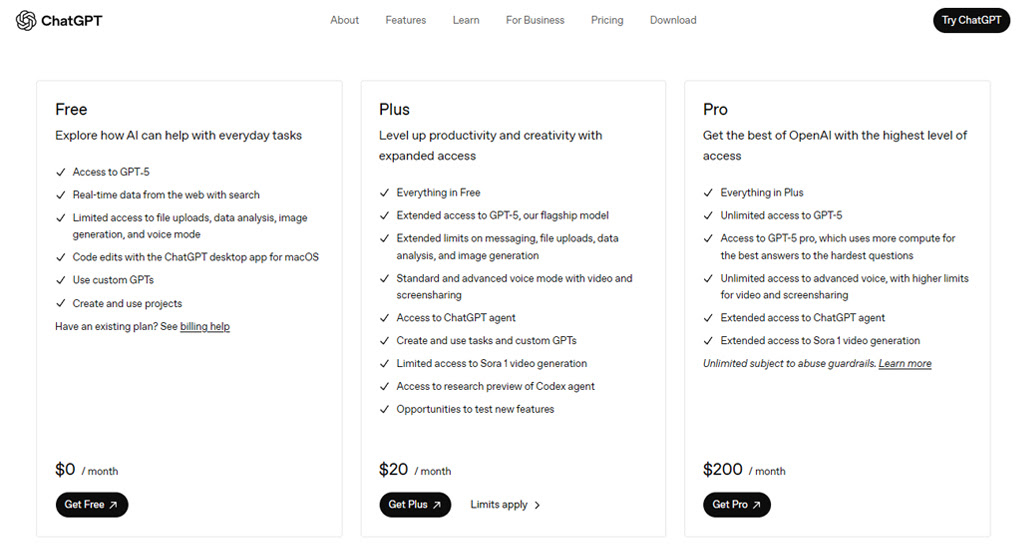
Would you pay a $20 monthly subscription fee for something that is ignored up to 70% of the time? I know a lot of marketers won't pay $20 a month for some of the most effective tools out there, let alone content generation.
This varies a lot based on your budget, the volume you need to generate, which AIs you use, and more. That's why "the risk of losing money" isn't in the above section, but I put it down here as a variable consideration.
Is it Bad to Use AI for Metadata?
Like I said above, there's not really a firm yes or no answer here.
I will say, though, that it seems like the answer is leaning towards no.
Why?
- A handful of studies from reputable marketing firms have shown the AI-generated meta content to perform worse than human-created content, or even Google-created content.
- The time savings aren't necessarily very impactful, especially if you're experienced and practiced at writing your own.
- There's always the possibility of a big AI-focused Panda-like algorithm update that punishes sites for using it uncritically.
On top of that, it really seems like meta descriptions are on the cusp of being entirely obsolete, and the best meta titles match your H1s, and you probably shouldn't be using AI to write something as absolutely critical as your H1s. So, in my view, skip the AI for this one; it's just not worth it. If you want to make sure your titles are working hard for you, it helps to know where to put your SEO keywords and how to measure the pixel limit on page titles and descriptions.

Related Posts
Leave a Comment


Fine-tuned for competitive creators
Topicfinder is designed by a content marketing agency that writes hundreds of longform articles every month and competes at the highest level. It’s tailor-built for competitive content teams, marketers, and businesses.
Get Started