How to Correctly Use the Ahrefs Content Gap Analysis Tool
 Written by James Parsons • Updated April 15, 2026

Content marketing is a huge world with thousands of people competing for just about every space. It can be very difficult to stand out from the pack without some kind of keen insight or advantage, but everyone is always searching for those insights and advantages. How do you compete without spending a million dollars?
One option is spying. You might have a small marketing team, but that doesn't mean you can't leverage the efforts of others in the field. After all, your competition also has its own marketing teams, and if they're out-ranking you or competing directly with you, it means they're at least on par with your own team.
So, copy their homework.
This is the driving motivation behind competitive analysis. When you watch what your competition is doing, you can do what they're doing, but spend the extra time and effort to do it better. That way, you can stand on their shoulders to reach even greater heights.
And, really, they're probably doing the same to you, so turnabout is definitely fair play.
Obviously, you can't just steal their content or copy their site wholesale. That's at minimum unethical and likely illegal. What you can do, though, is look for the origins and sources they use, and engineer the same results (but better) from base principles.
In other words, steal their keyword research and create content that's better than theirs.
The first step to this process is performing a content gap analysis. This used to be a process you had to tediously do by hand using spreadsheets and scrapers, but modern tools have made it easy. Ahrefs has one of the best, so I wanted to run down how to use it here today.
Key Takeaways
- Content gap analysis identifies keywords competitors rank for that you don't, revealing proven topic opportunities to target.
- Ahrefs Content Gap tool automates competitor keyword comparison, providing search volume, difficulty, CPC, and traffic estimates per keyword.
- The tool is available on all Ahrefs paid plans, starting at just $29 per month.
- Filtering results by main positions, brand exclusions, volume, and difficulty helps reduce overwhelming keyword lists to actionable opportunities.
- After identifying gap keywords, create content that matches but outperforms competitor pages already ranking for those terms.
Table of Contents
What is a Content Gap Analysis?
Imagine I gave you a list of ten fruits and had you write blog posts about each of them. Then, I pointed you to a website that had ten blog posts, each one about a different fruit.
You go through that website. There, they have blog posts that are a lot like the ones you have. A post about bananas, a post about grapes, a post about oranges, all covered in depth on both of your sites.
Then you notice something. You wrote a post about limes, but they didn't. Instead, they have a post about raspberries. You have a post about blueberries, and they don't, but they have a post about watermelons, and you don't.
With me so far?
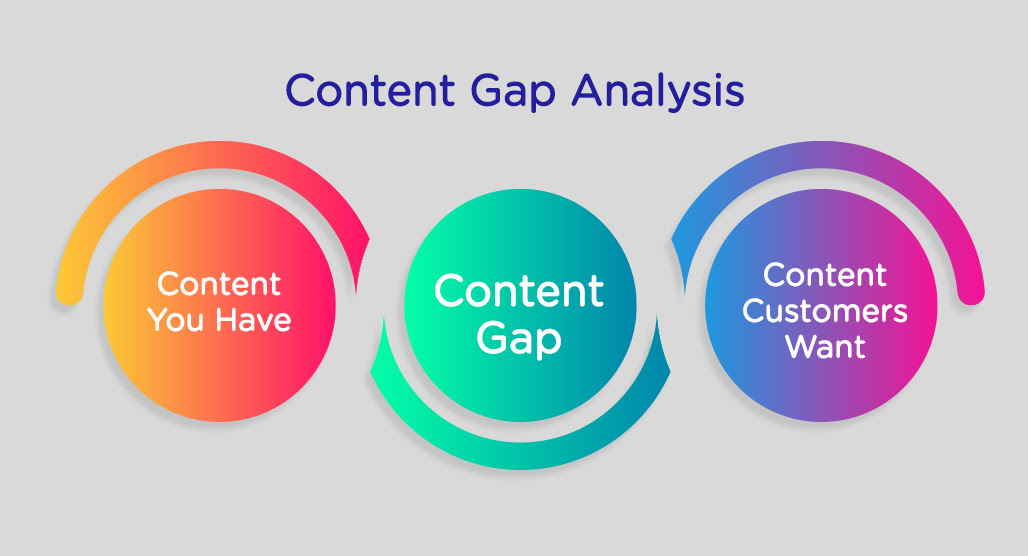
What is a content gap?
A content gap is a gap in coverage between you and at least one competitor.
In the fruits example, technically speaking, the content gap encompasses both what you cover and what they don't, and what they cover that you don't. Since you aren't focused on what you cover already, though, you can ignore that half.
So, your analysis shows that out of 10 posts, 8 of them are on the same topics. You have two unique topics that they didn't cover, which is good. They have two that you don't cover, so you write those down. Raspberries and watermelons: two topic ideas you know are relevant, and you know can rank, because your competitor is ranking for them.
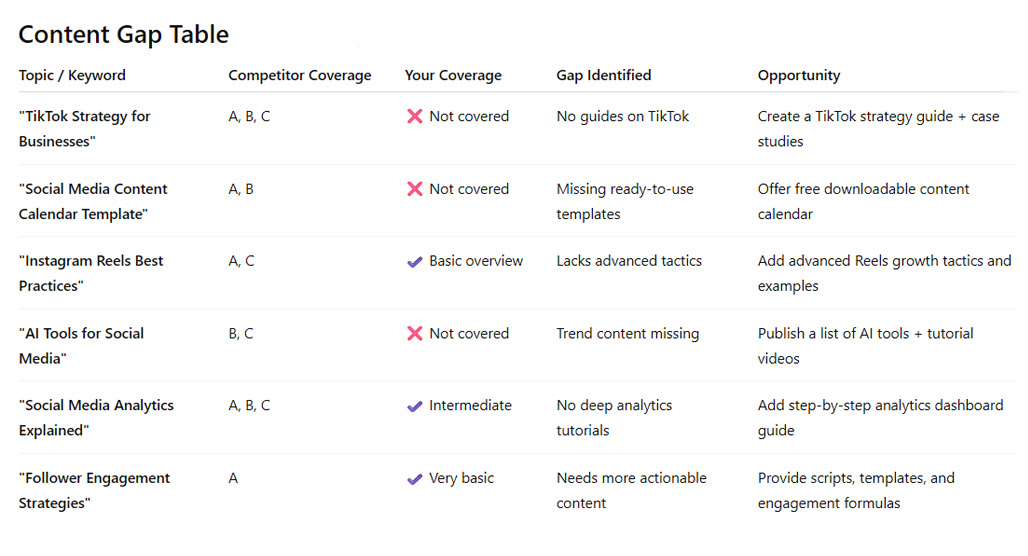
A content gap and a keyword gap are similar, but slightly different. That's because one blog post generally has one overall topic, but might have dozens or hundreds of keywords it can rank for. That one blog post about watermelons is one topic (watermelons), but could have tons of keywords, from "how to pick a ripe watermelon" to "how to eat a watermelon the right way" to "best watermelon recipes", depending on the kind of content the competitor wrote.
How to analyze content for content gaps.
Tediously.
The general process is simple in concept, but tedious and time-consuming in execution.
You need a keyword analysis tool or a topic analysis tool, depending on how you want to go about your analysis. Most content gap analysis tools make use of keywords instead of generalized topics, so they're kind of the same thing. If you're wondering about the difference between SEO topics and keywords, it's worth understanding before diving in.
So, you turn a keyword scraper loose on your site and build a list of all of the keywords you rank for. After all, you can't perform a gap analysis with only one data point.
Then, you do the same thing to your competitor and build a list of all the keywords they rank for.
Then you sort and compare the lists. You'll end up with keywords in four categories.
- Keywords you both rank for. These keywords can be set aside and either ignored or used as a way to benchmark; if you outperform them, they're good, and if they outperform you, you can schedule that content for improvement.
- Keywords you rank for, but they don't. These are great, but you need to keep an eye on them and play defense. If a competitor targets them (and they probably will if they're doing the same analysis), these are the places they'll aim to hit.
- Keywords they rank for, but you don't. These are your opportunities. They prove that the topic is relevant to the industry and that content can rank for them, so if you can outdo their content, you can steal their place.
- Keywords they rank for, but you can't. This is similar to the third category, but it includes things like brand-name or product-name keywords that you aren't reasonably going to want to target or try to out-rank the competitor on. You're never going to out-rank them for their own brand name, after all.
Everything in this spreadsheet can be used for different purposes, but the one most important for a content gap analysis is the third category. These are the keywords you can then validate as viable topics and produce content to target.
What is the Ahrefs Content Gap Analysis Tool?
It's a tool, backed by the huge amount of data Ahrefs possesses, that does the process I outlined above for you. Well, more or less.
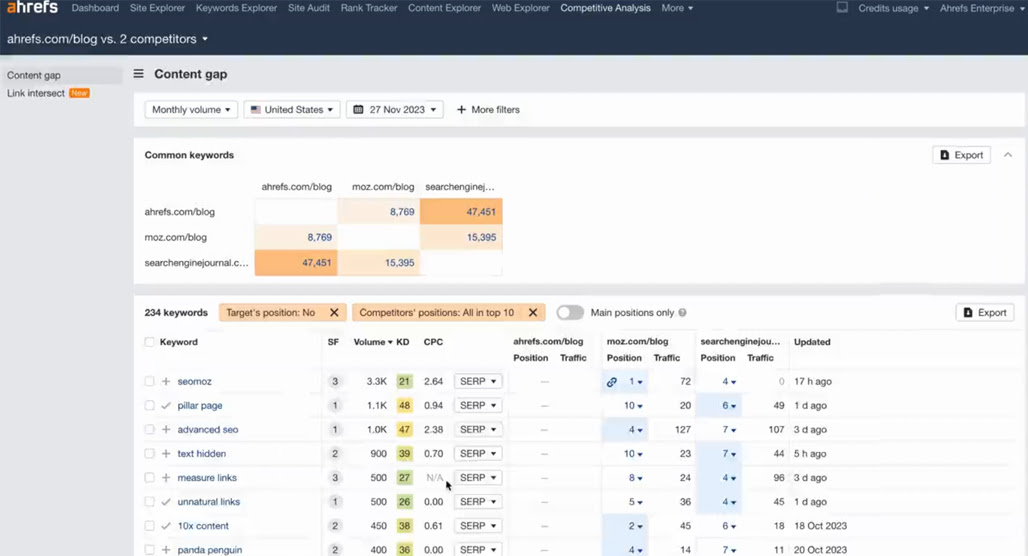
The Ahrefs tool is pretty powerful for a handful of reasons.
- Ahrefs is second only to Google in terms of how much web data they harvest and analyze, and their analytics are second to none because of it. It will be some of the most accurate data available without being able to access competitor Google dashboards.
- It can give you a bunch of additional data about keywords, rather than just a keyword list; that's data you would normally need to use a different tool to analyze from a keyword list you generated from a research tool.
- It can do multiple competitors at once. Instead of targeting one competitor at a time and working on a gap list, then repeating the process with another competitor, it can be done for several competitors all at once.
- There are many different kinds of filters you can use for the data you get. You can, for example, prioritize keywords that multiple competitors are ranking for, keywords where "ranking" means at least the top 10, rather than a broader definition, and more.
Ahrefs also allows you to analyze keywords and competing content, not just domains, which can help you identify second-tier keywords you can include in existing content to make it more broadly available. That's something you would normally need a tool like MarketMuse or Clearscope for.
What does the Ahrefs Content Gap Analysis Tool cost to use?
Big data and powerful features surely come at a cost, right?
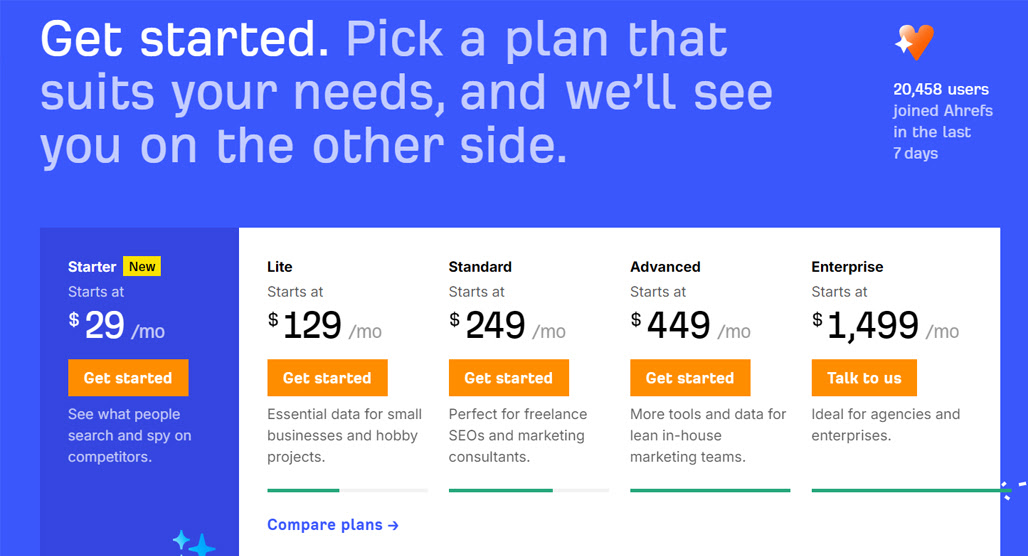
Nothing in life is free, yeah, but that doesn't mean you're paying out the nose for it. The content gap analysis tool from Ahrefs is available in all of their paid plans. Bad news for the people using the free webmaster tools version, but any paid version includes the feature. That means you can get it at the cheapest starter plan, which is just $29 per month.
What information does the Ahrefs Content Gap Analysis Tool give you?
A lot.
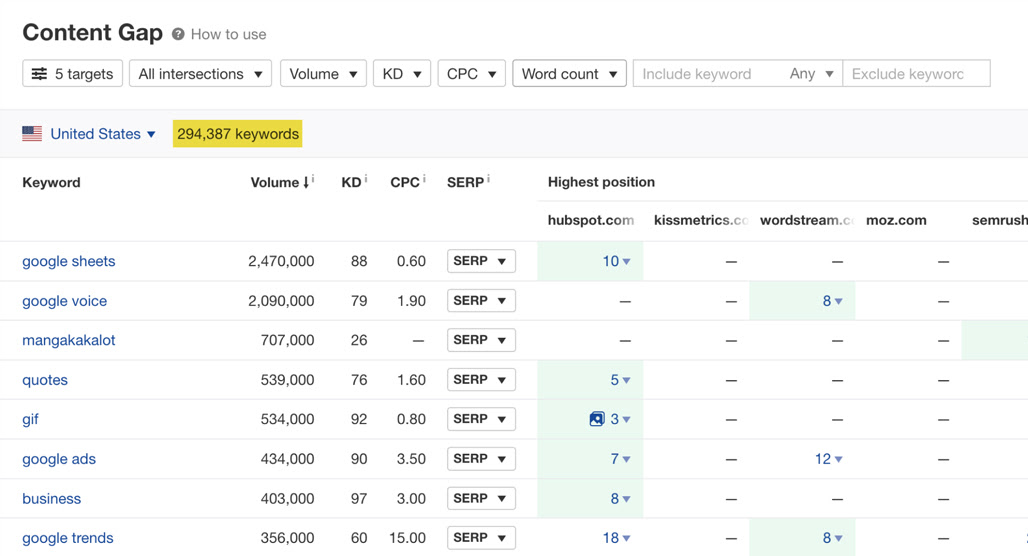
First, you get a nice chart showing the raw number of keywords per competitor that aren't overlapping with yours. It will probably be a pretty excessive number (seeing hundreds of thousands of keywords is intimidating), but that's what the filters are for.
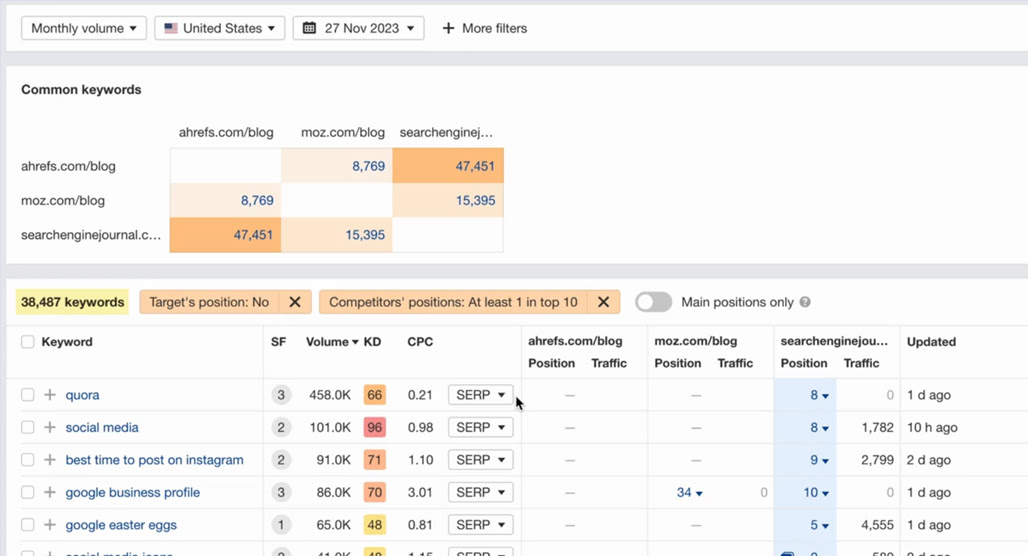
Under the keywords list, you get a bunch of useful metrics for each keyword.
- The keyword itself
- The search volume for the keyword
- The estimated keyword difficulty
- The estimated cost per click for the keyword, if relevant
- The highest SERPs position for each competitor for the keyword
- Estimated traffic for the keyword
- How long ago data for the keyword was updated in the Ahrefs index
All of this will give you an idea of whether or not the keyword is something you can effectively target.
Are there alternatives to Ahrefs for content gap analysis tools?
Certainly.
Semrush includes a content gap analysis of up to five competitors at once, along with its other features, in much the same way Ahrefs does. Similarweb has a keyword gap and overlap analyzing tool. Ranking Gap is a stand-alone tool, and SEO PowerSuite has one as well.
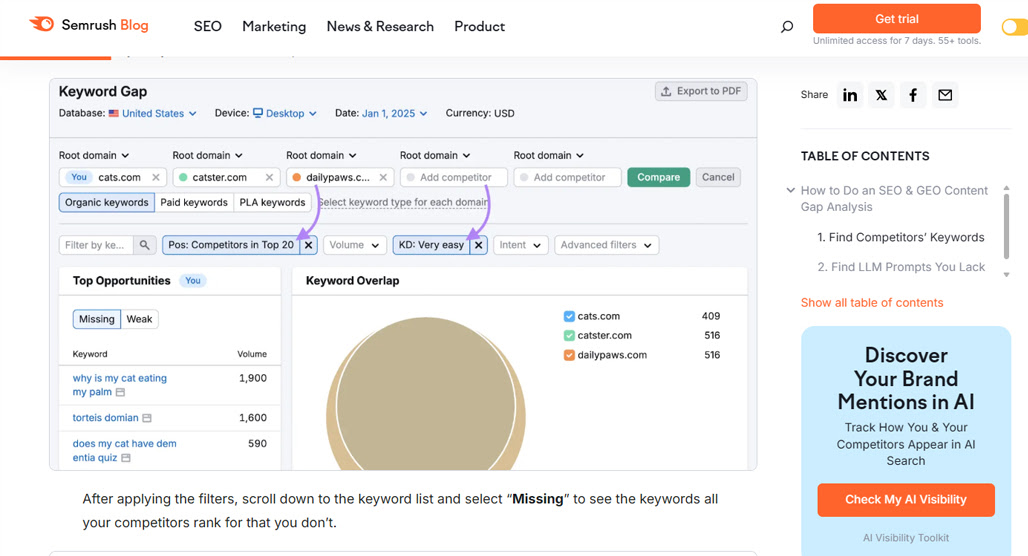
You are certainly free to give any of these a try, and if you like the results, go ahead and use them. In fact, let me know if that's the case.
For me, I prefer Ahrefs for two main reasons. The first is that Ahrefs has, as mentioned, the biggest of the big data indexes short of Google. Any of the other tools will have less data, which means less information and less keywords, and even less accuracy. The only people who could outdo Ahrefs are Google, and Google isn't sharing.
The other reason is that I already have and use Ahrefs for a lot of other features, so it's a tool I already have access to. If I were starting from scratch, I'd still probably consider Ahrefs since the price for the starter plan is so good, but you could also cobble together some utility from other tools through cheap and free plans.
How to Use the Ahrefs Content Gap Analysis Tool Properly
So, how do you actually make use of the Ahrefs Content Gap Analysis tool? You might notice that this actual guide, despite being the ostensible focus of the article, is a relatively short section at the end. That's because it's really easy to use, and all of the hard work is stuff you have to do with the information you learn.
Step 1: Identify your top competitors.
You need competitors to run a gap analysis, so knowing who your top competitors are is critical.
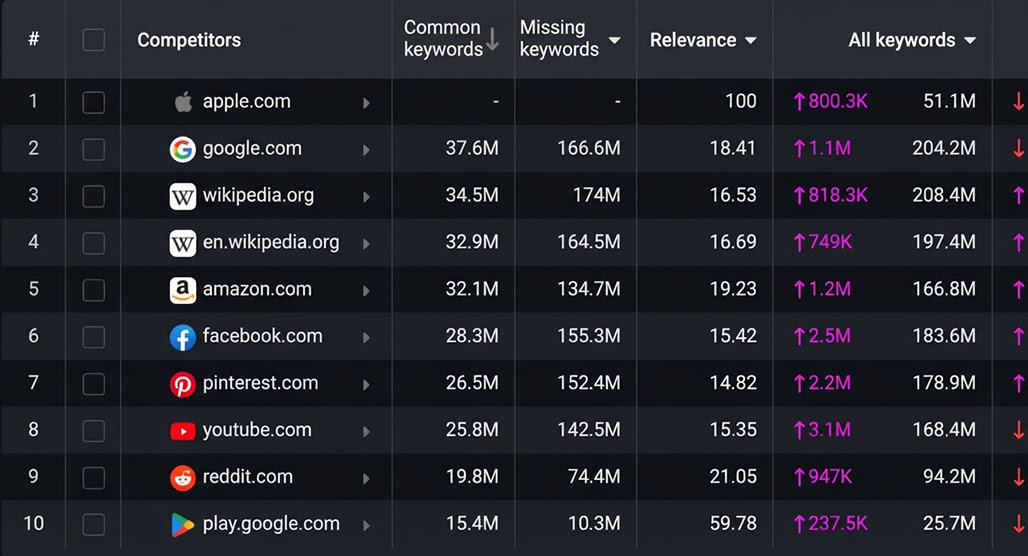
The key here is that you want competitors relatively close to you. Don't target the industry giants here; you're going to get a list of a million keywords, 900k of which are irrelevant to you. You want to find keywords you can compete for, not a list of keywords that you might one day be able to think about looking in the direction of ranking for.
Step 2: Run the Gap Analysis Tool and gather results.
Actually using the Gap Analysis Tool is super easy.
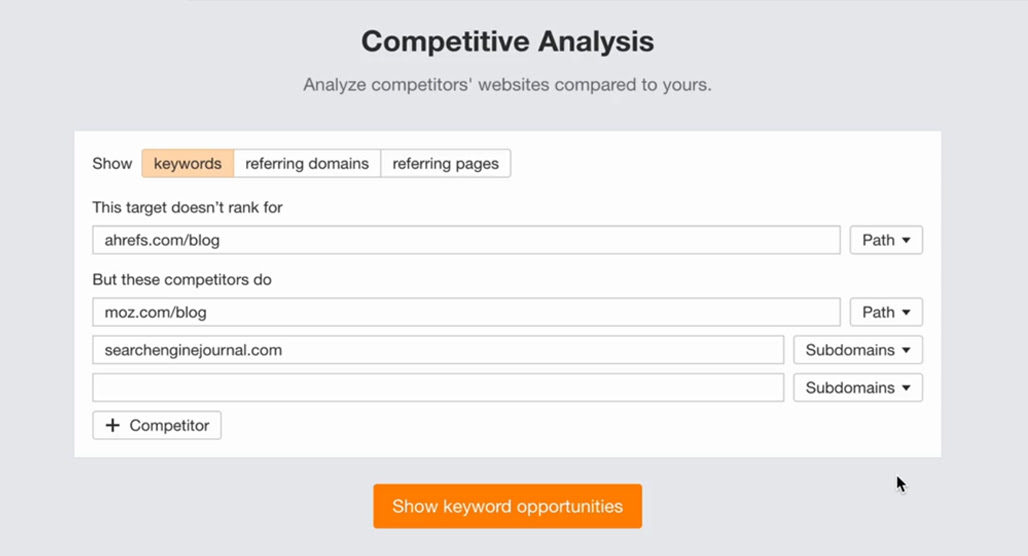
Here's what you need to do:
- Go to the competitive analysis section of Ahrefs and click on keywords.
- Under "this target doesn't rank for", put in your own domain name.
- Under "but these competitors do", add your competitors. I recommend sticking to 1-3 at a time for the easiest results, but it's up to you if you want more.
- Click "show opportunities" to get the report.
You'll be given a nice, big list of keywords and all the information I mentioned above about each of them.
Step 3: Filter the resulting keywords list.
At this point, you might have anywhere from a few thousand to a few hundred thousand keywords in the list. Most of those aren't going to be helpful, so let's refine it.
Click "main positions only". This will restrict to just keywords with organic search results, and will leave out featured snippets, AI results, image packs, sitelinks, and all the other rich results that aren't as useful for our current purposes.
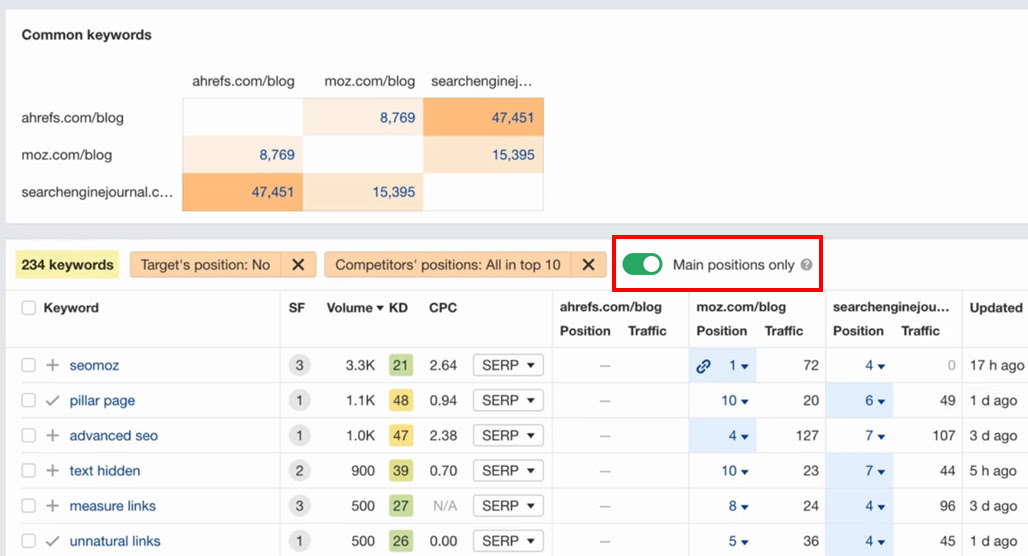
Under filters, add a rule that excludes competitor domain names or brand names from the results. That way, you get rid of the competitor's own keywords you won't be able to compete for.
Consider adding more filters for topics you don't want to cover on your site. You can do this incrementally; if you find keywords popping up that aren't useful as you scroll through, add a new filter to remove them.
Filter out the lowest volume keywords. While there are good ways to use zero-volume keywords, they're not the main focus of your current research.
Filter out keywords with the highest difficulty. It's up to you to determine what level of difficulty is too much for your site to handle. If you're unsure where to draw the line, it helps to understand why writing about topics that are too hard to rank can hurt your strategy.
Your goal is, generally, to get the keyword list down to something of a reasonable size. For some people, that's anything under 100,000 keywords. For others, it might be the top 5,000. It's really up to you how filtered you want the list to be.
Step 4: Evaluate the keywords you're left with.
At this point, you have a choice. How do you want to analyze the keywords list?
You can keep it in the Ahrefs dashboard and just go through it and pick keywords to work on; that's fine.
You can also export the data as a CSV and import it into your spreadsheets, or into other keyword analysis tools, or other marketing tools you use.
Ahrefs even provides a Google Sheet template you can paste the data into, which will format the most useful metrics for you right there.
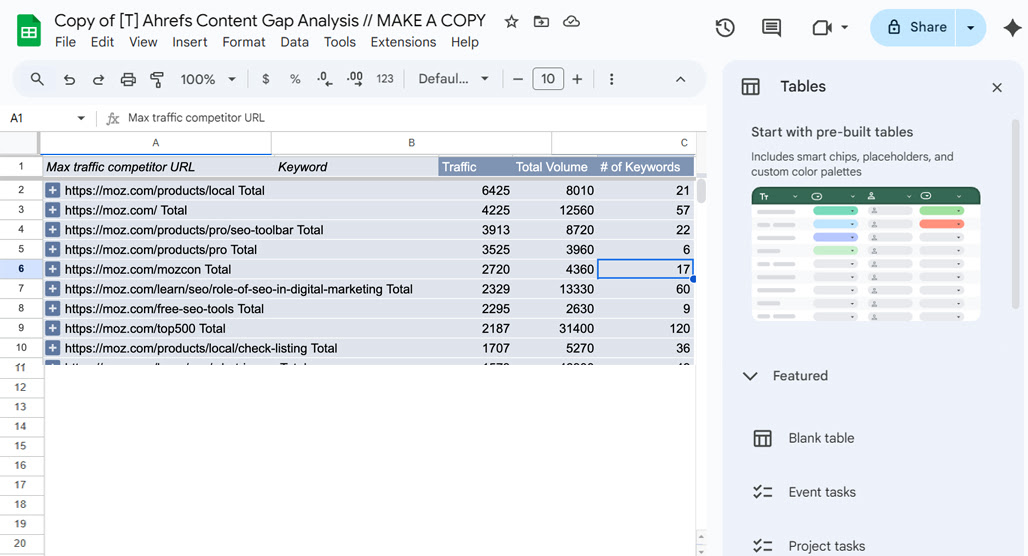
The template there is very useful, because it will nest individual URLs with the keywords they rank for, and you can explore why a page ranks for those keywords. You can often find pages that look like opportunities, only to realize the keywords aren't anything relevant to your business, so it wouldn't really be useful to replicate the work.
Your goal here is to take all of this fantastic data and narrow it down into an actionable list of topics you can cover on your site, with keywords you haven't ranked for before.
Step 5: Produce competitive content for those keywords.
Now, do the work. You have topics and keywords, you have competitor pages showing you the minimum quality level necessary to rank, all you have to do is do what they did, but better.
That's it! That's all you need to know to make use of the Ahrefs keyword/content gap analysis tool. I think it's fantastic, so let me know if you've made good use of it, or if you would suggest any other tips to make it more effective. If you ever find yourself running out of content ideas after exhausting this process, there are plenty of other methods worth exploring.

Related Posts

Leave a Comment


Fine-tuned for competitive creators
Topicfinder is designed by a content marketing agency that writes hundreds of longform articles every month and competes at the highest level. It’s tailor-built for competitive content teams, marketers, and businesses.
Get Started