What's The Difference Between SEO Topics and Keywords?
 Written by James Parsons • Updated April 15, 2026


A lot of marketers will use terms like topics and keywords in the same context, and often refer to them in similar ways. So much so that you would be forgiven for thinking that they're the same thing. The truth has more nuance to it, as it always does, and it's worth digging into and knowing.
Before I get started, I want to talk a little about perspectives. I'm going to go over one particular way of understanding topics and keywords, but it's by no means the only way to understand these two terms. I find it the most useful for developing a content plan, content clusters, and general content marketing. Beyond this use, though, you can find other ways of dividing the two that can be useful in their own ways.
All of that is to say, if your understanding differs from mine, I'm not necessarily saying you're wrong. Your perspective might be just as valid (and you can certainly share it in the comments so we can discuss it), but by that same token, it might be useful to consider things my way instead.
It's all about what you find most helpful.
Key Takeaways
- Keywords are specific search terms users type, while topics are broader subject areas encompassing many related keywords and semantic variations.
- Google's semantic indexing and NLP advancements allow search engines to rank pages based on topics, not just exact keyword matches.
- LLMs and modern search engines are fundamentally topic-based, analyzing word relationships rather than matching specific keyword strings.
- Keyword stuffing is counterproductive today; search engines recognize topic relevance across many keyword variations without needing each explicitly.
- Keywords remain useful for understanding audience intent and as differentiators for narrow searches, but broad topic coverage is now the priority.
The Traditional View of Keywords
Keywords are pretty obvious, and they're something you're probably familiar with unless you've only gotten into marketing in the last few years.
A keyword is, put simply, the thing a user types into a search engine.
If you want to find where you can buy running shoes in your area, you can type "running shoes near me"; that's your keyword.

Keywords can be just about anything. A single word, a brand name, a product model number, a question.
- "Shoes" is a keyword.
- "Nike" is a keyword.
- "IH4363-100" is a keyword.
- "Where can I buy Nike Air Jordans?" is a keyword.
Under the old view of keywords, you had to use specific keywords in a piece of content if you wanted it to be visible at all, let alone rank. The hunt for keywords that are specific and narrow enough to have low competition, but valuable enough to have high traffic and conversion potential, was endless.
Back then, the concept of topics existed, but not quite the same way it does now. You could have a website dedicated to reviewing all kinds of athletic shoes, and you could say your site's topic was athletic gear. You could have individual sections about Nike shoes, Adidas shoes, and so on. Or, you could have a section on sports shoes, a section on running shoes, a section on hiking shoes, and so on. Or both!
Your overall topic and your keyword match: athletic shoes. As you get narrower, they diverge. A keyword might be "the ten best shoes for running," while the topic is "the best running shoes." Similar, congruent, but not quite identical. Understanding how parent topics work in SEO can help clarify this relationship.
Search Enhancements and a New Paradigm
Over time, a few things happened.
Marketers absolutely saturated the internet with keyword-laden garbage. If you're old enough to remember the internet pre-2011, a single Google search would get you 10, 20, 30 or more pages, all on different websites, that were carbon copies of one another with a couple of keywords changed, if that. Copied content, thin content, keyword-infused content, all meant just to be the page you saw when you searched for a keyword. It made the internet largely homogenous, and the only thing separating sites from one another was the weight of backlinks they built.
Obviously, this sucked.
That's where Panda, Penguin, and the rest of the uniqueness algorithm updates happened. That forced sites to produce longer and better content, without just relying on keywords and backlinks to surface them.
Later, another big enhancement came about: Google's investment in semantic indexing and natural language processing. These technologies advanced the ability of search engines to "understand" what a page was about.

The biggest effect this had was that you could now find pages in the search results that were about the same topic as your keyword, but might not have used the keyword you used at all.
This was the start of where topics came in. The topic of a page encompasses the keyword, but also a whole cloud of related keywords. Topics are amorphous, without clear boundaries, and they can blend together. Some overlap between pieces within the same overall topic is expected. In fact, it's even encouraged, since it's where you find opportunities for internal links.
Topics and the Modern View
A topic is what you get when you take a piece of content and distill it by asking, "What is this post about?" Topics can also emerge from distilling entire categories or entire sites. "Content marketing" is a topic and encompasses my whole site, for example.
The key is that topics have more to them than just the keyword that represents them.
Take a keyword like "Market Research".
With just the keyword, you don't get much to go on. But as a topic, you can consider other details that inform the content you would create.
- How to perform market research
- What are the goals of market research
- What are the best tools for market research
- How to know if your market research is done right
- Defining different audiences for market research
You can come up with a representative keyword for each of these, but that keyword needs additional context, like search intent, audience targeting, and the goal of the content to be considered a topic.
Something I frequently mention when I talk about things like rank tracking is the limitation of tracking rankings for a keyword when we live in a topic-focused paradigm.
A rank tracker can tell you where your page ranks for a given keyword. But consider how many different keywords could all point to the same topic.
Take a food blog with a recipe page for making fudge using condensed milk as the main ingredient. The primary keyword might be something like "Condensed Milk Fudge", reasonably enough.

But a lot of different keywords can lead to the same result.
- Fudge recipe with condensed milk
- Condensed milk fudge recipe
- Fudge with sweetened condensed milk
- Fudge with condensed milk
- Sweetened condensed milk fudge
- How to make fudge with condensed milk
There are a ton of variations, reorganizations of words, and so on, all of which Google can recognize as having the same topic and the same intent behind them, and serve the same page to users, despite nearly none of those specific keywords appearing on the page.
You also have semantic matching and relationships to consider. Topics encompass the semantic breadth of a subject, while keywords do not.
If someone searches for "what ingredients do I need to make fudge", Google can understand semantically that a potentially-useful result is a recipe using condensed milk, since it answers the question. But, it's not the best result, since the best result would be an informative piece discussing different kinds of fudge using different ingredients.
Word Relations, LLMs, and AIO
The most recent development to shake up marketing is the advent of the LLM.
I'm not going to get into a deep technical discussion or an ethical discussion of LLMs, but it's important to talk about them to some degree here, because LLMs are fundamentally topical engines.
LLMs are what happens if you take a massive corpus of written works and break them down into their component parts, namely words. Then you study the relationship of those words. Which words naturally follow which other words? Which words are more likely to follow those words and phrases?
When you type something on a phone, and the keyboard suggests the next three words you might choose, it's a very simple prediction, looking at the last few words you typed and guessing what the most common next words will be. You'll notice that when you type another letter or two, it further refines those suggestions. It can almost always guess your next word before you're done typing it.
LLMs do the same thing on a much broader and more complex scale. The deep math behind it all can calculate entire paragraphs or pages based on a seed, and the more specific the seed is, the more guidance you give to the math.
The same sort of deep analysis of relationships between words powers modern search engines like Google, and LLM-first search engines like Perplexity, reaching a similar result through different starting points.
This is why even a fairly simple keyword, plugged into Google, can generate a detailed overview in the AI Overview summary. It's also why, sometimes, you'll see the AI overview choke and say "we don't know what this specifically refers to, but it might be," followed by a guess fueled by the best statistical relevance it has. And, of course, sometimes it can't generate anything at all when there's not enough originating data.
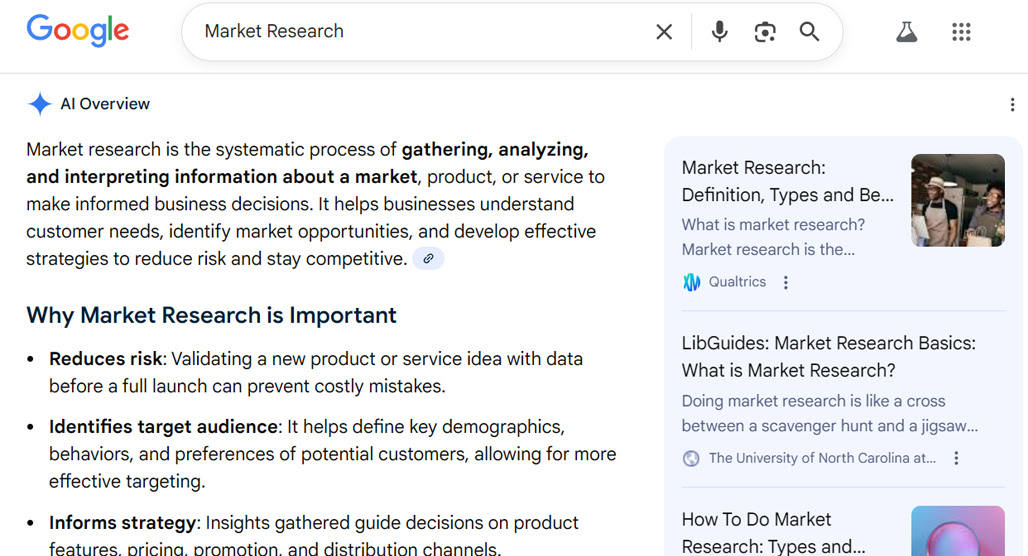
This is why modern marketing centers around topics so much. Topics are how the search engines "think" about content, index it, and present it to visitors.
Using Topics and Keywords for SEO
Modern content marketing and SEO require thinking about both topics and keywords. It's not an exaggeration to say that keywords are somewhat on their way out, though.
This is because keyword research will usually give you a list of variations of a keyword, like the list of fudge-related keywords above. Except, there's no real point to having that list. The search engines aren't reliant on specific keywords to surface content anymore. If you tried to shoehorn in all of those variations into one piece of content, you would probably take a ding for keyword stuffing.
Topics tend to be a lot more useful. Just thinking about it, you can start at the top and subdivide your way down into specific, useful topics for individual pieces of content.
You might want to start a food blog based on desserts. You divide it into desserts by type and think about cakes, cupcakes, brownies, cookies, pies, candy, etc. You take each of those and divide it by flavor, like chocolate, lemon, vanilla, mint, fruit, etc. You can add modifiers like gluten-free, sugar-free, and so on.
Eventually, you reach a point where your topic is narrow enough that further variation is just spinning around those keywords, and that's when you have a topic for a piece of content.
Modern topic research tools approach this in different ways. Some of them distill topics or even use LLMs themselves. Others approach it from keywords and figure out topics from there.
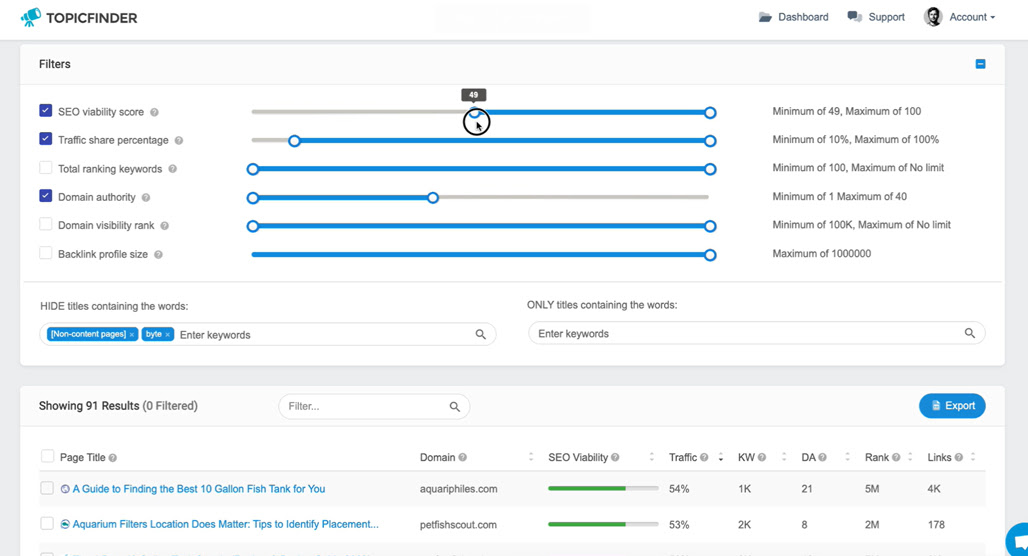
Keyword lists are also useful for discovering topics. I've talked a lot before about keyword grouping and content clustering. When you take a bunch of closely-related keywords and group them up into a cluster, what do you have? A topic.
Don't disregard keywords entirely, though. They're useful for considering the elements of a topic to cover and how. Keywords can inform the kinds of details a user would want to see in coverage of a topic.
The way I see it, modern content marketing has drawn back away from the hyper-niche, ultra-specific keyword coverage, and into broader and more all-encompassing topics. Sure, you aren't going to cover the topic of "SEO," "Desserts," or "Shoes" all on one page. But you can encompass a lot of different keywords surrounding running shoes in one guide to running shoes.
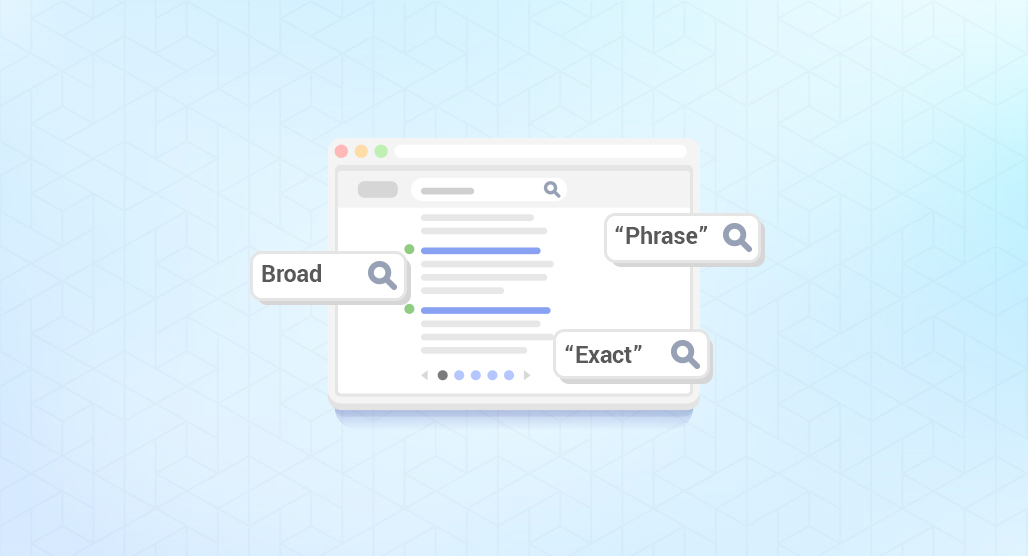
The other area where keywords are still useful is as differentiators for muddy topics. We've all had cases where we're looking for something specific and narrow, but Google's semantic indexing means all you get are broader and more generic results that don't suit your needs. You try varying kinds of quotes and search operators to narrow it down, and may finally find what you're looking for.
In essence, keywords are still useful if they're the kind of thing users would put in quotes to search.
Beyond that, we've firmly moved into a topic paradigm, where thinking about, writing about, and robustly covering whole topics is the goal of content marketing. Narrow, laser-targeted focus on specific keywords won't cut it anymore.

Related Posts


Leave a Comment


Fine-tuned for competitive creators
Topicfinder is designed by a content marketing agency that writes hundreds of longform articles every month and competes at the highest level. It’s tailor-built for competitive content teams, marketers, and businesses.
Get Started