What is Keyword Proximity vs Prominence vs Density?
 Written by James Parsons • Updated April 15, 2026


The marketing world is full of metrics, many of which have different names to describe the same thing, so it can be pretty confusing when you're hearing about yet another term and you need to know what it is.
Fortunately, in this case, these terms are distinct, defined, and related, so it's easy to learn about all of them in one go.
Keyword density, keyword proximity, keyword prominence, and even terms like keyword frequency are all ways to analyze the keyword use and distribution throughout your content. They're more important than ever in a world of natural language processing and LLM-based search, so knowing how they work and how to optimize for them can be very useful.
Key Takeaways
- Keyword frequency is a raw count of keyword appearances; keyword density divides that count by total word count, with 0.5-1% being the ideal range.
- Keyword prominence refers to where a keyword appears on a page; high-prominence locations include H1 titles, meta titles, URLs, and the first 100 words.
- Keyword proximity measures how close the individual words within a keyword phrase are to each other, not how close separate keyword instances are.
- Natural language processing means Google can recognize keyword intent even when phrase elements are split or reordered throughout content.
- Over-optimizing proximity can make content appear unnatural or algorithmic; writing naturally for humans is the most effective proximity strategy.
Starting with Keyword Frequency
Though it's not mentioned in the title, keyword frequency is also related to this whole discussion, so it's worth bringing it up as well.
As you can probably guess, keyword frequency is the number of times that your keyword appears on the page. Frequency is not a comparative or derived metric; it's just a count. However many times a keyword appears is your frequency. If you use your primary keyword 10 times in a 1,000-word post, the frequency is 10. If you use your primary keyword 10 times in a 4,000-word post, the frequency is still 10.
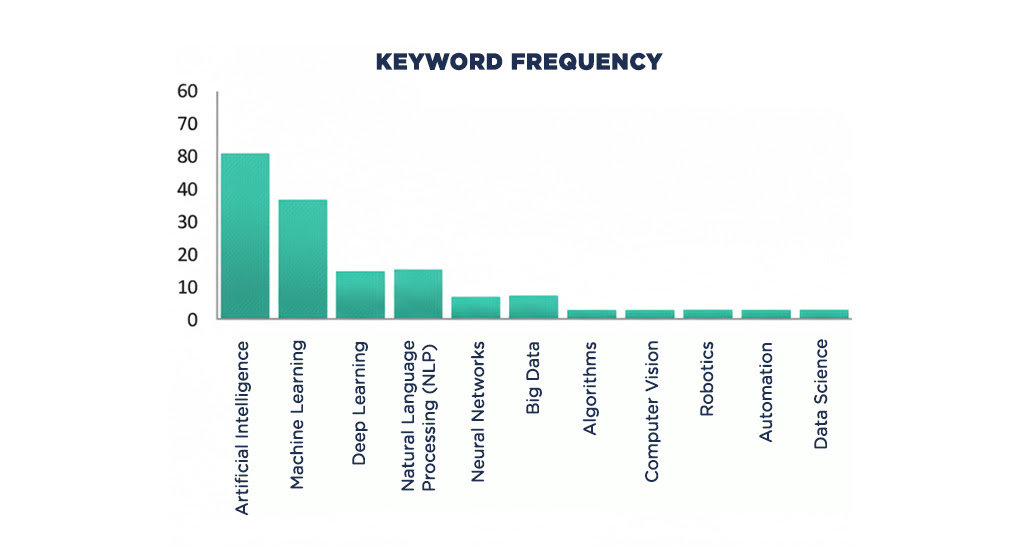
Frequency is one of the older SEO metrics surrounding keywords. Many years ago, when search engines were much less sophisticated than they are now, frequency was one of the main ways they could determine what a page was about.
One of the main algorithms used for this measurement back in the day was the TF-IDF algorithm. That is, Term Frequency - Inverse Document Frequency. This was a way of mathematically representing how important a term or keyword was across the whole of a document. If you're interested in the math, you can read more about it here. Or don't; understanding it isn't terribly necessary, and it's outdated by now anyway.
The problem with keyword frequency was also that it was easy to game. Want a page to be prominent for a given keyword? Use the keyword more! Want a page to rank for a keyword, but you can't fit the keyword in your content naturally? Who cares, do it anyway! Hide it if you have to!
Obviously, this was a bad thing, and was very quickly deemed to be a spam signal Google named keyword stuffing. It's still something that can get you in trouble today, even if the algorithms aren't really affected by it anymore.
Calculating Keyword Density
Keyword frequency is not a derived metric, but keyword density is. Simply put, it's the frequency relative to the sum of the content. More use of the keyword in a smaller space is a higher density.
Take the two examples above.
- Using a keyword 10 times in 1,000 words is a density of 1%
- Using a keyword 10 times in 4,000 words is a density of 0.25%
Calculating density is simple. Just take the frequency of the keyword (the number of times it appears in your content) and divide it by the total word count of the piece. Multiply the result by 100 for a percentage. 10/1000 = 0.01, * 100 = 1%. 10/4000 = 0.0025, *100 = 0.25%.
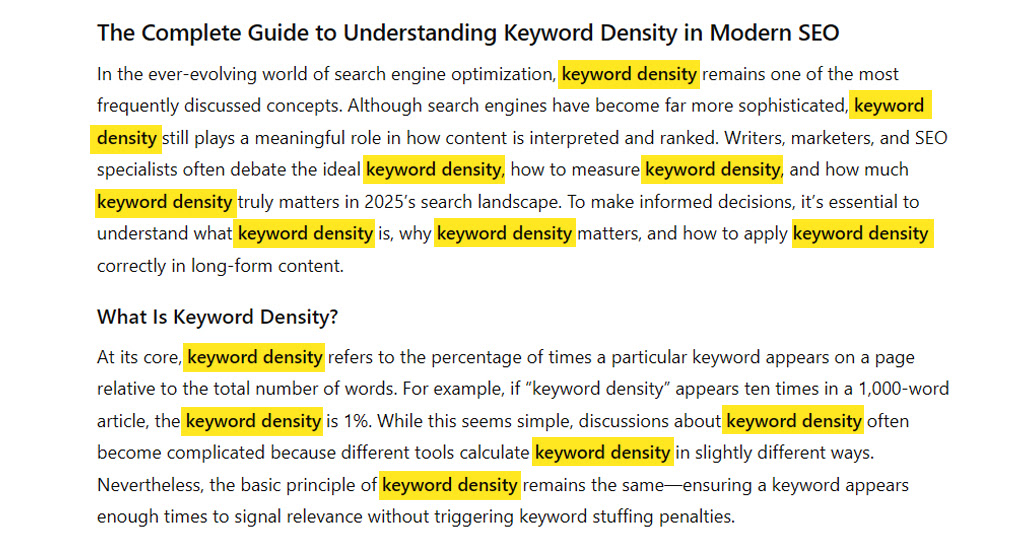
When Google decided that keyword frequency could be a spam signal, marketers went to work figuring out where they drew the line. Density is one of the ways they evaluate it. After all, the frequency of a keyword used across 4,000 words might be fine, but if that same frequency was crammed into 500 words, it would be nigh-unreadable. Raw frequency wouldn't be the deciding factor, but maybe density would.
There was an era of content marketing where keyword density was one of the most-watched metrics, and marketers did case study after case study to determine what the "ideal" keyword density was.
The answer, by the way, was almost always somewhere in the 0.5% to 1% range. Any higher a density and you risk sounding unnatural; any lower and you lose opportunities to mention the keyword.
This seems to still hold true today.
That said, Google has never really used raw keyword density as an important metric. TF-IDF is itself a sort of keyword density metric, but with more sophistication and nuance to it, since it analyzes language beyond just word density. After all, if the density of a phrase was all it took, words like "the" would be immensely overused keywords, right?
If you stand a few yards back and squint, all of this looks vaguely like the outline of what would eventually become LLM structures, in much the same way that a sapling becomes the Pacific Northwest.
Expanding into Keyword Prominence
Thus far, if you've spent any time in content marketing circles over the last decade, everything I've said is old hat. So, what about keyword prominence?
Keyword prominence is a kind of modifier to keywords. The location of a keyword gives it more or less value as a keyword. Some locations for a keyword are more prominent than others; hence, prominence.
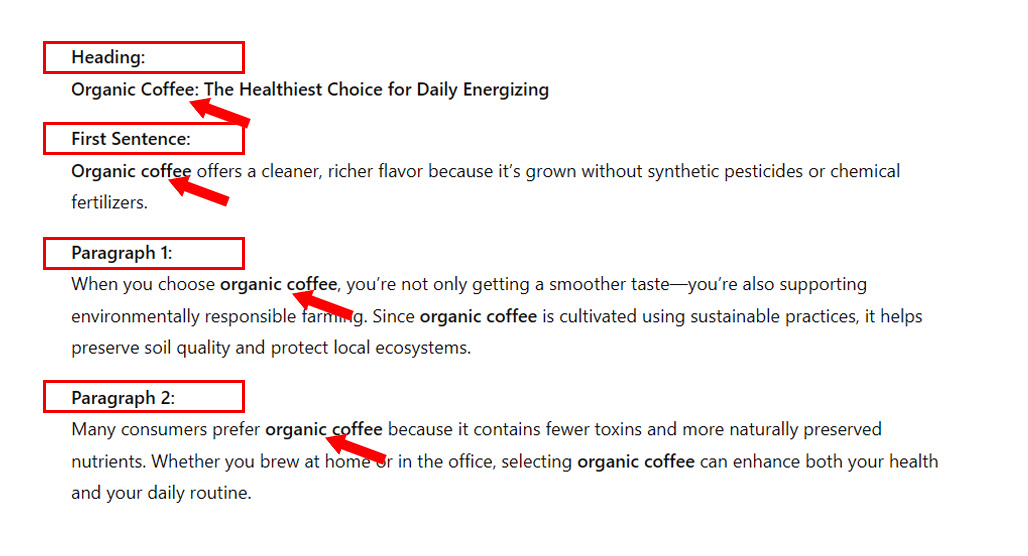
Keyword prominence can be relevant to humans and to search engines.
Human-relevant prominence means the keyword is:
- In the H1 title of the page.
- In the quick summary or lede of the page.
- In the subheadings throughout the page.
- In the first 100 words of the page.
It can also be made to stand out by making it part of link anchor text and by using formatting like bold and italics to draw attention to it.
Meanwhile, search engine prominence means the keyword is:
- In the URL of the page.
- In the meta title of the page.
- In the meta description of the page.*
- In image alt text and descriptions.
These are locations where the search engines can see the keyword and attribute it to the page, but humans are less likely to encounter it. Most people aren't reading the meta information versus what's just on the page, and things like image alt text are only encountered if people are directly looking for it, or if they're using screen readers.
The asterisk by meta description, by the way, is because meta descriptions are on the verge of being deprecated; Google rarely keeps the meta description you supply, so they aren't really important anymore. You can measure the pixel limit on page titles and descriptions to optimize what you do provide.
Search engines also see the human-relevant locations for keywords and assign them greater prominence, though the amount they give might vary.
There are also locations where prominence decreases below the baseline. Keywords in navigation, in sidebars, and in footers are a good example. Since these are site-wide rather than on the page alone, they're heavily limited in the value they can provide. That was, after all, one of the main ways keyword stuffing was used to exploit old iterations of the algorithm.
Bound Together with Keyword Proximity
Keyword proximity sounds like it would have something to do with how close together different instances of a keyword on the page are. How many words are there between two uses of the keyword?
Except that's not really as relevant as it sounds as a metric. Consider a passage like this:
The point of today's post is to teach you about keyword proximity. Keyword proximity is not a measurement of how close together keywords are, but rather, how close different parts of one keyword phrase are to the other parts.
This is natural writing. You wouldn't think I was keyword stuffing "keyword proximity" in, even though the proximity for that keyword is super high, since it's used back-to-back.
You could make this into a relevant metric by evaluating an average proximity, but then you're getting pretty close to just measuring density again.
No, keyword proximity is (as the example passage spoils for you) a measurement of how close different elements of a keyword phrase are to each other.

It's another element of natural language processing. Broadly speaking, Google can understand that when you're talking about "secondhand running shoes" and "buying used running shoes from a secondhand store," the keyword "secondhand running shoes" is present in both phrases.
This is why, when you perform a Google search for a phrase, you can often find results that suit your needs but don't ever actually use that specific phrase. It's a huge benefit when you're, for example, trying to remember song lyrics or a movie quote, but you can't get the phrasing exactly right. But, it's worse if you're trying to cover a very narrow and explicit topic, but there are a lot of variations that aren't, technically, the same thing.
Proximity is somewhat important in that you want the elements of your exact keyword to be, well, exact. But, if you want to talk about a topic but feel like you're overusing the keyword in terms of density, breaking it up and shuffling it around can still be a good way to discuss the overall topic without overusing the keyword. Understanding how broad, phrase, and exact match keywords work can help you decide when variation is appropriate.
Variance in proximity may also be an element of ranking these days, under natural language processing. If your post uses the exact-match keyword throughout, but pointedly does not use any proximal variations of the keyword, it can come across as unnatural in an algorithmically-generated sense. This is one reason writing about topics that are too hard to rank can backfire - the more competitive a term, the harder it is to write naturally around it without over-optimization.
How to Use These Metrics for SEO
Defining the terms is one thing, but how do you actually use these bits of data to improve your SEO?
Keyword Frequency in SEO
First up is frequency, and it's the easiest to talk about: you don't really have to care about it on its own.
Measuring the specific keyword frequency of a post isn't really a valuable metric to watch because it's something that requires context. It's like that meme: "Is 4 a lot? Depends on the context. Dollars? No. Murders? Yes."
Without contextual data to give you insight into what it means, a raw keyword count for a post doesn't do anything for you. But you should still track it, because it's important for density.
Keyword Density in SEO
Density is one of those metrics I have a love-hate relationship with. There was an era of content marketing, a few short years, where density didn't really matter, and natural language writing was more important. Low-density posts could rank well, high-density posts could also rank well, and the idea of a "sweet spot" was too variable to matter.
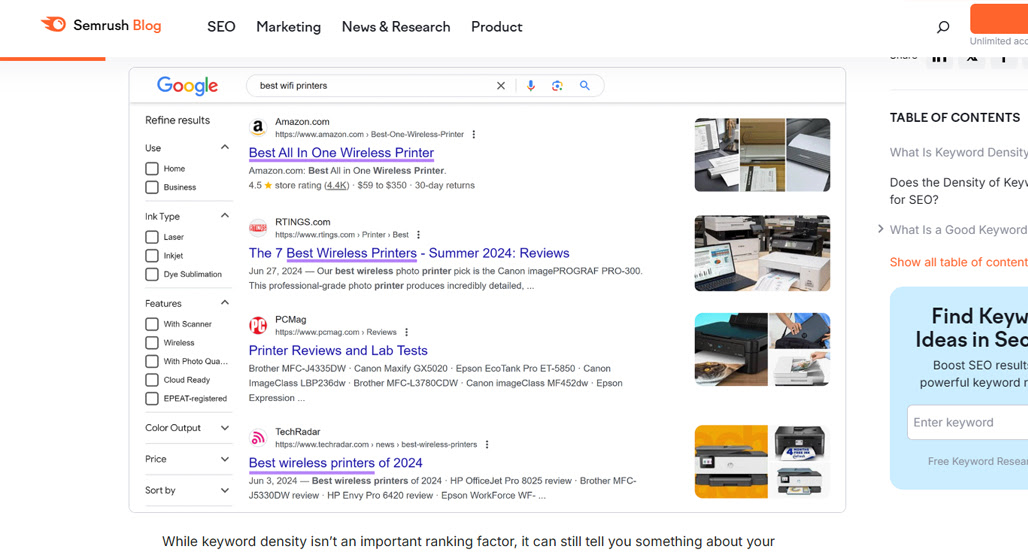
That may also just have been wishful thinking, really, since density does matter in a small way. As I mentioned before, somewhere between 0.5% and 1% seems to be the sweet spot. That's 10-20 uses in a blog post around the length of this one, for example.
The good news is, it's easy to track keyword density if you don't care about nuance. If you do care about nuance and you want to track implicit keywords, keyword variations, and proximal keywords, then you're going to have to do more work harvesting that data.
The good news is, you don't really have to do that. Aim for a reasonable keyword density, avoid going overboard such that your posts sound unnatural, and let the secondary keywords be their own thing.
Keyword Prominence in SEO
Keyword prominence is the easiest of the metrics to use, because it's really just a checklist. Make a list of all of the important places where your keyword should go, and make sure your primary keyword is in most of them.
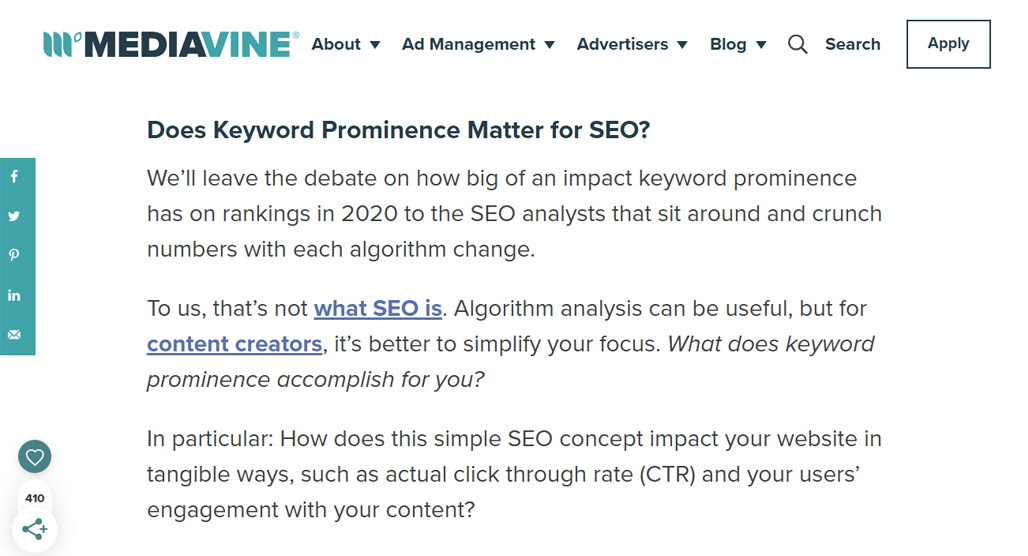
If you don't want to do that on your own, good news: I wrote a whole post just on places where you should put your keywords. Check it out here: Where Are the Best Places to Put My SEO Keywords?
Keyword Proximity in SEO
Keyword proximity sounds like one of the harder metrics to measure, because you have to think about specific instances where you're using your keyword phrase broken up throughout the content. Realistically, though, you might not actually be thinking in those terms.
In fact, I think you shouldn't be thinking in those terms.
Google wants to see natural writing aimed at human beings. Data points like keyword proximity are one way they can evaluate text to determine if it seems written for humans or not.
Once you start optimizing a data point like that, you start to float outside of what is considered natural writing. Even if, to a human, it still reads more naturally than an over-optimized piece of copy, from a mathematical point of view, it stands out. It might look more like algorithmic content, more like AI content, more like spun content, or just less natural in general.

Basically, my advice is this: in between normal uses of your primary keyword, just write naturally. Don't be afraid to use parts of the keyword phrase. You're discussing the topic, so don't be afraid to speak the name of the topic in the content, right?
As long as your writing sounds natural, you're going to be fine in terms of proximity.
While using specific keywords is important, writing naturally about your topics is more important. An appropriate array of proximal keyword variations will emerge organically as you discuss your topic, and you usually won't have to do anything beyond that in terms of optimization for proximity.

Related Posts



Leave a Comment


Fine-tuned for competitive creators
Topicfinder is designed by a content marketing agency that writes hundreds of longform articles every month and competes at the highest level. It’s tailor-built for competitive content teams, marketers, and businesses.
Get Started