What is Keyword Stemming and How Does It Affect Your SEO?
 Written by James Parsons • Updated May 9, 2026

Here's the thing: Google figured out how to connect those words a long time ago. Since 2003, its algorithm has understood that "run," "running," "runner," and "ran" all orbit the same core concept. You don't need to force every variation into your content to signal relevance. The engine is already making those connections.
The concept behind this is called keyword stemming - and understanding how it works changes the way you strategy content very. Instead of stuffing paragraphs with repetitive keyword variations, you can write naturally and trust that Google will read between the lines.
I'll break down what keyword stemming is, how search engines use it to interpret your content, and what it means for your day-to-day SEO writing. By the end, you'll have a clearer sense of how to work with the algorithm instead of around it.
Key Takeaways
- Since 2003, Google has connected word variations like "run," "running," and "runner," making exact keyword repetition unnecessary.
- Keyword stemming lets search engines match queries to relevant content even when exact words don't align, bridging searcher and writer language.
- Top-ranking pages now have ~50% lower keyword density than before, reflecting Google's preference for natural language over repetitive phrases.
- Creating separate pages for stemmed variations of the same keyword causes cannibalization, splitting ranking potential instead of consolidating it.
- Long-tail and unexpected queries account for significant traffic; stemming helps pages rank for variations writers never explicitly targeted.
Table of Contents
The Simple Definition of Keyword Stemming
Keyword stemming comes from an idea in linguistics called "stemming," which is the process of cutting back a word to its base or root form. That root is called the stem. Words like "bake," "baking," "baker," and "bakery" all share the same stem - and a search engine that understands stemming knows those words are closely related.
This matters because people don't all search the same way. One person might type "best ways to bake bread" while another searches for "bread baking tips" or "professional baker advice." The underlying intent is the same. But the words on the page and in the search bar don't match. Stemming is how a search engine bridges that gap.
Without stemming, a search engine would have to treat every word form as a separate entity. A page about "baking" would only rank for searches that use the word "baking" - not "bake," not "baker," not "bakery." That would make search quite a bit less helpful for everyone.
In plain terms, keyword stemming is the ability of a search engine to recognize that different word forms carry the same core meaning - it lets the engine match a search query to relevant content even when the exact words don't line up, which is a fairly big deal for how search works at its foundation.

The term itself comes from computational linguistics; scientists have studied word structure for decades. The goal has always been to help machines understand language the way humans use it. Search engines adopted these ideas to get better at connecting users with content that actually answers their questions.
From the search engine's perspective, its job is to know what a person wants and then find the most relevant content available. If it can only match exact words, it fails a giant portion of users. Stemming is one of the tools that makes search feel intuitive instead of rigid - and it helps you write content that works with search engines instead of against them. Understanding how search intent maps to content is another layer of this same idea.
How Google's Stemming Algorithm Has Worked Since 2003
Google has been able to connect word variations to search queries for over two decades. The capability was confirmed on December 4, 2003, when a Google representative known as "GoogleGuy" posted about it on WebmasterWorld.com. That post made clear that Google could already find these relationships between words like "run," "running," and "runner" without needing each one to appear separately on a page.
This wasn't a small change. November 2003 had just seen the Florida update roll out, which was one of the biggest algorithm changes Google had made up to that point. The timing matters because it tells us that stemming was part of a wider push to make search results more intelligent and less dependent on exact word matches.
To understand why Google needed this, consider the problem from a searcher's perspective; it's a frustrating experience for anyone who just wants a recipe.

So Google built a way to find the root of a word and connect it to its related forms. A page about "bake" could now rank for searches like "baked goods" even if the word "baked" never appeared - this made search feel more natural because searchers don't always use the exact words a page uses. This is also why understanding broad vs phrase vs exact keyword matching still matters when planning your content.
What that means practically is that Google has never been a simple word-matching machine - at least not since 2003 - it was designed from an early stage to understand language with a bit of flexibility, and stemming is one of the foundational tools that made that possible.
This was years before semantic search, RankBrain, or BERT entered the picture. Those later developments expanded on the same core idea in much bigger ways. But stemming came first and it laid the groundwork for how Google learned to read pages as language instead of just strings of text. Tools that help you find the top keywords in your industry are built on top of this same understanding of how Google processes language.
Why Keyword Density Has Dropped - and What That Tells Us
BrightEdge found that pages ranking in the top 10 have around 50% lower keyword density than they did two years before. That is an actual drop and it seems like something worth mentioning.
For years, SEO writing was built around repetition. The idea was that the more times a page used its target keyword, the more Google would associate that page with the term. So writers would work the same phrase into headings, opening paragraphs, image alt text, and closing sentences - sometimes to a degree that made the content feel robotic.
Stemming is a big part of why that strategy has become outdated. Because Google can connect variations of a word to the same root, it does not need to see the exact same phrase repeated to know what a page covers. A page about "home loan applications" that also uses "apply for a mortgage" and "loan applicants" is telling Google the same story through different words.
Google's systems are built to read content the way a person would, and heavy repetition reads as unnatural. Pages that rank well now tend to use language that covers a topic instead of hammering one phrase into the ground.
The assumption was that Google needed the exact string of words to make a match. Repeating a phrase twenty times does not add twenty points of relevance - it can add noise. Understanding keyword proximity, prominence, and density makes it clearer why raw repetition falls short.
The drop in keyword density at the top of search results is not a random data point - it goes well with how Google has grown to read content more like a reader and less like a keyword scanner. Content that serves the reader with natural language tends to hit a wider number of word forms anyway, and that's what stemming rewards. This also connects to how keyword ranking actually works in practice.
The Connection Between Stemming and Long-Tail Keyword Coverage

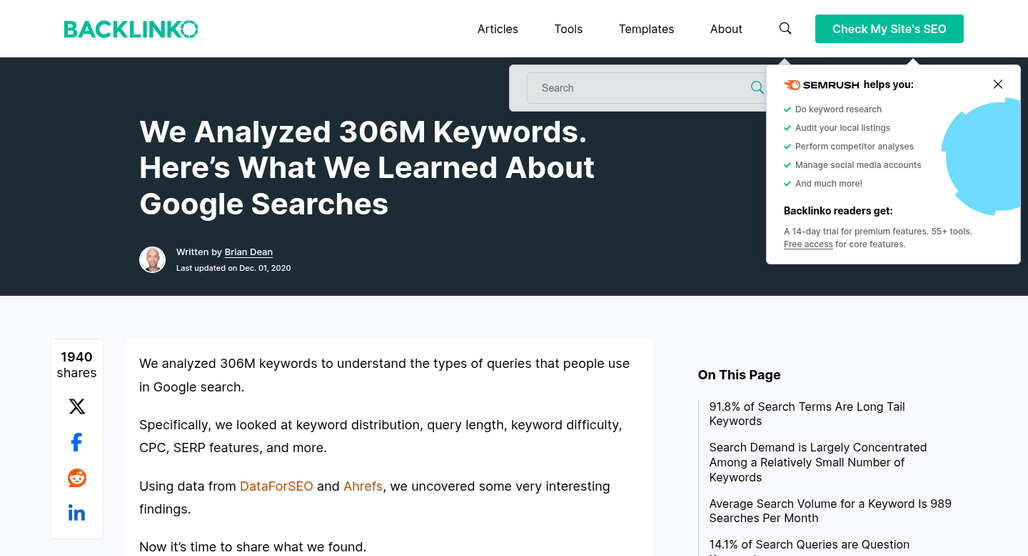
Long-tail searches make up 91.8% of all search queries, according to Backlinko; it's a bit of very conversational and sometimes unusual phrases that people type into Google every day. Google also reports that 15% of searches are new - queries it has never seen before.
No content strategy can plan for every one of the variations; it's where stemming does some of its most helpful work.
When a search engine understands that "optimize," "optimized," "optimizing," and "optimization" all share a common root, it can connect a user's query to a page that never used their exact phrase. A well-written page about how to optimize a website might rank for searches about "website optimization tips" without ever targeting that term. The writer didn't plan for it - stemming made the connection.
This matters quite a bit for long-tail coverage because long-tail phrases tend to have lower search volume but higher intent. A page that ranks for dozens of related variations can pull in actual traffic from terms you never thought to include in your keyword research; it's not a loophole; it's just how language-aware search engines work.
The data from Ahrefs can add another layer to this. Around 46% of the clicks recorded in Google Search Console go to queries that are hidden or unexpected - terms the site owner never tracked or targeted. Stemming is a big reason that number is so high. Google finds connections between content and queries based on linguistic relationships instead of exact matches.
For content planning, this changes how you think about a single page's possible reach. A page doesn't have to repeat twenty keyword variations to rank for them - it needs to cover a topic with enough depth and natural language that a search engine can map it to a number of related queries.
Where Keyword Stemming Shows Up in Your Content
Stemmed keywords don't live in one location - they scatter across everything you write. Your headings, body paragraphs, meta descriptions, image alt text and anchor text all carry word variations without you having to plan it that way.
Take a root word like "optimize." In a common part of content, you might use "optimized" in a heading, "optimization" in the body and "optimizing" in a meta description. Search engines read them as connected, and that's the point.
| Root Word | Stemmed Forms You Might Use |
|---|---|
| optimize | optimized, optimizing, optimization, optimizer |
| rank | ranked, ranking, ranks, rankings |
| convert | converted, converting, conversion, converts |
| market | marketed, marketing, marketer, markets |
Alt text is one place writers forget to consider. If your image is about a product being assembled, "assemble" and "assembly" do work there. The same applies to anchor text - the words you use to link somewhere are part of your content's keyword picture too.

If you write, you're already doing most of this. Good writing uses different language because it reads better, and that variation is what stemming relies on. You don't need to map out every word form to write a paragraph.
The issue starts when writers go the other direction and lock themselves into exact-match repetition. Forcing the same keyword into every sentence doesn't improve your rankings - it makes the content harder to read and tells search engines that something feels off. Natural variation is a feature, not a workaround.
Over-engineering this part of the process pulls focus away from what actually makes content helpful.
Common Mistakes Writers Make When They Ignore Stemming

One of the most recognizable mistakes is repeating the same exact keyword form throughout a piece of content. A writer might use "optimize" in every paragraph because that was the target word from the brief. But search engines already connect "optimize," "optimized," and "optimization" - so repetition does not help rankings and tends to make the content feel unnatural to read.
The bigger trap is building separate pages for terms that stem from the same root. If your site has one page targeting "best running shoes" and another targeting "best shoes for running," you are basically competing against yourself. Search engines may see these as the same topic and split the ranking potential between pages instead of consolidating it into one strong result. Content teams fall into this pattern quite a bit when keyword lists are built without checking for overlap.
That overlap gives you what SEOs call keyword cannibalization. Two pages fighting for the same search queries and neither one performs as well as it could - a problem for growing websites where content production moves fast and individual pages are not necessarily reviewed in the context of what already exists.
There is also the danger of thin content. A writer who does not understand stemming might create a short page just to target a slightly different word form. The page has little substance because there's not much new to say - the topic was already covered somewhere else on the site. Search engines tend to undervalue pages that don't add anything meaningful to a conversation.
Some other habits worth watching for include targeting plurals and singulars as though they need separate pages, writing content that feels forced because a word form is being protected at all costs, and ignoring natural synonyms in favor of exact repetition. None of these habits help. They usually get in the way of content that actually reads well and covers a topic thoroughly - which is what search engines want to reward.
How to Do Keyword Research With Stemming in Mind
Keyword research with stemming in mind starts with finding a root term and mapping out how searchers search for that same idea. That change in thinking changes how you plan content from the start.
Start by picking a root word and pulling its variations together before writing anything. If you're researching "optimize," you want to see "optimization," "optimized," and "optimizing" in the same view - not spread across separate keyword lists as though they're unrelated topics. Most keyword tools let you filter or group by term, so use that to build a fuller picture of how one idea gets searched.
From there, group related stemmed terms into a single content piece. One page should target the root term and its close variations together instead of three pages that all say the same thing to the same person; it's actually a helpful gut-check to run during research.
The question to ask is if you're targeting the same searcher twice with two different pages. If the answer is yes, that's a red flag. Two pages with heavily overlapping intent will compete with each other in search results and neither one will win.
Search intent is the other piece to keep in mind. Sometimes two stemmed forms of a word have different intents - "run" and "running shoes" go in different directions, just to give you an example. So grouping by stem alone isn't the whole job. You also want to look at what the search results show for each variation to decide whether to combine or separate them.
A few things worth doing as you research:
Look at autocomplete and "People also ask" results for your root term - these surface the variations people use. Check if the top-ranking pages for two similar terms are the same pages or different ones. If they're the same, that's a sign the terms belong together on one page. If they're different, they probably need their own space.
Write Smarter, Not Harder - Let Stemming Do the Heavy Lifting
Google's ability to find these stemmed keywords has been baked into its algorithm since 2003. It's not a new trick or an upcoming trend to chase - it's a foundational part of how the search engine reads and understands language, and it rewards content that goes well with that. Relevance and natural language will always outperform rigid, repetitive keyword targeting.
A helpful next step is to take a fresh look at your existing content with stemming in mind. Think about whether you've been stuffing an exact keyword where a different form would have read more naturally. Small edits - swapping a repeated root word for its plural, its verb form, or a related variation - can improve readability and search relevance at the same time. Write for the person reading the page first, and trust that Google is smart enough to follow.

Related Posts



Leave a Comment


Fine-tuned for competitive creators
Topicfinder is designed by a content marketing agency that writes hundreds of longform articles every month and competes at the highest level. It’s tailor-built for competitive content teams, marketers, and businesses.
Get Started