What Are the Best AI Article Rewriter Tools to Use? (Updated)
 Written by James Parsons • Updated April 15, 2026
With modern generative AI, there are a few different primary ways that people use it. Some use it to generate new content from scratch. Others use it to take existing content and rewrite it with some goal in mind. For example, they might want to take something stuffy and overly formal and turn it casual, or write it from a different perspective, or insert more jokes and snarky asides throughout the piece. You can also take a longer piece of content and use AI to create spin-off versions of that content, like short versions for social media.
In the past, I've talked about which tools I think are the best for this kind of content rewriting, but the world of AI moves very quickly, so the same recommendations aren't always viable just a few months (let alone years) later. So, I decided to revisit it and revamp my list.
Key Takeaways
- AI rewriting tools serve distinct purposes: tone adjustment, SEO optimization, content humanizing, format conversion, and brand consistency.
- AI-rewritten content will rarely reliably pass AI detectors, and detection technology will continue improving over time.
- Ethical concerns around AI rewriting depend on whose content is rewritten, the purpose, and potential Google penalties.
- Recommended tools include Ahrefs (free), Semrush (SEO), Descript (scripts), Jasper (brand continuity), and Wordtune (short content).
- The AI tools landscape changes rapidly; some platforms showing short-term tactics may disappear or face algorithm penalties soon.
Table of Contents
Is it Ethical to Rewrite Content with AI?
Before I dive right in, I wanted to lightly touch on this particular elephant in the room. Is it ethical to use AI to rewrite content?
In my view, there's no clear answer to this, and it hugely depends on a few major factors.
First: whether or not you consider AI ethical at all. There are still a lot of ongoing questions about the ethics of training and building AI in the first place, with massive copyright cases being litigated in the US, Europe, and elsewhere. Whether training counts as fair use or whether it's theft is a tricky question.
There are, certainly, clear instances of theft and misuse of protected content involved in training AI. But do the ethics trickle down to you? If you're simply using the product and not training your own, are you committing harm? What's your stance on the phrase "there is no ethical consumption under capitalism"?
I don't have an answer here, which is why I'm going to focus more on the other factors.
The second major factor is what content you're choosing to rewrite. This goes right back to a discussion that has been happening in marketing circles for decades. If you take content from another site, spin it in an original way, and publish it as your own, is that legitimate? Or is it plagiarism?
The technical definition of plagiarism requires substantial similarity between the content. Unique word choices, unique phrasing, and unique structures all change the content enough to make it more original and less sketchy.
There's also a line here to consider. When a human does a rewrite, they're often putting their own spin and knowledge on the topic along the way. When an article spinner or AI rewriter does it, there's no human touch. Does that change the math?
Beyond that, you also have the purpose of the rewritten content. If you're trying to build a website based entirely on spinning the content of other websites, that may be somewhat less ethical than if you're spinning your own content with the goal of using it in different forms and on different sites. Especially if you created the content yourself in the first place.
Why do I bring any of this up?
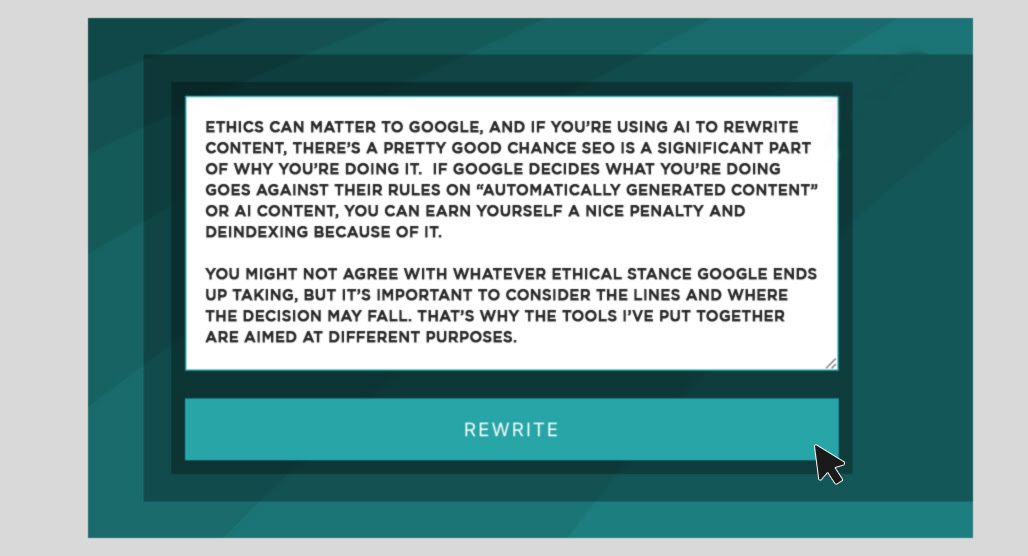
Ethics can matter to Google, and if you're using AI to rewrite content, there's a pretty good chance SEO is a significant part of why you're doing it. If Google decides that what you're doing goes against their rules on "automatically generated content" or AI content, you can earn yourself a nice penalty and deindexing because of it.
You might not agree with whatever ethical stance Google ends up taking, but it's important to consider the lines and where the decision may fall. That's why the tools I've put together are aimed at different purposes.
Will AI-Rewritten Content Pass AI Detectors?
The other big consideration you need to make is this: will AI-rewritten content pass AI detection?
In this case, the answer is almost always no. But it depends heavily on which detectors you use. I've tested a bunch of different detectors, and the only consistent thing about them is how inconsistent they are. Sometimes a more complex prompt can fool them. Sometimes it depends on the topic. It's really all over the place.
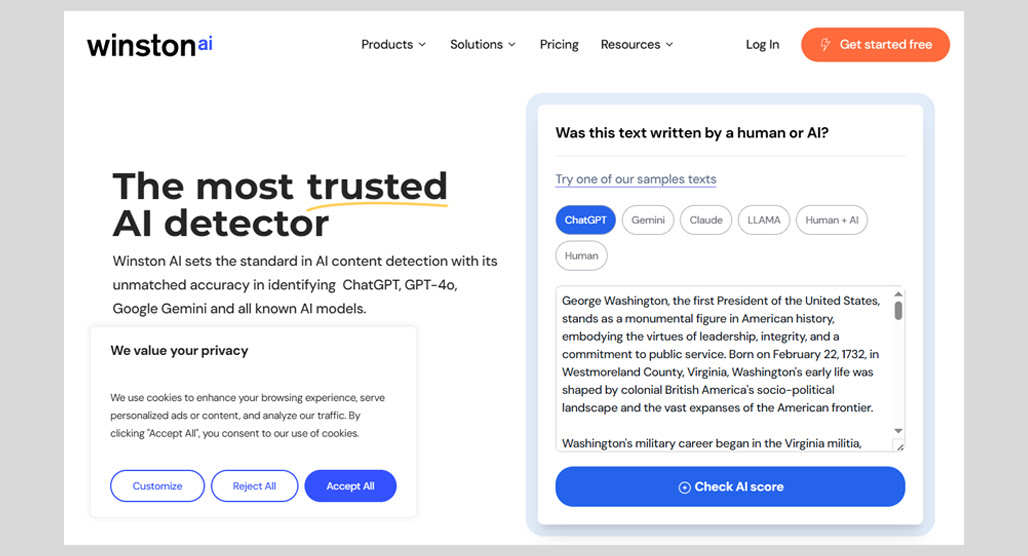
I would, however, never assume that rewritten content will pass. Moreover, even if it passes now, it might not in a few months or years. Detection, just like the generators themselves, will improve.
This is a big concern, especially if you're trying to use an AI rewriter to humanize content, particularly to fool AI detectors. It might work, or it might work for a while, or it might not work at all. Don't assume you'll be entirely safe if you have anything valuable riding on it.
Now, with all of that out of the way, let's look at some of the specific tools you can use for different purposes.
AI Rewriting Tools for Different Purposes
I've tried to list out the best tools for specific purposes, but keep in mind that not only will the perspectives change over time, but the tools can add new features, change their underlying models, or even evaporate entirely at the drop of a hat. If any of this falls out of date, or if you have alternatives I haven't considered, let me know in the comments.
Best for rewriting paragraphs for free.
My choice: Ahrefs.
I'm a big fan of Ahrefs, and I use a lot of what they have to offer. This tool is very limited, since it's a free tool, but it does show you what their larger paid tool can do.
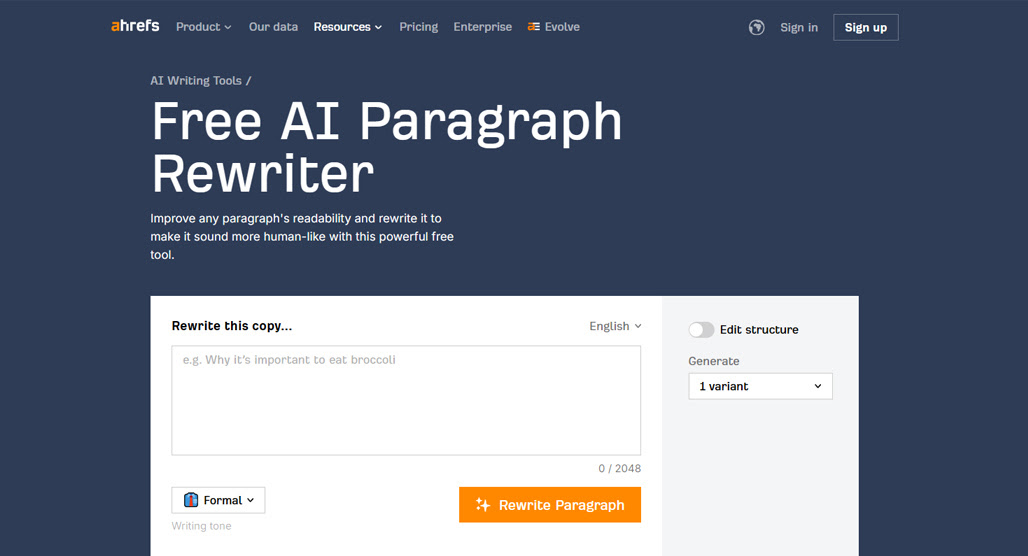
This tool can rewrite up to 2,048 characters of content, which will probably be around 300-400 words at a time. You can choose one of 16 different preconfigured tones or set a custom tone keyword to spur the AI into a direction you prefer. You can also toggle on or off the "edit structure" button, which can make it more or less rigid in how it revamps your content. Finally, you can have it generate one, three, or five variations to pick from.
Obviously, if you were trying to rewrite large chunks of content, whole blog posts, or eBooks, or otherwise more elaborate projects, the free tool isn't going to do it for you. But for smaller things, like social media blurbs, product descriptions, excerpts, or elevator pitches, it can work quite well.
Best for rewriting content to target AI overviews.
My choice: Brandwell.
Brandwell is an AI platform that mixes three different LLMs and a bunch of proprietary prompting in between them and you. The goal is simple: take content you've created, whether it's manually or with AI, and rewrite it into a form that is optimized to be cited by other AIs, like ChatGPT Search, Perplexity, or Google's AI Overviews. Since these kinds of AI searches and zero-click searches are increasingly important in SEO, targeting them specifically could be beneficial.
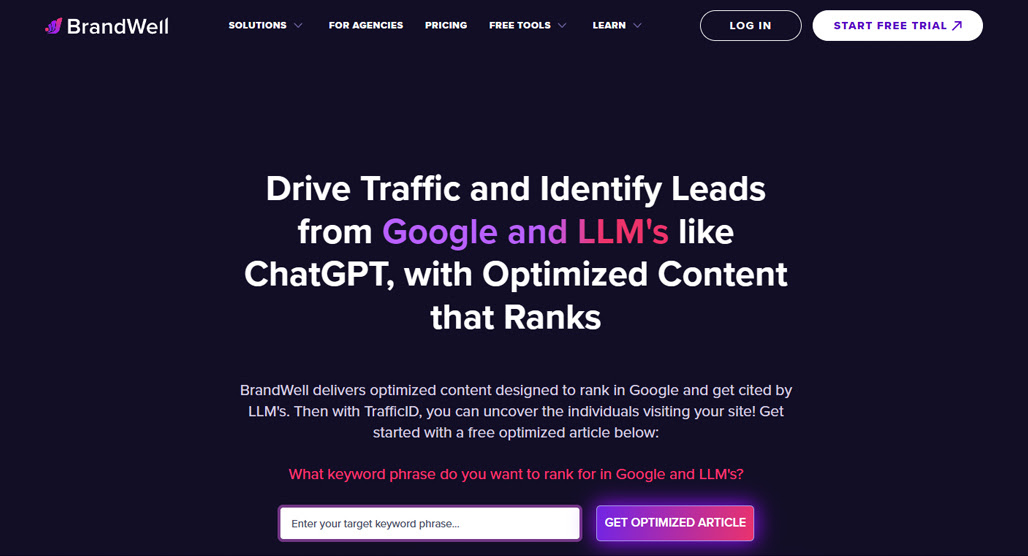
I'm keeping a close eye on this platform, though, because they do have a few hallmarks of something that might implode sooner rather than later. For example:
- They claim it can't be detected by Google as AI content, which I would never bet on.
- They offer "natural" backlinks with their "co-op-based brand publisher network," which reeks of PBN to me.
- They focus a lot on short-term, potentially unsustainable gains.
Basically, if you want to use them, get to it ASAP before some kind of Google algorithm blasts their strategies apart.
Best for taking human content and revamping it.
My choice: Semrush SEO Writing Assistant.
Like Ahrefs, I trust Semrush a lot more than I trust a lot of other companies and tools out there, especially in the AI space, where a lot of them are just elaborate (or not so elaborate) prompts between their interface and ChatGPT.
Semrush's SEO Writing Assistance is a fairly powerful AI-powered editor, sort of like a cross between something like Clearscope and Grammarly. In fact, it beats out Grammarly, which used to be good until they decided to use a fairly poor implementation of AI to do what they did before, but worse. Sorry, a bit salty on that one.
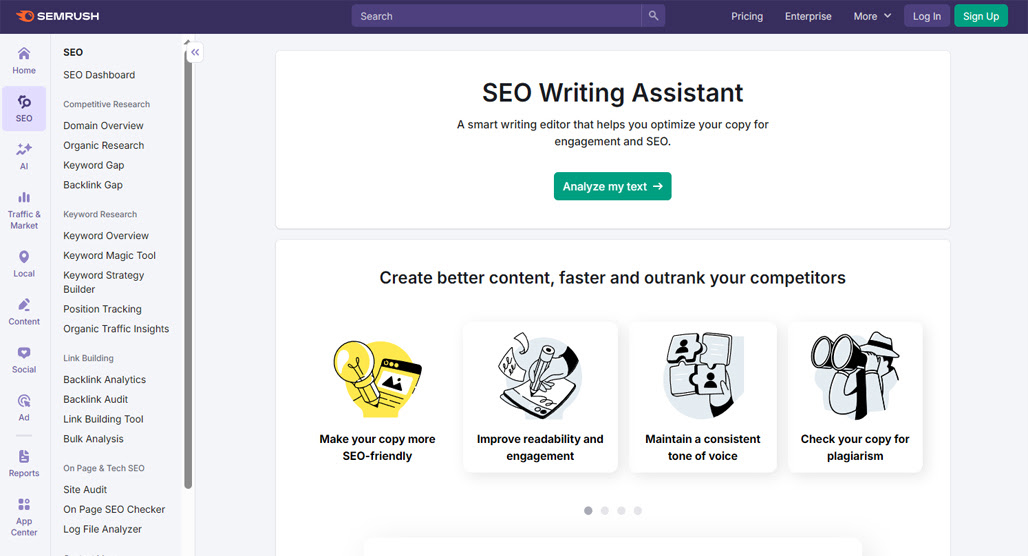
Whether you have a first draft and want to pump SEO juice into it, or you have an optimized piece of content and want to shift its focus, Semrush's tool is very good. It also has a lot of useful analysis attached. Since it's part of Semrush, too, it's right there with a lot of other powerful research and analytics tools.
The eternal downside of Semrush is the price, where the entry-level plan is over $120 per month. The content engine alone is very limited and still $60 monthly. If that's out of your budget, there are some more affordable Semrush alternatives worth considering.
Best for taking AI content and humanizing it.
My choice: Humanize.
This one is tricky because I truthfully don't think it's possible to humanize content using an AI. It's like asking a human to see colors only a mantis shrimp can see, or to smell the things a dog can smell. It's a fundamental disconnect between the prompt and the tool. By definition, any AI output is AI output, which means it will follow patterns and be vulnerable to the kinds of analysis that detect AI content.
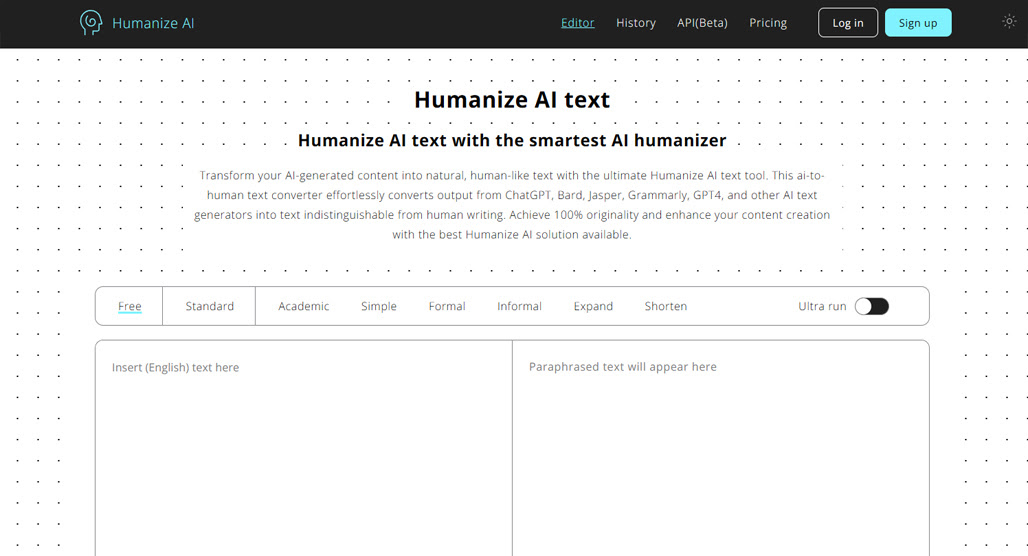
I've done a lot of work on this while developing my own AI detector, and the truth is, just about every AI humanizer does the same sorts of things. They inject typos, they remove "red flag" words, and so on. The trouble is, some of those things are undone by editing, and others are just a different form of red flag.
Out of the humanizers I've tried, Humanize is the best, but sadly, that's not necessarily saying much.
Best for converting content into scripts and other formats.
My choice: Descript.
Descript is a fairly robust and popular AI rewriting tool that bills itself as a does-everything platform. One of its main selling points is the ability to switch between modes seamlessly, so you can process a single piece in multiple different ways and for different purposes.
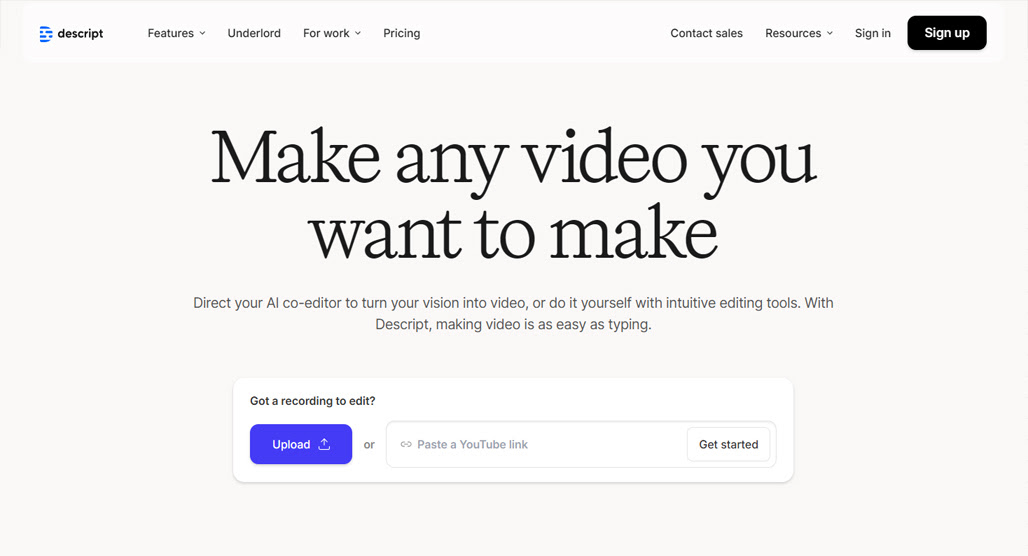
Out of all of them, I've found it most compelling as a way to turn something like a blog post into a punchier and more compelling video script. The option to convert to a script alone is good, but then you can enhance that script with other features, like the filler word removal tool.
It also functions in reverse, turning a video script into a blog post, but I haven't found that to be as useful. But then, I'm almost always starting with a blog post myself, so maybe it's perfectly viable and I'm just not the target audience for it.
Best for business continuity.
My choice: Jasper.
Jasper is one of the oldest AI platforms and does a lot of things. I have mixed feelings on it, but one thing they do right is a business-focused feature that helps when you have half a dozen or more people all working on your content: brand continuity. You put information and keywords, flags, and other data into the system, and it uses that information to ensure that the content you create is all produced using those guidelines.

It's essentially like developing a back-end prompt that ensures a consistent brand voice and tone is written into anything you're creating. You can do that manually with nearly any free-form LLM, and most guided experiences help with pinning some of it down, but Jasper's is the most formalized of them.
Best for minor adjustments to short content.
My choice: Wordtune.
Wordtune has a lot of small tools that can be handy, including a paraphraser, a summarizer, and a grammar checker. The most useful that I've tried, though, are the simple tone adjustments. Something as trivial as taking an email and rewriting it to be more or less formal for different contexts can be very handy in some situations, and it does a lot of it through contextual analysis, which means it can fit right into a workflow fairly easily.

With a free plan that gives you a taste of the things it can do, it's easy to see if it would help you before you put money into it, too.
Alternative AI Rewriting Tools
I've only really chosen a selection here, and my criteria are based as much on my own limited experience as on any extensive testing. Since there are seemingly hundreds of AI companies springing up and folding every week, it's hard to keep track of all of them. That's why I've tried to choose ones that have a bit more longevity behind them, since it's always a pain to recommend something and find it disappeared a month later. If you're looking for a starting point, our roundup of Wordtune alternatives worth considering covers some solid options.
Still, if you have alternatives or suggestions, let me know what you think.

Related Posts


Leave a Comment


Fine-tuned for competitive creators
Topicfinder is designed by a content marketing agency that writes hundreds of longform articles every month and competes at the highest level. It’s tailor-built for competitive content teams, marketers, and businesses.
Get Started