Guide: How Does SERP Gap Analyzer (TopicRanker) Work?
 Written by James Parsons • Updated April 15, 2026
Successful content marketing requires a keen understanding of the keywords and topics in your niche. Experience is the best way to gain this understanding, but there are also dozens (if not hundreds) of tools out there to help. Some scrape keyword data, some add analytics to bring context to those keywords, and others help with brainstorming, clustering, interlinking, and more.
One somewhat popular tool in the space right now is TopicRanker, also known as SERP Gap Analyzer. This tool, previously independent, was purchased and added to the Semrush app library to become part of their feature set.
How does it work, what can you do with it, and what limitations does it have?
Key Takeaways
- SERP Gap Analyzer, originally TopicRanker, is now a Semrush app that identifies keyword opportunities by analyzing competitor weaknesses.
- Reports flag weaknesses like slow pages, outdated content, poor readability, missing meta keywords, and short word counts in competitor rankings.
- The tool requires both a Semrush subscription and its own plan, costing a minimum of $239 per month combined.
- Several weakness indicators are criticized as unreliable, particularly exact-match title analysis and flagging content older than six months as outdated.
- Reports take 90 minutes to generate, and the Basic plan limits users to just nine keywords total across three monthly reports.
What is SERP Gap Analyzer?
SERP Gap Analyzer can be found at topicranker.com or as an app added to Semrush via their app marketplace. It was originally developed by Dmitry Dragilev, known for building SaaS apps that keep being bought by companies like Semrush and Adobe.
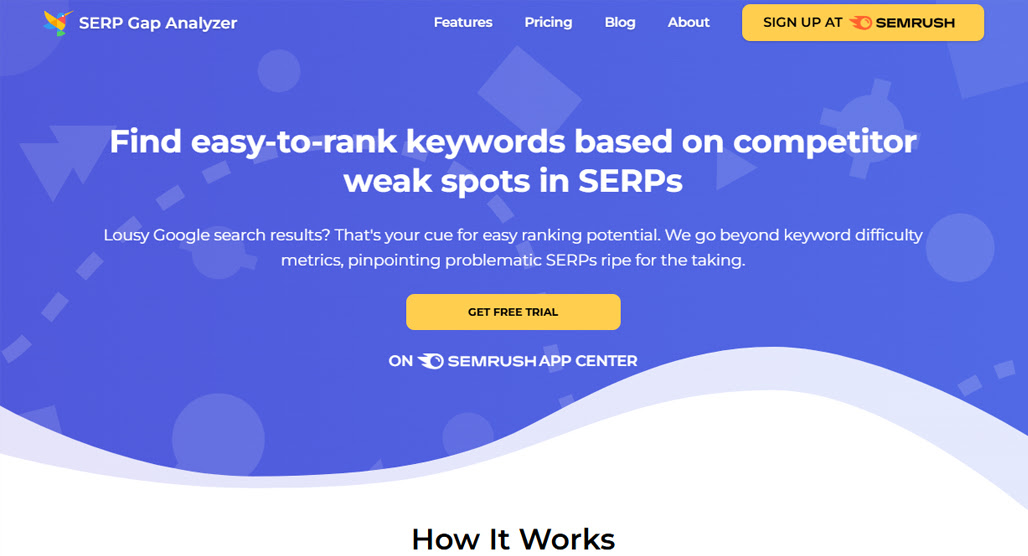
Conceptually, it's a common idea for a tool. You start with two pieces of data: a keyword and a domain you want to scan. It will do its thing and give you a report with data about related keyword phrases, including data like search volume, ranking difficulty, competitor weakness, and more.
You can then take this data and use it to look for gaps and weaknesses in coverage for keywords in your niche. By targeting underrepresented keywords, you can gain a stronger position more easily instead of having to fight off stiff competition for every blog post.
Gap analysis is interesting because the more people use it, the worse it works. There needs to be gaps in coverage for a gap analyzer to find, otherwise you aren't getting much of value out of the process, right?
SERP Gap Analyzer doesn't really do anything to solve this problem, other than be reasonably expensive for an app within an already expensive tool. Still, there's enough room in most niches that you can get some good information from it, so I can't be too down on it.
How Does SERP Gap Analyzer Work?
Once you sign up and have access to the tool, using it is pretty simple.
First, you need some starting data to run a report.
- A domain name, typically your own, since you're running a report on what opportunities can work for you.
- A seed topic, usually a broad keyword that encompasses the niche you want to cover.
- Your preferred language and country for search result analysis.
Then you click to run your report and wait. And wait. And… more on that in the pricing section, so stay tuned.
When it generates, the report gives you a list of keywords, which are longer-tail keywords relating to the seed keyword you plugged in. Each keyword has the global search volume, an estimate of the minimum authority you'd need to rank for the keyword, and a list of icons that indicate any particular weaknesses in the existing results for that keyword. You can also click to view more robust details for any given keyword it generates.
One useful bit of data is that, at the top, the report shows what estimated authority your site has in the niche. So, if your site has an authority of 30, and you see that most of the keywords have a recommended authority of 40 to rank, you'll have a bit of a hard time; if you see keywords with recommended authority in the 10s and 20s, you'll be well-positioned to claim them. This uses Moz domain authority, for reference.
Note here that the authority recommendations are for ranking in the top ten, i.e., the first page of the SERPs; it does not mean that's the authority necessary to rank #1. That is likely much higher.
Now, about those icons. There are five of them that indicate potential problems with the pages in the SERPs.
- Slow pages. Some of the pages in the top 10 for the keyword have poor ratings in Google PageSpeed Insights; your site, with similar content and authority, could out-rank them by being faster and more responsive.
- Outdated pages. Some of the pages in the top 10 for the keyword are older than six months.
- Unreadable pages. These are pages that lack formatting and readability boosts, like bullet lists, table of contents, line breaks, and so on. They use the Flesch Reading Ease Score, which is common in text analysis.
- Missing Meta Title Keywords. This is pages that don't have the relevant keyword in their meta title.
- Short pages. In this case, they flag any page that has under 1000 words of content as a weakness.
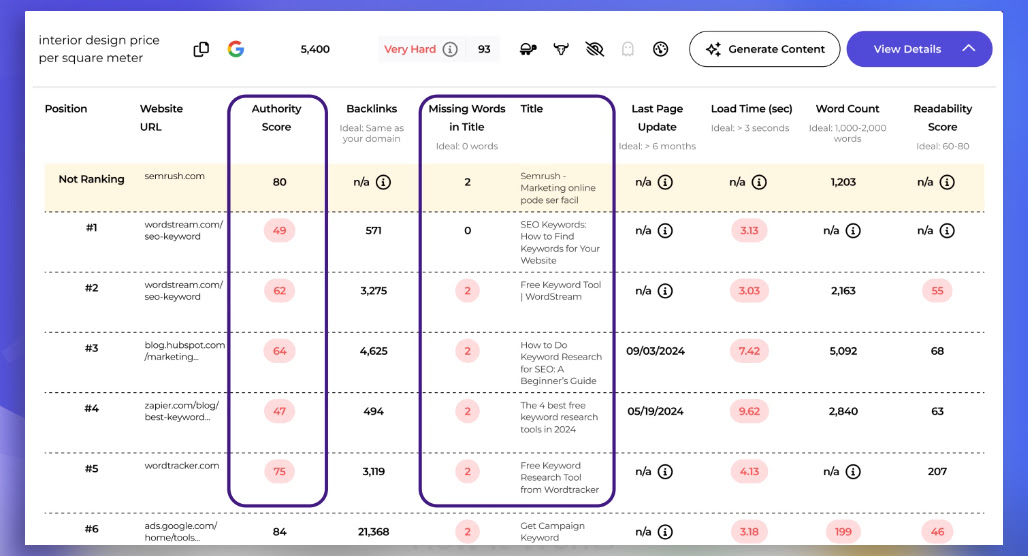
If you think one of the keywords is worth targeting, you can click the View Details button and see all of the information they give you about it. It's a full report on each of the top ten results for that keyword as they stand at the time of the report, including:
- The current position.
- The specific URL of the page.
- The Moz authority score for the page (not domain!)
- The number of backlinks pointing at the page.
- Whether or not the title is missing any of the words from the keyword phrase.
- What the specific title is for the page.
- When the page was last updated.
- How long the page took to load.
- What the word count of the page is.
- What the Flesch readability score is for the page.
- What the Moz spam score is for the page.
Any identified weakness is flagged in red, so you have an easy, at-a-glance look at where your page might fall if you don't have any of those weaknesses.
As you might expect from a recently developed SEO tool, there's also an AI button to generate title ideas, content briefs, full articles, or meta descriptions for you. The content brief (the only one worth elaborating on) gives you a content focus, target audience, and list of H2s + topic bullet points to cover, and a list of commonly asked questions (like the Google People Also Ask box) that can be incorporated in the post.
The other big way to use SERP Gap Analyzer is by giving it access to your Google Search Console, where it will scan your site and look for weaknesses and gaps that you can fill. It will identify pages on your site that have lower average ranking positions, low clicks and impressions, or low CTRs, and give you ideas for how to fix and improve them.
Those suggestions include basically the same list of things, like building backlinks, adding keywords to the title, updating them at all, improving load times, boosting readability scores, and so on.
There are also a couple of small additional AI tools, like having it suggest seed keywords for you, but they're not really core functionality, so I'm not paying them much mind. All of the AI tools are just using some version of GPT (GPT-4 as of this writing, but we all know these models keep changing), so it's nothing all that special.
What Does SERP Gap Analyzer Cost?
SERP Gap Analyzer has a seven-day free trial. After that, you have to pay for one of the two paid plans.
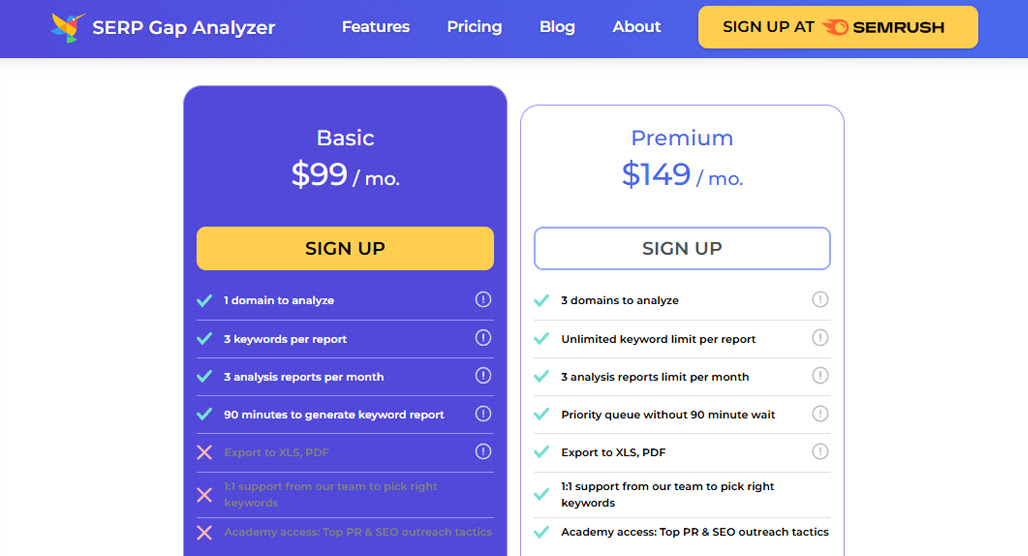
The Basic plan gets you an analysis of one domain, three suggested keywords per report, three analysis reports per month, and takes 90 minutes to generate the report.
The Premium plan gets you three domains to analyze, unlimited keywords per report, but still just three reports per month, and access to a priority queue so you skip to the front of the line for the 90-minute wait. It also allows you to export your reports, and access to their team to help you choose the right keywords to use.
Basic costs you $99 per month, while Premium costs you $149 per month.
But that's not all! See, this isn't a stand-alone tool; it's an app inside Semrush. That means you have to have a Semrush account, which starts at $140 per month.
That means for the bare minimum functionality, you're looking at $239 per month. Now, obviously, Semrush has a ton of useful features, so it's not like you're paying a bunch extra for nothing, but it is still more of a barrier than it might seem like from the outset. If the cost feels too high, you might want to explore free alternatives to Semrush before committing.
What Are the Drawbacks of SERP Gap Analyzer?
I have a bunch of gripes with SERP Gap Analyzer as a tool.
First of all are the icon-based weaknesses and opportunities that they give you in the reports that I outlined above. I don't entirely agree with these as "weaknesses" if we're being honest.
- PageSpeed, sure, it's technically a weakness, but the chances of you and the competition being so 1:1 comparable that site speed makes the difference are pretty slim.
- Outdated content is extremely topic-dependent. Evergreen content is a huge part of content marketing for a reason, and the average age of pages ranking well in the SERPs is five years old. Saying that content older than six months is a gap is nonsense.
- Using the Flesch Reading Ease Score to call a page unreadable is only tangential to SEO success in my experience. It's also not likely to be a full deal-breaker for a site.
- Meta title keyword mismatch? Yeah, you aren't getting hundreds of long-tail keyword variations in the meta title, the way the gap analyzer works virtually guarantees that no "opportunity" is going to have that match. They're almost definitely using a better keyword in the title.
Overall, only the "short content" one is one I find relevant, and even then, it's not necessarily going to be fully accurate because there are reasons why a page might have a short word count and still be highly relevant. Maybe it's centered around an embedded video. Maybe it's a brief tutorial with a lot of relevant images. Still, it's better than the other metrics.
The full report is also kind of weak to me.
For one thing, I'm not entirely sure I trust the metrics. In the tutorial video made by the developer showing off the tool, he uses a seed keyword that generates "Database tuning in SQL Server" as the top opportunity. The report claims that the authority score necessary to rank for this is 13, and that pages hit every weakness. Going through them:
- The top domains are pages like Microsoft.com, solarwinds.com, and Reddit. It assigns authority scores in the 10s and 20s to these sites. Do you really think Microsoft has an authority score of 29? I don't.
- The backlink numbers are whatever. It's the links that they find pointing to the specific page, which, sure.
- Missing words in the title?
Alright, I'm breaking from the list format for this one. The seed keyword generated "Database Tuning in SQL Server" as the keyword phrase. Then, it identifies titles such as:
- "Monitor and Tune for Performance - SQL Server"
- "What is SQL Performance Tuning?"
- "SQL Performance Tuning: 7 Practical Tips for Developers"
- "SQL Performance Tuning Made Simple"
Are all weaknesses? Do you really believe that not having the word "in" in the title is a weakness? I don't think so. Basically, this tool is identifying keywords using exact match rules and claiming that lacking the exact match is a weakness, which might have been true with how SEO worked 20 years ago, but has not been true since the early days of semantic indexation, and definitely not since AI language processing.
Other information I already mentioned. Page updated date, load times, word count, readability score, they're all small factors other than word counts, and even then, it's not necessarily fully representative.
The same goes for the self-analysis tool. In fact, in the same video, it even has an example of a page with the recommended keyword of "which keywords are best to target" and identifies missing words in the page title, where the page title is "which keywords are best to target: how to & why guide".
For another, the page with the title "Yes, SEO Keywords Can Be Phrases (12 Best Examples) " is dinged for not having enough of the keywords from the suggested keyword phrase "what are some words or phrases people use when searching for your products or services."
Now, it might sound like I'm cherry-picking these examples, but this is in the demonstration video promoting this product. That second one, Dmitry draws specific attention to. Do you think that's a good title change to make? I don't.
And a 90-minute wait for a report is killer, and not in a good way. I get that they're doing a lot of scraping of Google and getting Moz data, but still, that's a long wait.
Then there's the AI features. Things like AI titles and meta descriptions are whatever. The content outlines and full article generation are comparable to other AI content writing tools, but I still don't think any AI-generated content is going to be as good as human-crafted content. You can make your own judgment, but I'll tell you, they aren't doing anything unique with GPT-4 that you can't do on your own.
All of this wouldn't even be that bad if it were a tool that cost you, like, $20 a month. But it's not! It's a tool that costs you at least a hundred dollars for a whopping nine keywords per month.
So, should you use SERP Gap Analyzer?
If you already have and like using Semrush, then you can use the free trial of SERP Gap Analyzer and give it a look yourself. Personally, I don't think it does anything super useful or unique, especially not for the price. Maybe you'll feel differently, though, so at least give the trial a try.

Related Posts
Leave a Comment


Fine-tuned for competitive creators
Topicfinder is designed by a content marketing agency that writes hundreds of longform articles every month and competes at the highest level. It’s tailor-built for competitive content teams, marketers, and businesses.
Get Started