What Makes a Good Seed Keyword for Topic Expansion
 Written by James Parsons • Updated April 15, 2026


One thing I've been talking about recently is something I consider to be an intermediate strategy in content marketing, which is content clustering. When beginners start out with content marketing, they often shotgun content out into the world, taking keyword lists and running down them, creating posts for each in isolation.
Intermediate content marketers start to dig into more planning and the relationships between content. I don't just mean finding ways to add internal links; I mean planning out things like search intent, the overall funnel for content, and the mapping between related posts.
Content clusters generally use a pillar-and-spoke method for the best effect. One overall topic gets a huge, high-value post, and a lot of smaller, related, supporting topics all spin out from there, covering niche topics in greater detail before linking back to the main post.
Consider something like a Wikipedia page for, say, a country. You'll have the main page for the country, and it has individual sections for things like the history, geography, economics, demographics, and government of the country. Each of those sections often has links to longer and more detailed pages covering those specific subjects. For example:
Obviously, Wikipedia is an extreme example, when every third word on a given page can be a link out to another page all about that subject, and the relationships between them can be tenuous. But, it gives you an idea of the kind of mapping that goes into a topic cluster.
One question that comes up when you're planning a topic cluster, then, is what makes a keyword a good seed to spin out into a cluster? After all, there's a lot of frustration to be found if you take a keyword you thought was decent, but it turns out each section you thought could support an article is really more of a 200-word FAQ entry.
If you're dipping your toes into the idea of building content clusters, how do you pick the keyword to expand? What makes a keyword a good seed, versus one that can't support a cluster?
Key Takeaways
- Good seed keywords are short, broad, high-volume, and highly competitive - essentially the opposite of long-tail keywords.
- Breadth matters most: a good seed keyword must generate enough distinct subtopics to support a full content cluster.
- Seed keywords exist at different levels - site-wide, category, or cluster - and purpose determines which tier fits best.
- Cross-referencing multiple tools gives more accurate search volume estimates, since Google's ranges can be misleadingly wide.
- You can work top-down from a seed keyword or bottom-up from a keyword cluster tool to find the right starting point.
What Makes a Seed Keyword Good?
To start, let's look at what qualities a seed keyword has, and then we can discuss how to evaluate those factors for a given keyword, and what you're looking for.
Generally speaking, seed keywords are sort of the opposite of long-tail keywords. Long-tail keywords are longer keywords that encompass narrower topics but tend to have less competition and more reasonable thresholds necessary to rank for them in search.

Seed keywords are meant to be the higher-up, less attainable keywords. They work for clustering because of all of the support content - made up of long-tail keyword content - funneling links, traffic, and interest to the seed keyword's content pillar.
- Seed keywords are generally short, only a couple of words at most.
- Seed keywords are relatively broad and can encompass many different areas of discussion within their overall topic.
- Seed keywords have a high search volume.
- Seed keywords have generally high competition.
Depending on the purpose of the seed keyword, you might use short-tail keywords or medium-tail keywords for this.
To use an example:
- Short-tail: "Content Marketing"
- Medium-tail: "Budget Content Marketing"
- Long-tail: "Budget Content Marketing Tools"
In this case, the short-tail keyword is a great seed keyword for a whole website, but not so much for a single pillar post or content cluster. The medium-tail keyword is much better for a content cluster within an overall website, and the long-tail keyword is good either as a smaller cluster (since you could spin it off into tools for different marketing tasks) or as a post on its own.
Generally speaking, you'll have your first seed keyword just from knowing your own industry. Sneaker sales, content marketing, web development, lawncare; whatever your subject is, that's your top-of-the-top seed keyword.
The Length of a Seed Keyword
The length of a seed keyword does not, in itself, matter. You aren't going to judge a seed keyword based on how many words it uses. But rather the breadth and depth of the topic it encompasses.
That said, the length of a seed keyword is generally an indication of how deep down the taxonomic tree of information it is. "Exercise" is a seed keyword that encompasses an entire element of the human experience. So is "diet". But "health" could also be a seed keyword a step above them, by encompassing both diet and exercise. Similarly, you could do an entire website just based on cardio exercises, so "cardio exercise" can be the top-level seed keyword you use.
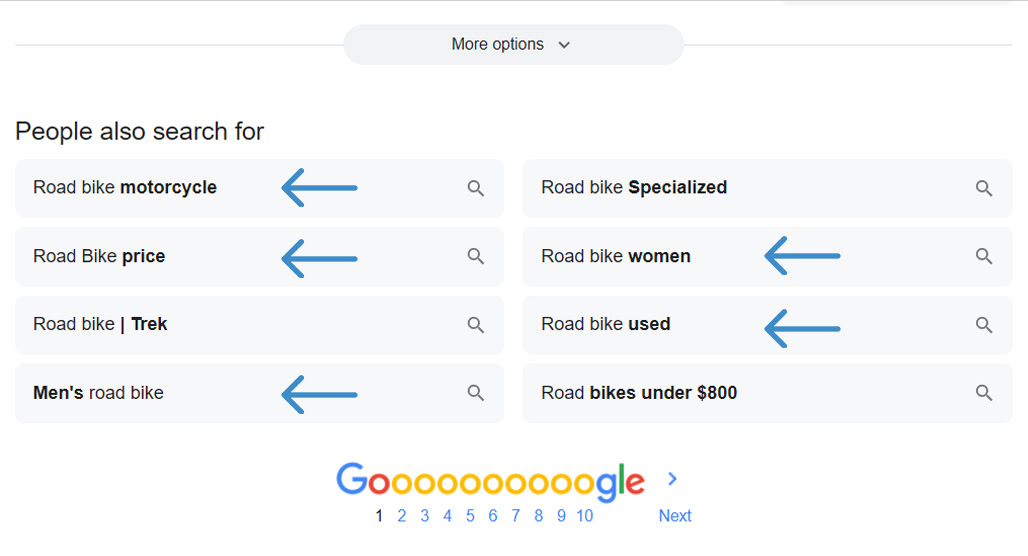
The more words used in a seed keyword, the narrower it is generally going to be. That's just how our language works; the more words you add, the more modifiers, descriptors, and limiters you're adding to the topic.
A short-tail keyword is going to be harder to target and rank for than a medium-tail keyword, and a medium-tail keyword is going to be harder to target and rank for than a long-tail keyword. Of course, that's all contextual as well - the short-tail "exercise" is a lot harder to rank for than the short-tail of something like "power cables" might be.
This is a function of the next quality on the list.
How Broad a Seed Keyword Is
How broad a seed keyword is is a kind of measurement of how many subtopics it can be broken up into.
"Exercise" as a seed keyword can be broken up in a lot of different ways. You can talk about the types of exercise (strength, balance/flexibility, aerobic), or you can talk about exercise with bodyweight, with weights, or with tools and machines, and so on. Each one of those subdivisions is broad enough to be a seed keyword itself, in fact.
Meanwhile, narrower seed keywords have narrower sub-topics. "Power cables" is a narrower topic because there are only so many things to discuss about it; infrastructure cabling versus appliance cabling, voltages, types of extensions and plugs, and so on. While that's a decent-sized list, the difference here is that these sub-topics aren't generally seed keywords themselves.
Evaluating how broad a seed keyword is comes down to figuring out how many keywords it spins off into. You can do this manually with brainstorming, or you can use keyword tools to spin off recommendations.

A common trap I see intermediate content marketers fall into is trying to build clusters with keywords that are too disconnected, so keep that in mind. If you want to understand how clusters work at a deeper level, check out our guide on topic clusters and why they matter.
What do I mean?
If you're trying to target "exercise" as your seed keyword, you'll want the content that feeds into it to be top-tier content about second-order topics related to exercise, like cardiovascular exercise, strength training, and the like.
Each of those needs to be built up with its own set of content feeding into it, though. Since "strength training" is a very broad seed keyword itself, you aren't likely to rank for it on its own either. You need to build it up like a pillar as well. You might use keywords like "dumbbell workout," "resistance training," or "strength training at home" to do so. This is also where understanding the difference between SEO topics and keywords becomes important.
To figure out what level of seed keyword you can target as a cluster, you need to look at the search metrics for that keyword.
Seed Keyword Search Volume and Competition
The two attributes that help define a seed keyword versus a longer-tail keyword you can actually rank for are the search volume and competition of the keyword.
Search volume, usually monthly search volume, is the number of times the keyword is searched for across the search engine. Google gives out very broad estimates of the scale of search volume, but they don't tell you where a keyword falls in the range they provide.
For example, a keyword might have an average monthly search volume of "10K - 100K" in Google's keyword tool. But, the difference between a keyword with 11,000 monthly searches and one with 95,000 monthly searches is pretty big! It's even worse for the higher-tier seed keywords, where the range is more likely to be 100K to 1M or 1M to 10M.
My recommendation is to check search volume using several different tools (like the Google Keyword Planner, Ahrefs, and WordStream's tool) to get a closer estimate of the real search volume.
Search volume is important for a seed keyword because the more volume it has, the more the sub-topics will have. The narrower and shorter-tailed the keyword is, the lower the volume.
Think of it this way. Getting a small-scale win and earning 1% of a keyword's traffic doesn't seem like much, especially compared to dominating a keyword and getting 95% of its traffic.
But, if the keyword you win that gives you 95% is only pulling in 10,000 people per month, that's 9,500 visits; if the keyword you get 1% of is pulling in 10,000,000 people per month, your 1% is still 100,000 visits.
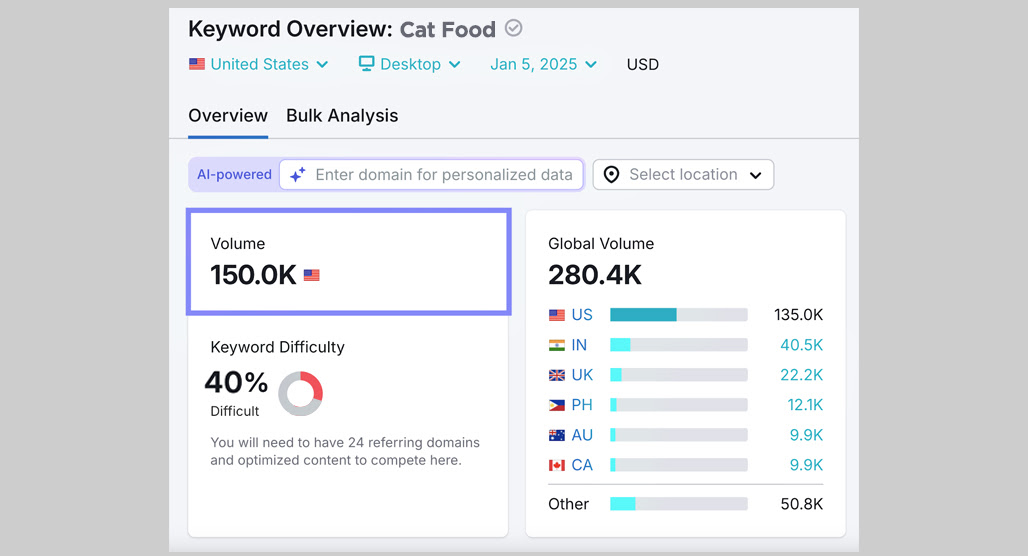
The related metric is keyword difficulty and competition. These are an estimate of how hard it would be for a piece of content to rank for the keyword.
Seed keywords are nearly impossible to rank for if you're anything short of a massive site dedicated to the subject.
Plug "exercise" into Google and what sites come up? Mayo Clinic, the National Institute on Aging, the National Health Service, Wikipedia, WebMD, Medline, the American Heart Association, and so on. What are the chances that your blog is going to break into that cohort? Pretty damn slim.
Now put in something like "upper body dumbbell workout" and see what comes up. You have sites like SELF Magazine, Men's Health, Muscle & Strength, Nourish Move Love, and some YouTube videos. That's a much easier group to break into.
You can even further divide that topic up. "The best dumbbells for an upper body dumbbell workout." "Upper body dumbbell workout for women." "Top dumbbell exercises for building upper body strength." These are the kinds of long-tail keywords that are easier to rank for than their broader seed counterparts.
Checking keyword difficulty is tricky, too. There are tools that can do it, but there are also a lot of factors that can skew the results or make certain keywords less or more viable than the numbers make it seem. I cover that in my guide there, though, so give that a read.
Picking a Great Seed Keyword
If you want to pick a seed keyword, the first thing you want to do is determine what purpose you're going to have for it.
Some seed keywords are best for a whole site. Men's Health is a site dedicated to men's health, and that's their top seed keyword. They can rank a page for that keyword, but it's their homepage, and with good reason.
Other seed keywords are better for subsections on a website. You'll often see these as the overall categories for a website. On Men's Health, you have things like Men's Fitness, Men's Grooming, Gear for Men's Health, and so on.
Worth noting is that these keywords are also often seed keywords for entire sites; the sites just have a lower ceiling than the more generic top-level keywords. There are plenty of sites dedicated just to men's grooming, after all.
Below that are seed keywords that make up topic clusters. These can support a pillar post, and the topics spun out from them make up individual pieces of content.

There's an art to figuring out where a keyword sits in this scale, and a lot of it is contextual. You often see smaller sites rebrand to encompass a broader topic as they grow, because they dominate their top-level seed keyword and want to step up a tier.
Once you have a purpose for your seed keyword, take a look at how it stands with competition and search volume, and see what the potential rewards can be. That gives you an idea if it's a site-level, a category-level, or a cluster-level keyword. From there, you can spin off the step below it, and the step below that, and so on until you reach individual content keywords.
You can also do this in reverse. Generate a topic list with something like Topicfinder, which gives you the keywords and topics of content in your niche, and use a keyword clustering tool to find commonalities between them. Then, work your way up the chain to find a seed keyword, and then go back down to spin it out even more.
There's nearly infinite depth to explore, so keep in mind that there's no firm endpoint to this research. You'll need to pump the brakes at some point and change gears into actually producing content, sooner or later.

Related Posts



Leave a Comment


Fine-tuned for competitive creators
Topicfinder is designed by a content marketing agency that writes hundreds of longform articles every month and competes at the highest level. It’s tailor-built for competitive content teams, marketers, and businesses.
Get Started