KeywordTool.io Review: Data Reliability, Pricing, Tips and More
 Written by James Parsons • Updated April 15, 2026


There are many, many different tools out there for gathering keyword information. They work in a wide variety of different ways, from unique big data research to LLM list generation to scraping existing websites and resources.
KeywordTool.io is one of these keyword research tools, used by many big brands, from Adobe to Zillow. The question is: is it any good? How does it work, and is it worth using? Let's give it a rundown and see.
Key Takeaways
- KeywordTool.io scrapes autocomplete suggestions from 15+ platforms including Google, YouTube, Amazon, TikTok, and Instagram.
- Paid plans range from $70-$160/month (annual pricing), but there's no free trial-only a 30-day money-back guarantee.
- Search volume data largely comes from Google Keyword Planner, reflecting paid search metrics rather than organic traffic patterns.
- Key weaknesses include keyword overlap, no keyword difficulty scores, no SERP previews, and limited organic content insights.
- The article concludes better free and paid alternatives exist, making KeywordTool.io overpriced for what it actually delivers.
How Does KeywordTool.io Work?
First, let's look at the tool itself, what it promises, and how it works. You can find it at keywordtool.io, easily enough.
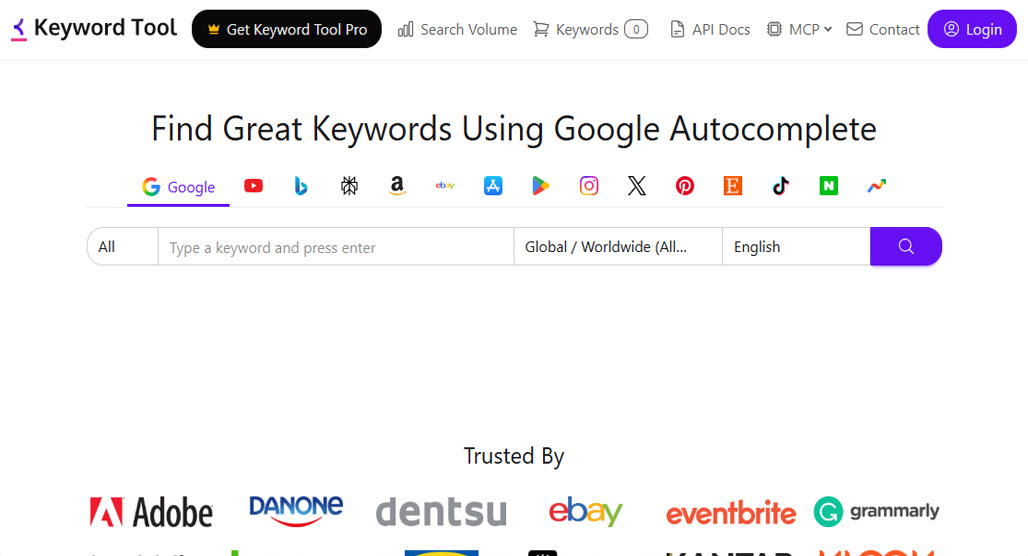
What do they promise? Keyword information pulled directly from the autocomplete recommendations present in many modern search platforms.
You know how these days, when you start typing in a search, the app you're using will offer suggestions on how to finish the query? It's a bit of an accessibility feature, so you don't need to type a lot on a mobile device, but it works for PC browsing too, for most of these apps.
Well, the idea behind Keyword Tool is that it just scrapes all of that information and gives it to you. It can't scrape things blindly, so you give it a seed keyword, and it gives you a full scraped list of the autocomplete suggestions the platform makes.
What Platforms Does Keyword Tool Scrape?
While Keyword Tool started out as a scraper for Google Autocomplete suggestions, they have expanded significantly over the years.
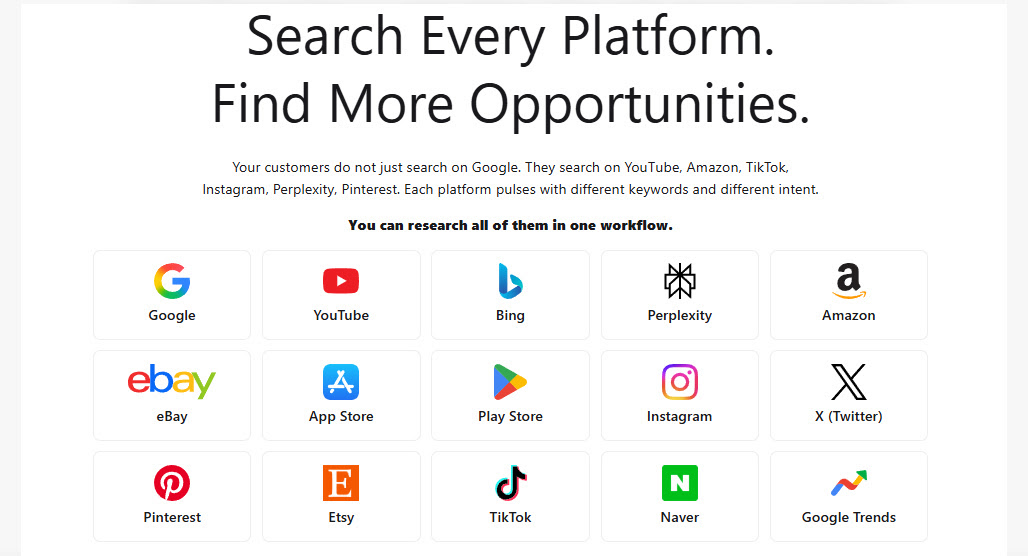
Today, they do:
- Google Search
- YouTube Search
- Bing Search
- Perplexity LLM Search
- Amazon Product Search
- eBay Product Search
- Apple App Store Search
- Google Play Store Search
- Instagram Search
- X Search
- Pinterest Search
- Etsy Product Search
- TikTok Search
- Naver Search
- Google Trends
The only unusual one on this list is Naver, which is a South Korean multimedia conglomerate that does search, among other things.
For whatever reason, Keyword Tool also has a word counter, which I can't imagine finding useful, given that I can't think of a place I type up something longer than a tweet that doesn't have a built-in word counter. They also have a URL for an image search, which just runs your image through Google Lens when you put it in. There are also a variety of "tools" they offer, like a long-tail keywords tool and a marketing tool, which are just their Google Search tool with a different URL. The results page isn't even different.
What Data Does Keyword Tool Give You?
So, what data do you get when you use Keyword Tool? As you might expect, it varies depending on whether you're using it for free or with a paid subscription.
When you plug in a seed keyword and search for free, you get very limited data.
For Google Search, you get a total number of keywords and the list of those keywords. You can also click on "questions" or "prepositions" for alternative data.

For example, I typed in "keyword planning" as a seed.
- Standard keyword results include 296 keywords, which include things like "keyword planning api", "what is a keyword", and "c keyword in".
- Questions gives me 44 questions, which include "how to do keyword planning", "is keyword planner free", and "who to consider when planning".
- Prepositions gives me 56 more keywords, including "keyword planning for SEO", "keywords for planner", and "Google keyword planner without login".
As you can see, the actual results are all over the place in terms of usefulness. I can also tell you that there are a lot of mostly duplicate results, such as the same phrase with 2024, 2025, and 2026 behind it.
If you pay for information, they give you more data about your keywords, but not more keywords. You access:
- The total search volume, average trend, top of page bid, and average competition for the seed keyword.
- Search volume, trend information, top of page high bid and low bid, and competition metrics for each individual keyword.
Other searches give you similar data as a baseline.
- YouTube search also gives you hashtag data, and replaces top of page bid with average CPC.
- Bing data gives you basically the same data as Google, but with CPC instead of bid.
- Perplexity is the same, though it seems to have over double the number of keywords.
- Amazon doesn't give you Questions data, and also doesn't work at all if your search isn't product-related.
- eBay and Etsy are the same as Amazon.
You get the idea. It's all broadly similar, but you're of course only going to get useful results for certain kinds of queries from certain platforms.
How Much Does Keyword Tool Cost?
So, if you want all that extra data, how much will it cost you?
Keyword Tool has three paid plans.
Pro Basic gives you 12 months of Google search volume data, Bing volume data, estimated volume data for the other platforms, and one user account. It's $70 per month.
Pro Plus gives you 24 months for Google and Bing, adds in the competition data and by-device breakdown for search volume, and five user accounts. It's $80 per month.
Pro Business gives you 48 months of Google data (but still 24 for Bing and 12 for the rest), adds in CPC data, and gives you 10 user accounts. It's a whopping $160 per month.
Those are the "paid yearly" prices, too, by the way. Paid monthly, it's $90, $100, and $200, respectively.
There is no free trial for any of these (unless you consider just using it for free and only getting the keyword lists), but they do have a 30-day money-back guarantee. If you're a large enough company, you can also request a demo of the tool or their API and get a one-on-one demonstration. I can't speak to the quality of that demo since I didn't get one. If you're looking for free alternatives to paid keyword tools, there are several worth considering.

If you want Keyword Tool's data through an API, they have three API plans as well. The basic is $300 per month, the mid-tier is $1,000 per month, and the full API is $2,000 per month. All of these are limited in volume and API requests per day.
Is Keyword Tool's Data Reliable?
This depends on what you mean by reliable.
Does it do what it says it will do? Sure. When you type in a seed keyword, it gives you suggested keywords that expand on your seed. The number of keywords it gives you depends on how broad your seed keyword is. I've seen some older reviews mention getting thousands of keywords, but I haven't seen any results recently that match that. Most seed keywords give 250-750 keywords for keyword suggestions, and 50-300 for questions and prepositions.
What about the other data? Is the CPC or search volume or competition accurate?
I'll say yes, but with a huge asterisk here. At least for Google information, their data basically comes from the Google Keyword Planner. Bidding information is the current information for the ad auction for the keyword. Competition is just the number of other people that are currently bidding on the keyword, on a scale of 0 to 100.
I assume the rest of the data is coming from similar API sources from those other platforms.

The biggest flaw is that this isn't representative data for the main reason you'd be using keyword information, which is organic content. You see a search volume estimate, and you assume it'd be organic search volume, but it's actually paid search volume, which is different in important ways.
I've also heard a lot of reports that the search volume data is just not very accurate at all. That makes sense when you consider that sources like Google's Keyword Planner use very broad buckets for volume data, which makes it not very useful other than very broad scale estimates. So, one of the few pieces of data they give you is not very useful or accurate.
What Are the Pros of Keyword Tool?
A tool like this wouldn't be around for over a decade if it didn't have something going for it, so what are the benefits of the tool?
Mostly, it's just simple, easy to use, and you can get a list of keywords for free. If you don't need (or don't trust) the PPC bidding and competition metrics, then getting a pile of keywords in a few seconds is a fine use of a tool. You don't have to pay for those, and to my knowledge, they don't cut you off after a handful of searches like some other "free" tools do.
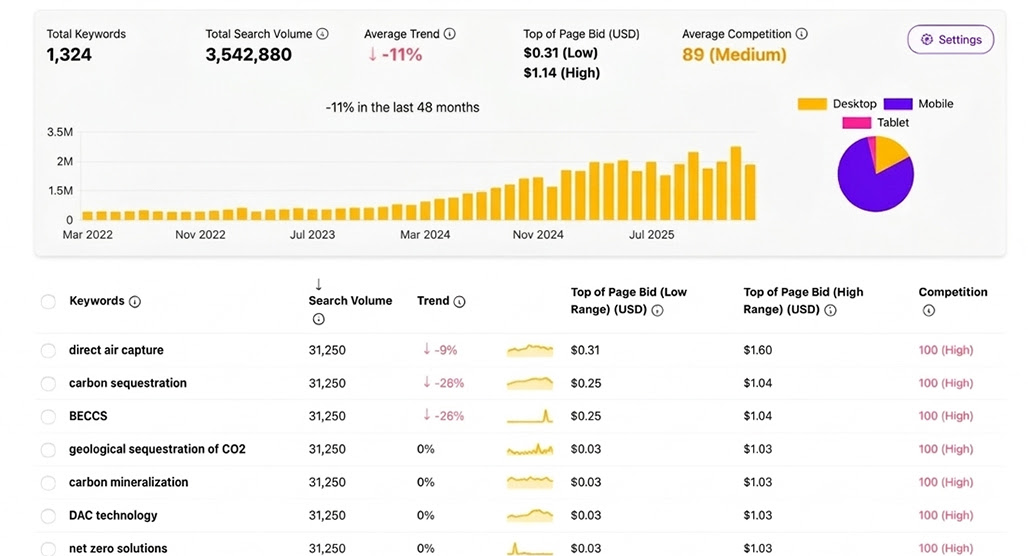
The fact that you can get keyword information for a bunch of platforms, including some less typical platforms, all at once? That's nice too. You don't need a handful of tools to do your social, ecommerce, and web search queries, since they handle all of them in one. You do have to tab through the results and get them all individually, but that's only a minor hassle.
You can also do some basic geographic and language targeting. That's handy if you're finding results that don't suit your needs.
You're also allowed to add up to 100 filter keywords and 5 negative keywords as a free user, and paid users can add more negative keywords (up to 2,000, which is hugely overkill in my experience).
The API they offer is fine, too. You would probably be fine just using the native APIs they're pulling their data from, but if you would rather work with just one API instead of half a dozen or more, this is a neat way to launder the data.
What Are the Cons of Keyword Tool?
Oh boy, here we go. Keyword Tool has some things going for it, and a lot of things working against it.
For one thing, it's really expensive for what you get. If you think about the kinds of things you want from a keyword analysis tool, and then look at the features and data Keyword Tool gives you, you'll see a huge mismatch.
- There's no analysis of the viability of the keywords for content. Since it's basically all PPC data, it's not as useful for organic marketing.
- There's a lot of overlap in keywords. The same keyword with four dates at the end does not mean you're getting four unique keywords.
- There's a lot of bad keywords. A good chunk of what they give you is not going to be valuable to you outside of certain very narrow niches, if it's useful at all.
- There's no competitive analysis other than an estimate of the number of competitors out there, based on ad bidders. No keyword difficulty, no competitor content quality, not even SERPs previews.
If we're being honest here, there's not really anything that Keyword Tool gives you that shouldn't be available for free. In fact, most of it is available for free from the sources they use; it's just slightly more tedious to gather on your own.
There's also one huge warning. Without a free trial, you're putting up a good chunk of money to use that 30-day guarantee. You have to trust them to honor that guarantee, and when they're based in the UAE and Hong Kong, communicating proactively to redeem it can be difficult.
I can tell you that, from personal experience using probably over a hundred different keyword tools, Keyword Tool doesn't really do anything special, or even all that useful. There are free Google scrapers out there that will also do the People Also Ask and other suggestions boxes, there are more advanced tools that give you way more data, and so on.
Getting a pile of keywords with nearly no filtering or contextual information isn't helpful for marketing. It leaves you with no guidance on how to actually use those keywords for your site's benefit.
Basically, by the time you know enough to know what to do with a pile of keywords like that, you know enough not to need something as overpriced and underpowered as Keyword Tool.
Should You Use Keyword Tool?
Being real, probably not.
But hey, why not just give it a try? You can run a few keyword searches using basic seed keywords and see what you get. You don't even need the pricing data or the competitor numbers or any of that. Just look at the keywords and compare them to other keyword research you've done in the past.
I'm guessing you won't find anything really innovative or useful. But then, truth be told, Google's auto-complete also isn't that rich of a mine for keyword data anyway. People convince themselves that it's in touch with trends and all the rest, but in my experience, it's some of the most generic keyword information you can get.
There are way more useful keyword tools out there that you can use instead. I already wrote a list going through over a dozen different free options, and of course, I built Topicfinder because I was broadly dissatisfied with everything else on the market for my own uses.

If you have $80 a month burning a hole in your pocket, there are better things you can spend it on, let's just put it that way.

Related Posts

Leave a Comment


Fine-tuned for competitive creators
Topicfinder is designed by a content marketing agency that writes hundreds of longform articles every month and competes at the highest level. It’s tailor-built for competitive content teams, marketers, and businesses.
Get Started