How to Use Scispace for Your SEO Topic Selection
 Written by James Parsons • Updated July 22, 2026

The problem with SEO content is rarely the keywords themselves. It is the reasoning behind them. Most tools are very good at telling you what people are looking for. But they give you very little insight into why those searches happen, what questions sit underneath them, or what the research actually says about the subject. That difference between surface-level demand and genuine substance is where SEO content quietly falls apart.
That is the space where Scispace does something different. Originally built as a research tool for academics and scientists, Scispace gives you access to a database of over 280 million academic papers, trusted by more than one million scientists worldwide - it was built so you can move past the noise and find the evidence-backed ideas, upcoming questions, and intellectual substance that most keyword tools basically can't surface.
For SEO content creators, that depth is not just a great bonus - it's a genuine competitive benefit. When you know what the research says about a topic, you can create content that actually earns authority instead of just performing for it. This guide will talk about how to bring Scispace into your topic research process in a way that's helpful, repeatable, and fairly easy.
Key Takeaways
- Scispace accesses over 280 million academic papers, helping content creators find evidence-backed topic ideas standard keyword tools can't surface.
- The Find Topics feature clusters subtopics from research literature, revealing content opportunities before they enter mainstream search demand.
- Deep Review stress-tests topic ideas by scanning thousands of papers, revealing whether research support is strong, contested, or nearly absent.
- Research-backed topics offer higher longevity, stronger trust signals, and greater depth potential compared to trend-based content ideas.
- Combining Scispace with keyword tools gives creators both demand data and evidence substance, producing a stronger overall content foundation.
Table of Contents
What Makes Scispace Different From Standard Keyword Tools
Most keyword tools are built to show you what people search for. That is helpful. But it only tells you half the story. What those tools can't tell you is what the research actually says about a topic.
Scispace is an AI-powered research platform with metadata on over 200 million academic papers and more than 50 million open-access full-text PDFs- it was built for scientists. But it turns out to be helpful for content creators who want to write about topics that have scientific weight behind them.
Here is the gap worth thinking about. A keyword tool might show you that "magnesium for sleep" gets strong search volume. But it can't tell you if the evidence for that claim is strong, mixed, or still being debated. That distinction matters quite a bit if you want to write content that holds up under scrutiny and builds trust with readers over time.
Content creators who skip the research layer tend to produce pieces that hit the right keywords but miss the substance. Readers see this and so do subject-matter experts who might otherwise link to your work.

Scispace lets you get into the academic layer without a library subscription or a background in research. You can search by topic and see papers, publication dates, citation counts and AI-generated summaries- it makes it much faster to know what the science says without reading dozens of dense studies from start to finish.
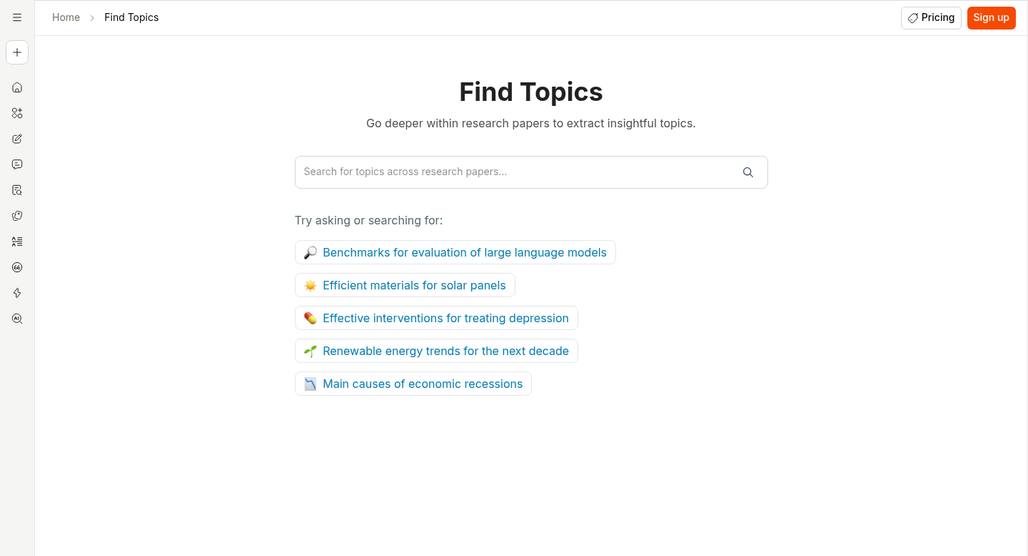
The platform also has a tool called Find Topics which is specifically designed to surface content opportunities from academic literature. That is what the next section covers in detail.
On the cost side, the Premium Plan starts at $7.20 per month which makes it accessible for solo content creators and small teams. You don't need to sign a business contract to get value from it.
Keyword tools align well with demand. Scispace aligns well with evidence. Using them together gives you a much stronger foundation to build content on than either one alone.
How the Find Topics Tool Surfaces Content Opportunities

The Find Topics feature pulls from a database of over 200 million research papers to surface what academics and scientists are writing about; it's a very different starting point from a keyword tool that measures search volume.
When you type a large subject into Find Topics, it returns results grouped into clustered subtopics, each one grounded in published research. So instead of seeing "gut health" as a single keyword, you might get back subtopics like the gut-brain axis, microbiome interventions in adolescents, or dietary fiber and inflammatory markers. These are angles that are out there in the literature but haven't necessarily been packaged into content yet.
That gap is where the value is. A keyword tool tells you what people are already looking for. But Find Topics can point you toward what people will be looking for once the research enters mainstream conversation.
In practice, the workflow is pretty easy. You enter a subject, review the clustered results, and look for subtopics that fit your audience but don't have much content coverage yet. The clustering matters because it helps you see relationships between ideas instead of just a list of standalone phrases.
Some content niches get more out of this than others. Health and wellness writers benefit enormously because the space is research-driven and audiences are hungry for accurate, substantive information. Finance and EdTech are strong fits too, and these are businesses that want to write about upcoming patterns before they become saturated. B2B SaaS is worth a mention as well - product categories like AI, cybersecurity, and data infrastructure are moving fast and the academic research tends to run ahead of the blog content by months or years.
If your content strategy depends on being credible instead of just visible, Find Topics gives you something to work with that most of your competitors won't have thought to look for. The research layer can add a dimension to topic discovery in oversaturated niches that's hard to replicate with traditional tools.
It's also worth mentioning that the subtopics you find here aren't just abstract academic ideas. Many of them map directly to questions your audience is already asking - you're just finding a more precise and defensible way to answer them.
Using Deep Review to Validate and Deepen Your Topic Ideas
Once you have a list of candidate topics, the next step is to test if they actually hold up; it's where Deep Review comes in. Added to Scispace in February 2025, it lets you run a focused analysis across a large pool of academic papers to see what the research says about a given topic.
The scale of what it can process is worth learning about. In one documented use case, Deep Review scanned 1,750 papers, identified 320 as relevant, and then built its synthesized answers from the top 20 most helpful sources; it's a structured look at what the literature actually supports - not a surface-level summary.
How to use it to stress-test a topic
Think of Deep Review as a way to ask hard questions about a topic. You can enter a topic or research question and then look at what comes back with a critical eye - is there a strong body of research behind it, or just a handful of loosely related papers? Do scientists usually agree, or is there active debate in the field?
That distinction matters quite a bit for SEO content. A well-settled topic gives you ground to write from - you can take a position backed up by evidence. A contested topic is also helpful. But it changes what you write. You'd want to acknowledge the debate instead of presenting one view as fact.
If Deep Review struggles to find relevant literature, that's a signal too - it doesn't automatically mean the topic is bad. But it does mean you should think before building a content piece around it. Trend-chasing topics that have no research foundation are risky to write about with any depth or authority.
What this means for your content briefs
This changes how you can structure the brief-writing process. Instead of guessing at what angle to take, you can go into a brief knowing which claims are research-backed, where the gaps are, and what the evidence actually looks like. That makes the brief more helpful to whoever writes the content - and it makes the final piece harder to challenge.
Deep Review gives you a layer of validation that most SEO workflows skip entirely. Running it on your shortlisted topics to prioritize them puts you in a much stronger position going into the next step. If you want to go further, using NLP analysis on your content can help you refine how well each piece actually covers the topic once it's written.
How to Prioritize Topics Based on Research Signals and Search Intent
Not every topic Scispace surfaces is worth writing about. You want to find something your audience actually needs. That you can cover with enough depth to be helpful.
Start by asking what the person looking for this topic already knows. A reader who is new to a subject needs foundational content. A reader who already understands the basics wants specifics, comparisons, or nuance. Research-backed topics tend to serve that second group well because they have substance to learn - not just surface-level definitions.
Search intent matters here more than you might think. If the dominant results for a keyword are listicles, Google is telling you something about what searchers want. But if research papers, case studies, and long-form guides dominate, that's a signal that depth is rewarded. Scispace helps you see where the substance is, and that points you toward intent categories where careful, evidence-based content can compete. For example, high-intent blog posts often reward this kind of depth over surface-level coverage.

One helpful way to weigh your options is to compare research-backed topics against trend-based ones across a few dimensions.
| Factor | Research-Backed Topics | Trend-Based Topics |
|---|---|---|
| Longevity | High - findings stay relevant for years | Low - tied to news cycles or hype |
| Trust signals | Strong - citations and data build authority | Weaker - often based on opinion or recency |
| Content depth potential | High - multiple angles to explore | Limited - narrow window before it's stale |
| Audience fit | Best for informed or solution-aware readers | Best for broad, awareness-stage audiences |
Use this thinking to filter your shortlist. A topic with strong research support, a clear audience need, and room to go deeper compared to what already ranks - that's the one to prioritize. Understanding how parent topics work in SEO can also help you see where a research-backed piece fits into a broader content hierarchy.
Competitive gaps matter too. If existing content on a topic is thin or relies on weak sourcing, a well-researched piece has an opening. That goes beyond rankings - and toward giving readers something that actually holds up. Tracking keyword velocity alongside your research signals can tell you whether that gap is widening or closing.
Building a Smarter Topic Strategy With Scispace
If you've been sitting on a topic you're not quite sure about - one that feels promising but unproven - that's where to start. Run a free Scispace search on it. See what the research says, where the gaps are, and if the angle you had in mind holds up. You might confirm your instincts, or you might find something even better.
To put this into motion:
- Pick one topic you've been uncertain about and search it in Scispace
- Look for recurring themes across studies - those often signal content gaps worth filling
- Note what's contested or evolving - that's where genuinely useful content lives
- Build your content brief around what the evidence supports, not just what ranks today
Search engines have become remarkably good at recognizing content that earns its position. The question worth asking is not how do I rank? but do I deserve to? A research-backed topic set is how you answer yes.
FAQs
What is Scispace and how does it help SEO?
Scispace is an AI-powered research platform with access to over 280 million academic papers. It helps SEO content creators find evidence-backed topic ideas that standard keyword tools can't surface, adding substance and authority to content strategies.
How does Scispace differ from traditional keyword tools?
Keyword tools show search demand; Scispace reveals what the research actually says about a topic. Using both together gives content creators both demand data and evidence-backed substance, producing a stronger content foundation.
What is the Find Topics feature in Scispace?
Find Topics pulls from academic literature to surface clustered subtopics within a broader subject. It helps content creators discover research-driven angles before they enter mainstream search demand, offering a competitive edge in saturated niches.
What does Scispace's Deep Review tool do?
Deep Review scans thousands of academic papers to validate whether a topic has strong research support, active debate, or limited evidence. It helps content creators build briefs around claims that are genuinely defensible and evidence-backed.
How much does Scispace cost for content creators?
Scispace's Premium Plan starts at $7.20 per month, making it accessible for solo content creators and small teams without requiring a business contract or institutional library subscription.

Related Posts

Leave a Comment


Fine-tuned for competitive creators
Topicfinder is designed by a content marketing agency that writes hundreds of longform articles every month and competes at the highest level. It’s tailor-built for competitive content teams, marketers, and businesses.
Get Started