What Are QDF Keywords and How Do You Target Them?
 Written by James Parsons • Updated April 15, 2026


I've been talking a lot recently about the importance of keywords and the ways keyword usage, entity-focused SEO, and AIO are all impacting content marketing. Part of this is because people keep coming up with new "kinds" of keywords, and I need to break down what they are, how they work, and if they're anything different from business as usual.
That leads me to another topic I've been tangentially aware of but haven't broken down as of yet: QDF keywords. You may have heard of them, or maybe not. What are they, how do you target them, and are they something worth spending extra time on? Let's dig in.
Key Takeaways
- QDF (Query Deserves Freshness) is a Google ranking factor introduced in 2007, rewarding recently updated, relevant content.
- Keywords fall into three freshness categories: freshness unnecessary, freshness contextually useful, and freshness always required.
- Targeting QDF keywords involves two main tactics: covering trending topics quickly and keeping evergreen content regularly updated.
- Google's Natural Language Understanding has shifted focus from specific QDF keywords to broader topics and entities.
- When updating old content, never change the URL-a new URL means Google treats it as entirely new content.
What is QDF?
QDF is actually not a new term. There's coverage of it as far back as 2011, and even then, that coverage starts off with "QDF is not new." It was introduced all the way in the far-off days of 2007.

QDF stands for Query Deserves Freshness. That alone can tell you nearly everything you need to know about it.
Nearly 20 years ago, search engines worked very differently than they do now. They were very rigid and very locked into specific keywords, and the "algorithm," such as it was, was largely based on a handful of signals like backlink numbers and the size of the site. It was a simpler time.
In the constant quest for improvement, Google (and the other search engines) pushed for different ways to make search results more useful to the people performing their searches. Back before 2011, one of those tweaks was to add "freshness" as a ranking factor.
It's a reasonable choice to make. When you're looking up information, there's a pretty good chance you want up-to-date information, right?
- If you're looking for driving directions, you don't want to be guided to a bridge that collapsed last year because a boat hit it.
- If you're looking for a place to eat, you probably would rather see a new hot restaurant and not one that closed a few years ago.
- If you're looking for troubleshooting information for a problem with your web browser, you probably want recent information and not information for a similar problem with different details from ten years ago on StackExchange.
At the same time, freshness can't be a dominant ranking factor. Otherwise, someone could spin up a copycat site, publish spun versions of everything on the site they're copying, and outrank them, which is clearly no way to live.
Generally, the idea is that if two sites have content that is similar across various SEO metrics like length, quality, backlinks, and authority, the one with the more recent update is more likely to be more relevant and valuable.
It's similar to, but not quite, newsworthy and news-focused content. News content is expected to be highly relevant for the first few days or weeks it exists, and then drop off rapidly. QDF content is a modifier more for evergreen content, where keeping older content up to date adds that element of freshness that keeps it going.
It can be useful to think of QDF not as something inherent to your content, but as something inherent to the way searches are performed, as well. It can be very contextual: someone searching for information about the Olympics is probably fine with historic information when it's in the off-years, but likely wants more updated news information during the Games themselves, even if their query is identical.
What Are QDF Keywords?
Keywords can be broken up into a thousand different categories and paradigms, and QDF is one of those ways of looking at them.
Under QDF, keywords can be divided into three groups.
- Queries where freshness is completely unnecessary.
- Queries where freshness may be useful, contextually.
- Queries where freshness is always important.
For example, if you were to search for something like "How to frame a poster", you'd get a bunch of instructions and tutorials (and framing services), but nothing there really needs freshness. It's not like there's active study into the methods used to frame posters; putting things in frames has been around for millennia, and there haven't really been any new developments.
In the middle group is something like the Olympics example above. Sometimes there's no real need for freshness, while other times there is, and it depends on what the state of the news is surrounding the topic.
Queries where freshness is always important are queries like "What's leaving Netflix this month?"; the only relevant answers to that question are recent answers, and anything older isn't valuable.

There aren't necessarily specific keywords designated as QDF keywords, though. Even a query like "what is leaving Netflix" would no longer be relevant if Netflix stopped dropping shows or failed as a business.
Unlikely, sure, but nothing lasts forever.
QDF and Language Understanding
Thinking about keywords in terms of freshness was a lot more relevant a few years ago than it is now.
Before you misinterpret what I said there, though, let me be clear: Freshness is still important. Queries still deserve freshness. But specific freshness-dependent keywords aren't as impactful anymore. They still have value, but they aren't the framework for entire strategies anymore.
All of this is because of the Natural Language Understanding work that Google has been doing for many years. From semantic indexing to language processing to LLMs, Google has put a lot of work into understanding language beyond the keyword level.
This is why topic-focused marketing and entity SEO have been so big the last few years.

When you write about a topic, you aren't really just targeting specific keywords anymore. You're targeting concepts, entities, word clouds of related concepts, all of which are touched on or brought up or relevant.
This is why you can type in a query and get results that fit the bill even though they don't use the specific words you used.
This doesn't change how relevant freshness is, but it does change how you go about targeting it. Instead of having to identify and use specific keywords, you identify topics and entities and cover them in your content.
How to Target QDF Keywords
Alright, let's talk mechanics. How do you target QDF keywords and reap the benefits of fresh content in Google?
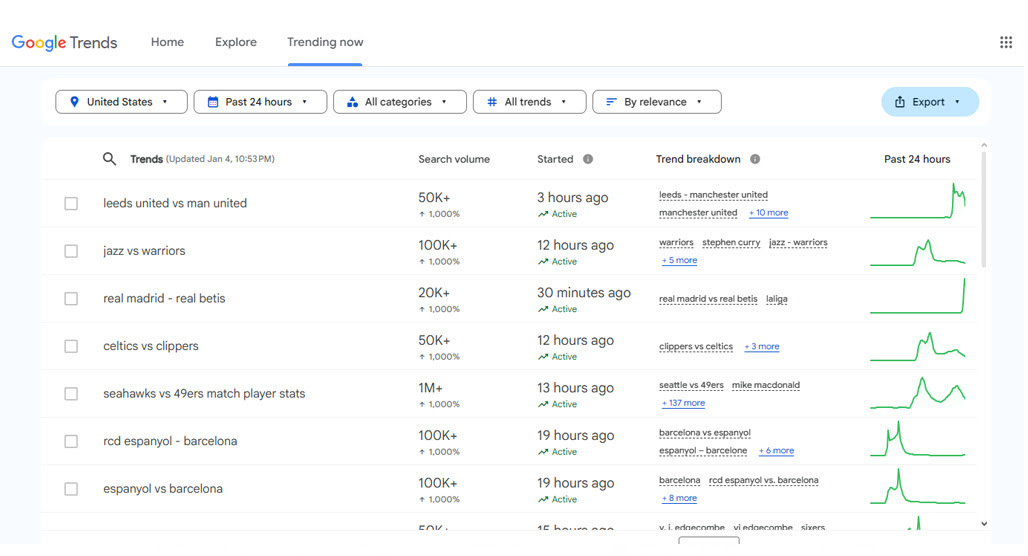
The answer probably shouldn't surprise you, but it all comes back to two things.
- Identify and cover trending topics.
- Keep older content up to date.
That's basically it. So, let's talk about each of those in greater detail.
Identifying and Covering Trending Topics
A big part of taking advantage of QDF is recognizing when a topic is trending and covering it.
You can generally trust Google to have its finger on the pulse of pretty much anything. Their index is so large and active, and their ability to monitor news feeds, social media streams, and other sources of trending data means you can find coverage in their index of topics that happened mere minutes ago.
Queries deserve freshness, and nowhere is that more visible than in trending topics. The latest, up-to-the-minute information surfaces near the top. Google even has specific knowledge graph boxes and enhanced search results for breaking news and trending topics.
If you've been in content marketing for any length of time, this should be broadly familiar to you. The push-and-pull between newsworthy and evergreen topics, the spike-and-drop model of traffic versus the slow-building snowball, and so forth.
The good news is, there's a pretty well-established pipeline for this kind of content production. You need some kind of trend-watching tool for your industry, you need a rapid turnaround in content production and publication, and you can benefit from the ability to rapidly update and maintain that content as long as it's relevant before going onto the next big thing.

I've even written about a lot of this before. Check out guides to some of those tools and techniques, such as:
Since trending topics are often short-lived, you can dedicate a lot of your effort to finding them and the rapid initial production, and then let them languish once the trend is fading.
My pro-tip strategy here is that, once those trends are fading and the rapid-update quality benefits are gone, you can convert the content into something more evergreen. The URL, the keywords, the topic coverage, the traffic, the backlinks, all of that can be maintained as you shift the content over into something with longer-lived value.
For example, any SEO-focused marketer can do news-reaction posts covering new Google algorithm updates. Moz explicitly then shuffles that content into the Google Algorithm Update History, maintaining all of that content in a reliable history that serves as an evergreen source of value.
Maintaining Freshness in Evergreen Content
The other side of the coin is maintaining freshness in older content.
You can't just go through and keep all of your old content refreshed all the time, though. If you do, you'll end up doing pointless refreshes to content that doesn't need to be changed. You'll also very quickly burn out, because trying to keep hundreds (or thousands) of pieces of content updated, even on an annual basis, is a massive undertaking.
You also can't fake it. You can change your publication date (or remove it entirely), and you can make little tweaks and edits to your content, but Google has the before-and-after photos, and they can tell when they're the same picture.
A few things can help out here.
The first is the same sort of trend-watching and monitoring tools as above. Keep an eye on trends; when something new is coming up, write new content. When something you've already covered is coming up, update the content for relevance.
The second is the 80/20 rule. This is a business principle where, broadly speaking, 80% of your results are going to come from 20% of your effort. So, you identify the top 20% of your content in terms of ongoing relevance and keep that updated.
A third is watching your metrics daily. When you see a post suddenly start to get more incoming traffic, that's a sure sign that there's a trend or a reason for it. Sure, sometimes it's just because some big site linked to you, but most of the time it's because Google is seeing a trend, sees your content as a good option for it, and starts to show you more in search.

Identifying which content to update is only the first step. How do you update content for freshness?
- Review the content for any references that could be dated. Memes, mentions of news, mentions of anything timely, all of these make the content feel older, so update or remove them.
- Check all of the links, internal and external. Fix anything that's broken, and update anything that's too old or no longer relevant.
- Look for claims or predictions you made, and update them with the results based on new information.
- Expand into new sub-topics, especially if they touch on other topics that are trending or are part of the new trend.
- When replacing information, consider keeping the old information. "In 2022, statistics said X. In 2025, now Y is happening." This also works as a great way to segue into analysis.
- That said, if a significant chunk of content is invalidated (like a deep discussion of a feature that is removed from an app), keeping that information around is useless. Replace the breakdown with a summary and discussion of the removal instead.
- Do a fresh review of the mechanical elements of SEO, including H2/H3 use, keyword use, choice of primary keywords, the metadata and alt text used throughout, and so on.
- Add more links. You can pretty much never go wrong with adding more relevant links, internal and external.
Try to add value, not just word count. Don't make changes for the sake of change, don't "spin" content when you aren't changing it for any real reason. I've seen a lot of people "refresh" their content basically just by rewriting it while saying all of the same things. It doesn't really do anything, and because of language processing, Google can tell you aren't adding anything new.
Another thing you can consider is adding a "what's new" section to the top of the post. People who are searching for the content might see an older publication date and might be skeptical, so front-loading new information (that you also place throughout the content) can be helpful to keep people updated.
Do not change the URL. This is a big one. I've seen people do "content updates" that effectively replace the post entirely, and they decide to put it on a new URL. That defeats the whole purpose of updating the content, since a new URL means new content as far as Google is concerned. Even a redirect will only maintain a small fraction of the value of the original post.
Generally speaking, I figure it's easy to keep a couple of blog posts updated every week. You don't need to spend all day working on one, just enough to be a tangible content refresh without wasting time or changing too much. For more on how many blog posts you should be writing each month, it's worth thinking about how content refreshes factor into your overall publishing cadence.
QDF keywords are nothing new, and the concept of query freshness will exist for as long as search engines do, so it's worth getting into the habit of buffing up content on the regular.

Related Posts



Leave a Comment


Fine-tuned for competitive creators
Topicfinder is designed by a content marketing agency that writes hundreds of longform articles every month and competes at the highest level. It’s tailor-built for competitive content teams, marketers, and businesses.
Get Started