What Are Seed Keywords in SEO and Why Are They Important?
 Written by James Parsons • Updated April 15, 2026


In my ongoing exploration of different kinds of keywords, here we come to one of the most common kinds of keywords you're likely to encounter. Seed keywords are something you've already dealt with and used, even if you weren't sure what they were or how to use them most effectively.
So, let's cover all the bases.
- What are seed keywords?
- Why are seed keywords important?
- How do you find and use seed keywords?
As the name implies, seed keywords are the basis of a whole content strategy, something that can grow like a tree from that one seed. It's worth exploring in detail, so let's get right to it.
Key Takeaways
- Seed keywords are the broadest, top-level terms that encompass your entire site, brand, or content strategy.
- They come in types including brand, industry, competitor, and conceptual keywords, each serving different marketing purposes.
- Seed keywords serve as the essential starting point for brainstorming content ideas and conducting deeper keyword research.
- You can find seed keywords through brainstorming, keyword research tools, Google Search Console, and competitive research tools.
- Rather than targeting seed keywords directly, use them as guardrails to guide content direction and build topic clusters.
What Are Seed Keywords?
Simply put, seed keywords are your top-level keywords. They're similar to parent topics, but as I've discussed before, keywords aren't quite the same thing as topics.
A seed keyword is what you get if you take a normal long-tail keyword and cut off the tail. Pare back the words until you're left with the bare minimum, the broadest term that is still relevant.

For example:
- Long Tail: "Where to buy red running shoes."
- Shorter: "Buy red running shoes."
- Shorter still: "Red running shoes."
- Seed: "Running shoes."
- Seed: "Shoes"
You'll note that there are two possible seeds here. Which one is a seed for you depends on the scope of your site. If you're a general apparel brand like Nike, "Shoes" is a seed for an entire branch of your site. If you're a more focused site like Runner's World, "Running shoes" is more likely to be your seed, since you aren't concerned with anything higher-level than that.
The idea of a seed keyword is that it encompasses large amounts of your overall content, marketing, advertising, and sales. One keyword could cover everything, or your site could be broken up into a small handful of seed keywords. Runner's World could be summed up with the seed keyword "running", while individual sections have their own seed keywords like "running gear", "running injuries" and "training for running".
As with most other kinds of keywords, the specifics are heavily contextual. Smaller, more niche sites have overarching seed keywords that are effectively niche keywords for other, larger sites. It's sort of like how a newspaper for a state is overarchingly covering that state, but is just a sub-section of a national newspaper, which itself would be a subsection of a global news agency.
Are There Different Types of Seed Keywords?
Seed keywords come in different forms and can be used for different purposes.
Broadly, you can consider seed keywords across two categories.

The first is the purpose of the keyword. Seed keywords that vary by purpose are keywords that serve different roles across the whole of your marketing.
- Brand keywords. Your brand name, your product names, your trademarks; these are all seed keywords for branded content.
- Industry keywords. These are more generic seed keywords that encompass your industry and niche, and where you have more competition.
- Competitor keywords. These are brand keywords when you don't own the brand. They can be useful for certain kinds of content, like comparison pages.
- Conceptual keywords. These are sort of like industry keywords, but not necessarily related to an industry, and can be combined with industry keywords for a more robust understanding of a topic.
Some of these seed keyword types are used to define who you are. Others are used to define your place in the overall industry. They can combine with other brand descriptors to convey your aesthetic and vibe. Others are keywords that define what you do.
The second category for seed keywords is what they encompass, or their scope.
Your website has a seed keyword, or more realistically, a handful of seed keywords for different purposes. But when you drill down, your blog will have its own set of seed keywords, and each of them makes up a blog category. Within those categories, seed keywords determine what kinds of topics you cover, in broad strokes.
At the smallest level, seed keywords define content clusters. Content clusters center around an overarching topic, and that topic is the seed of the cluster.
Now, seed keywords at a topic cluster level are more like medium-tail or even the higher end of long-tail keywords, depending on how narrow and specific your clusters are. They can still be thought of as seed keywords, though, and that makes them useful to explore when building out a content plan.
Why Are Seed Keywords Important?
Have you ever heard the phrase "elevator pitch"?
The idea is that, if you're ever conveniently in an elevator with someone empowered to make a decision about you, like an executive, it's an opportunity. You have a short time, just a handful of seconds, to pitch your idea. You need to have your idea refined down to just a few sentences that convey what it's about and entice the decision-maker to want to learn more.
Seed keywords are like the elevator pitch for your content, your site, your brand.
This isn't just for executives or investors; it's for you and your planning and development. The direction you take your site is defined by your seed keywords, even if that's not how you think of it.
Seed keywords are a starting point for brainstorming. When you start with the seed keyword, you understand the top-level breadth of everything you're trying to encompass within your marketing. Anything that could fall under the banner of the seed keyword is part of what you can cover.
Anything that falls outside the seed keyword presents a choice. Is it something that's important enough to your brand to want to cover it? If so, maybe you need to consider adjusting your overall seed keyword or adding a second. If not, you discard it as outside of your purview.
Seed keywords are the starting point for keyword research. When you start looking into more specific keyword research, you use your seed keyword as a starting point. Narrower sub-keywords give you ideas for what to cover when brainstorming content, including things you think of and things you don't.

Just about every keyword research tool out there will ask you to start with a seed keyword, and then will generate lists for you of sub-keywords all the way down the chain to the long-tail keywords you cover with individual pieces of content.
The simplest example is just using Google itself. When you go to Google.com and start typing in a keyword, Google pops up a bunch of options for what sub-keywords might be relevant.
- If you type in "shoes", Google offers ideas like "shoes near me", "shoes on sale", and "shoes for men".
- If you start with "running shoes" instead, you get "running shoes for men", "running asics", and "running shoes near me".
You can see how it refines down step by step until you reach something that a page, blog post, or product could be dedicated to.
Seed keywords are the focus of pillar pages. On a less conceptual and more practical level, seed keywords can be the focus and emphasis of pages you stand up as pillars of your online presence. That could be your one major service page, or pillar posts in your blog, or even (for some site styles) your homepage itself.
Some businesses are built by taking a seed keyword and developing everything around it. Others are built on an idea or a product, and the seed keywords are derived from the existing information to flesh out marketing around top keywords.
How to Find Relevant Seed Keywords
Identifying seed keywords isn't terribly difficult. There are a bunch of different methods you can use to find them.
Plus, unlike a lot of keyword-based marketing, seed keywords don't change all that often. Runner's World isn't going to suddenly be about something other than running, right?

Seed keywords change when there are major changes to the industry or to the business. For example, before 2022 or thereabouts, "AI", "LLM", and "AIOSEO" (and similar keywords) weren't seed keywords for marketing, because those technologies didn't exist yet. Similarly, there was a time when Apple was a brand focused solely on computers, and they would not have used phone-related keywords at all. Now, you can't imagine the Apple brand without the iPhone.
So, how do you actually find seed keywords?
Think About It
The simplest option is to just sit down with a pen and paper and think about it. Write down terms that come to mind when you think about your product, your service, your brand, and your industry. Group them up when they're related, and think about the overarching term that sits above them. Get other people to think about it as well, since different perspectives can offer different insights.

To help, you can also run through lists of questions to get you thinking.
- What is your website about?
- What is your product, what does it do?
- What would a user search for, where you hope to be found?
- What keyword would you buy ads to target?
- What would someone use to describe your business?
It's fine if you aren't perfect or don't cover all the bases; that's what tools are for.
You can also get some of this information from your users and audience. You can get this directly, via survey, or you can get it indirectly, such as through Google's "People Also Ask" box. These are likely to give you narrower, longer-tail keywords, but you can trim the tail and get the seed keyword from them.
Use Keyword Research Tools
There are dozens, if not hundreds, of keyword tools out there, and most of them have some way to identify seed keywords. Usually, you can type in any keyword, and the tool will show you the seed keyword from which it is derived, and other related seed keywords. You can climb up the chain until you reach a point where it makes sense to limit your marketing.
You can also get some seed keyword information from your own Google Search Console dashboard. Just by going to the performance review, you can see the top-level keywords that your site has any ranking for at all. If your site exists, it's indexed, and it's likely somewhere in the rankings, even if it's deep down. Google understands your site in a keyword paradigm, so they can tell you what your site's effective seed keywords are.

Note that: effective seed keywords. You may be targeting seed keywords you don't rank for, which means you haven't been effective enough yet at producing targeted content. Alternatively, you may have goals and intent to target other seed keywords, but if you don't actually have content for them published yet, you won't get them listed in the results.
Use Competitive Research Tools
Competitive research tools are similar to keyword tools, but with the goal of identifying what your competition is doing.
Start by finding the closest comparable brands and businesses to your own, and the ones that you want to be one day when your business grows.
Bring these domains to keyword research and competitive research tools. Even something like the Moz Keyword Explorer can do it.
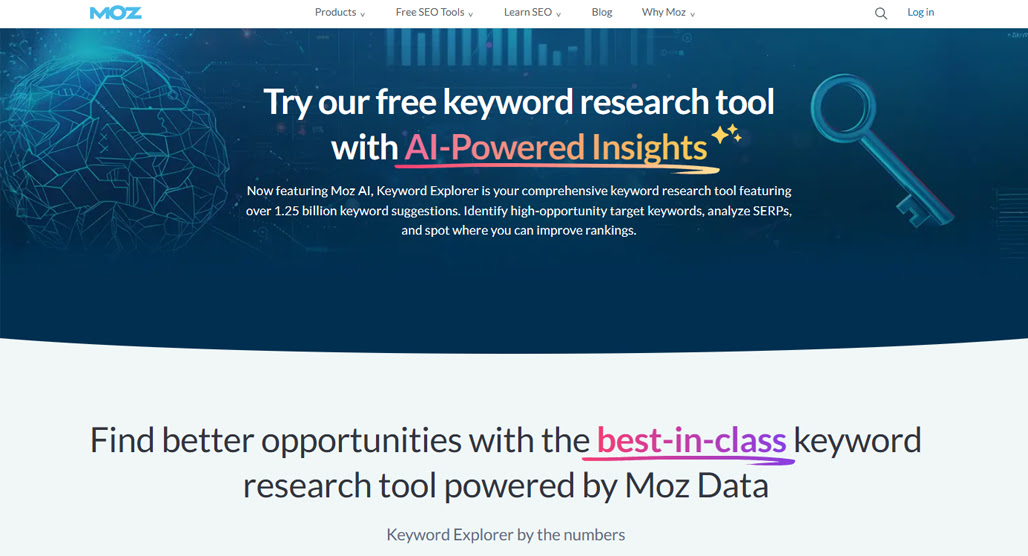
These tools usually give you a list of as many keywords as they can find. These will range from the top-level seed keywords to the narrowest branded keywords, and you'll need to filter the results. Normally, you'd want to filter for weaknesses and specific, narrow keywords you can target. But, when you're looking for seed keywords, you want to look at the opposite: what are the high-volume, high-value keywords they're using? Those are seed keywords, more often than not.
How to Make Use of Seed Keywords
Actually using seed keywords is pretty easy. Since they aren't tangible keywords you're trying to target with specific pieces of content, you don't need to worry about things like keyword difficulty or viability. In fact, it's almost detrimental if you do; if you filter out seed keywords because they're too difficult, you'll be stuck with super-niche keywords, and if you try to target them with expectations of success, you'll hit a wall of competition you can't surmount.
That said, you can do some filtering. If you decide that your brand's overall seed keyword is something very niche, it might be an indicator that you either need to expand or you need a new business idea that has legs.
You should also figure out the cap on your seed keyword. Runner's World is technically a site about a kind of exercise, but "exercise" isn't a good seed keyword, because it encompasses too much that they don't want to cover.
A seed keyword list won't actually be very long, either. It's more like a list of topics that you use as a sanity check for long-tail topics you want to cover. "Is this something that falls under the header of a seed keyword?"

Think of seed keywords as blog categories. If you keep having to make new categories to encompass the things you're writing, you're not appropriately using seeds.
On a mechanical level, you can use seed keywords with a snowflake method to spin out narrower and narrower topics.
Take a seed keyword and break it down. What are the broadest categories you can think of within that seed? Keep on breaking it down.
- Running
- Running Gear
- Running Shoes
- Running Apparel
- Types of Running
- Trail Running
- Urban Running
- Fitness Running
- Marathon Running
- Running Health
- Cardio Training
- Knee Injuries
- Running Gear
The more you break it down, the closer you get to specific pieces of content, specific products, or specific concepts you can cover on your site. A step or two up from those specifics is where you can base pillar content for clusters, landing pages for services, and so on.
Tangibly, seed keywords aren't the kinds of things you put into your individual page metadata, except as part of long-tail keywords. They're more conceptual, guidelines and guardrails for the direction you take your marketing. It's important to know them, and they can be a good starting point for further digging.

Related Posts


Leave a Comment


Fine-tuned for competitive creators
Topicfinder is designed by a content marketing agency that writes hundreds of longform articles every month and competes at the highest level. It’s tailor-built for competitive content teams, marketers, and businesses.
Get Started